
Inventory of Polychronic Values (IPV) Test
How the Scales are Structured
Who Usually Takes This Test?
See How You Compare
Below is a preview of how scores are typically distributed across each scale.
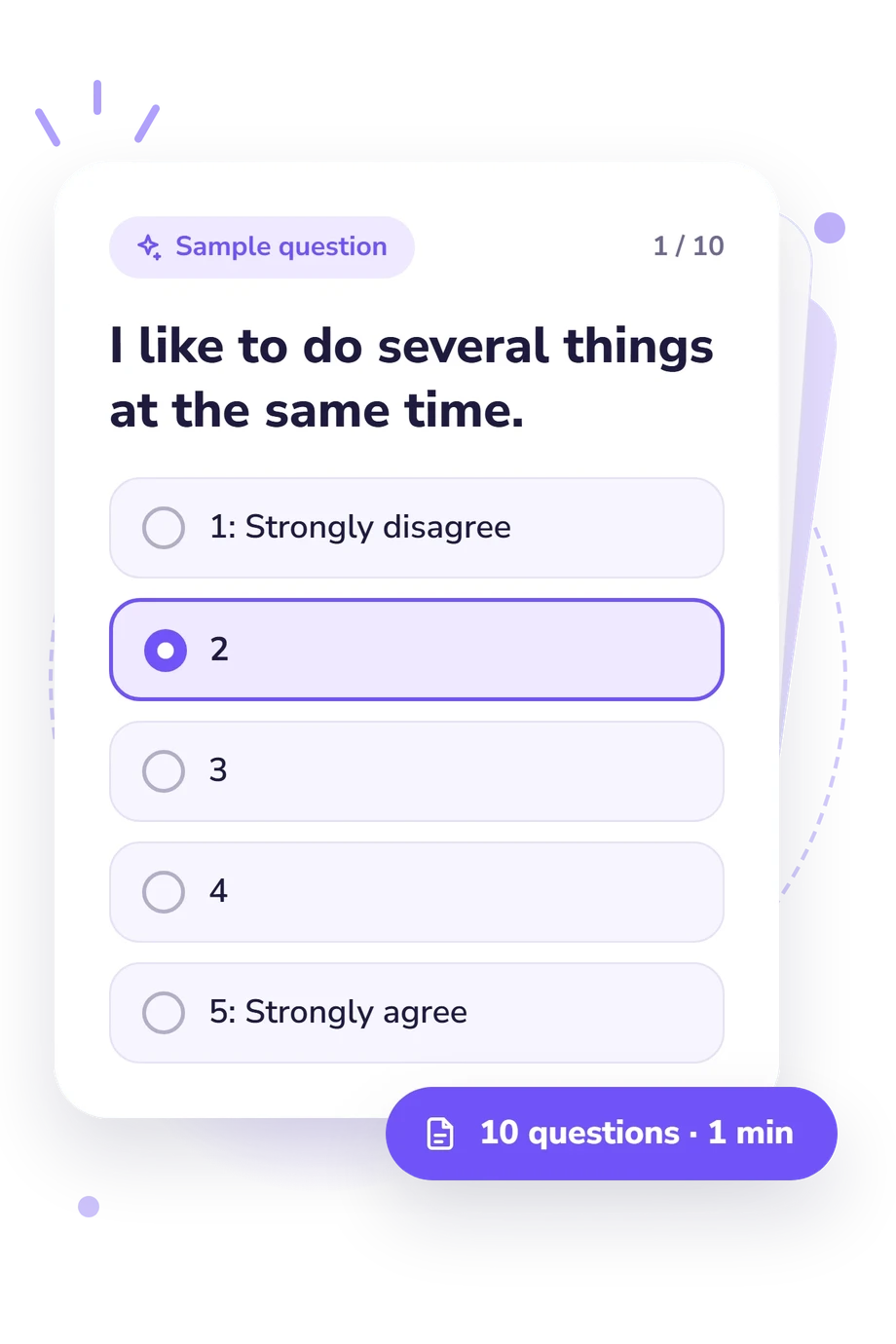
Example Questions From the Test
- 1: Strongly disagree
- 2
- 3
- 4
- 5: Strongly agree
- 1: Strongly disagree
- 2
- 3
- 4
- 5: Strongly agree
- 1: Completely disagree
- 2
- 3
- 4
- 5: Completely agree
Inventory of Polychronic Values (IPV) Test - Description and methodology of the test
People who are curious about task-order preferences can use the Inventory of Polychronic Values (IPV) Test to examine whether simultaneous activity or sequential completion feels natural. The questionnaire is suited to self-reflection about preferring several activities at once and viewing that arrangement as effective, with a result that places your preference along a continuum and shows the result band. A polychronic values assessment can make that pattern easier to discuss.
What This Assessment Explores
This questionnaire examines whether a person prefers coordinating several activities or completing them in sequence. Its items address simultaneous engagement, finishing tasks, and organizing work when personal choice is available. The result describes one preference dimension and includes the belief that the preferred arrangement is effective.
Preferences may change with deadlines or interruptions, so the score does not measure productivity or record behavior in every setting. As a polychronicity test, it describes a tendency toward one pole without treating it as a strength or weakness.
These item themes contribute to one displayed preference result:
- Simultaneous engagement shows a preference for handling activities in parallel.
- Sequential completion shows a preference for finishing one task before another.
- Flexible work organization shows a preferred activity order when choice is available.
Polychronic Values ranges from 1-5: More monochronic (1-2.4), Mixed preference (2.5-3.6), and More polychronic (3.7-5).
Methodology and Evidence Base
Each item uses a five-point agreement response, from disagreement to agreement. The wording contrasts liking several things at once with preferring to complete one task before beginning another, placing answers on opposite poles of one preference dimension. The form presents a single displayed preference result, without stating how individual responses are mathematically combined.
The closest published reference is the Inventory of Polychronic Values (IPV) described by Bluedorn, Kalliath, Strube, and Martin in 1999. This questionnaire is conceptually consistent with that instrument; Bluedorn, Kaufman, and Lane’s 1992 work and Edward T. Hall’s account of time provide the monochronic-polychronic framework. These sources clarify the construct but do not establish that this online form is a full reproduction or validated adaptation.
Because a polychronic work preference may differ by setting, the result is best read as a snapshot of tendency rather than a record of behavior. This version states no population norms or clinical threshold. Self-report can be shaped by mood, self-image, and the situation recalled. The score is useful for reflecting on work habits, not for judging ability or personality.
- Bluedorn, Allen C., Thomas J. Kalliath, Michael J. Strube, and Gregg D. Martin. (1999). Polychronicity and the Inventory of Polychronic Values (IPV): The development of an instrument to measure a fundamental dimension of organizational culture. Journal of Managerial Psychology, 14(3/4), 205-230. 10.1108/02683949910263747
- Bluedorn, Allen C., Carol F. Kaufman, and Paul M. Lane. (1992). How many things do you like to do at once? An introduction to monochronic and polychronic time. Academy of Management Executive, 6(4), 17-26. 10.5465/AME.1992.4274453
- Hall, Edward T. (1983). The Dance of Life: The Other Dimension of Time. Garden City, NY: Anchor Press/Doubleday.
Updated: