
Freudly+971 508685814hello@freudly.ai
Freudly
leadership

Servant Leadership Questionnaire (SLQ) Test
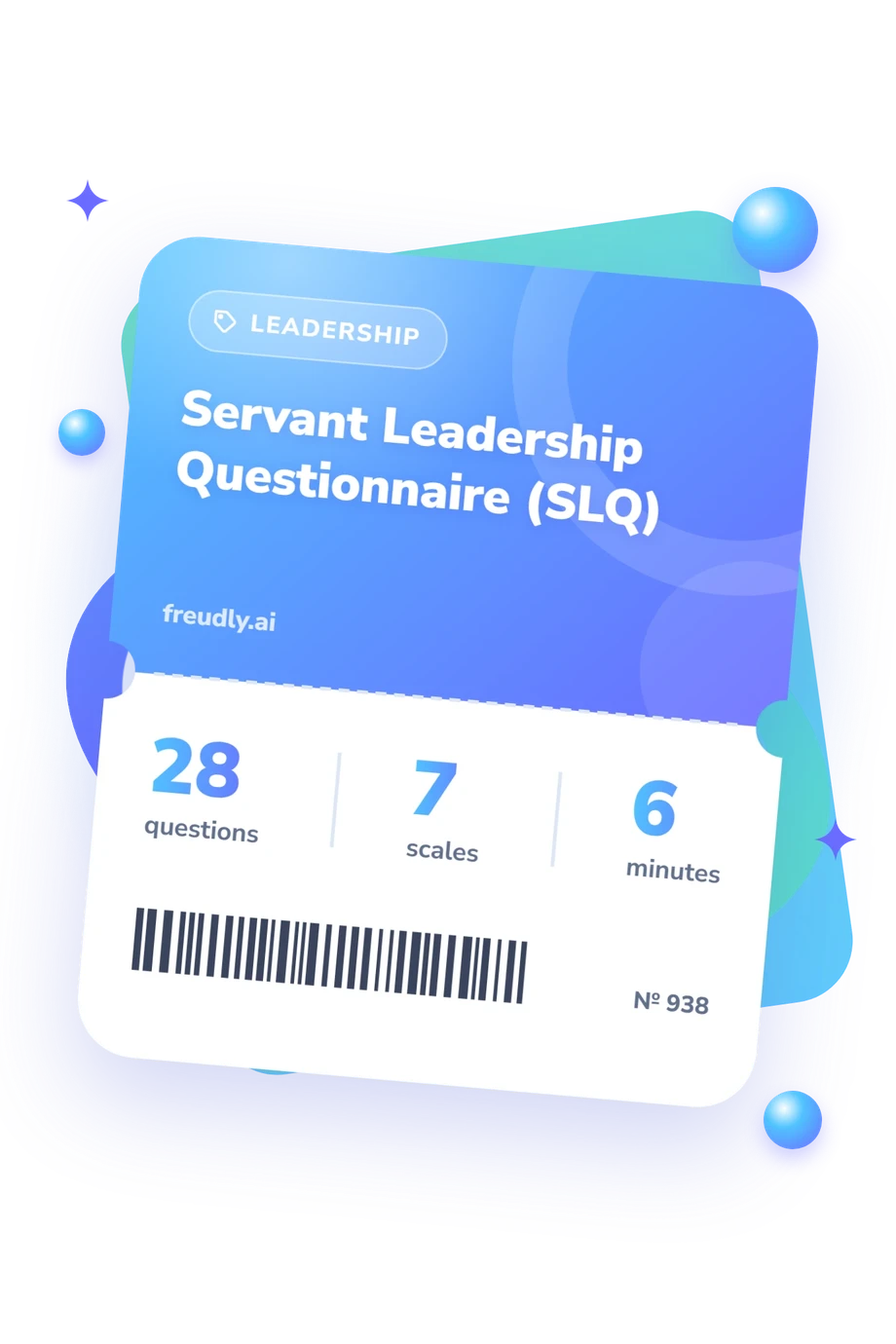
Take the online Servant Leadership Questionnaire (SLQ) Test - AI psychologist FreudlyYou can take Servant Leadership Questionnaire (SLQ) Testhere. Online version of a simple and accurate psychological test with interpretation.en
Understand how you lead through support and service in just 6 minutes. Get a clear snapshot across 28 items to pinpoint strengths, gaps, and next steps to grow trust and team performance.
Start Online Test
Questions: 286 minutes
08:30
October 2, 2025
October 2, 2025
Material has been updated
October 2, 2025
Material has been published
24,932 views
1,758 completions
1,530 likes
Verified by Daniel Hall
Psychologist with 25 years of experience
Share
Scale Explorer

How the Scales are Structured

example score
16/28
Ethical Behavior (EB)
Ethical Behavior measures a leader’s consistency in acting with honesty, fairness, and moral integrity in relationships and decisions.
Needs strengthening
Generally ethical
Strong ethical model
413: Needs strengthening | 1422: Generally ethical | 2328: Strong ethical model
A score of 16 falls in the Generally ethical range, suggesting ethical principles are usually present but may not be applied consistently across all situations.
example score
17/28
Conceptualization Skills (CS)
Measures how well a leader thinks strategically, sees the big picture, and generates ideas to guide organizational direction.
Developing
Adequate
Strong
413: Developing | 1422: Adequate | 2328: Strong
A score of 17 falls in the Adequate range, suggesting generally solid big-picture thinking with room to strengthen strategic clarity and idea generation.
example score
14/28
Establishing Community Values (ECV)
This scale measures how much a leader helps shape and sustain shared values, norms, and a sense of community within a group.
Low
Moderate
High
413: Low | 1422: Moderate | 2328: High
A score of 14 suggests a moderate contribution to establishing community values, with some consistent efforts alongside clear room to strengthen shared norms and trust.
example score
17/28
Emotional Healing (EH)
Emotional Healing measures how well a leader provides emotional support and helps others cope during difficult situations.
Low support
Moderate support
High support
413: Low support | 1422: Moderate support | 2328: High support
A score of 17 indicates a moderate capacity to notice others’ emotional needs and provide support during challenging moments, with room to strengthen consistency.
example score
16/28
Facilitating Growth and Success (FGaS)
Measures the extent to which a leader actively supports followers’ development and helps them achieve professional success.
Limited support
Moderate support
Strong support
413: Limited support | 1422: Moderate support | 2328: Strong support
A score of 16 indicates moderate support for follower growth and success, suggesting development efforts are present but not consistently emphasized.
example score
12/28
Empowering Followers (EF)
Measures the extent to which a leader delegates authority and supports followers' autonomy and responsibility-taking.
Low empowerment
Moderate empowerment
High empowerment
413: Low empowerment | 1422: Moderate empowerment | 2328: High empowerment
A score of 12 falls in the Low empowerment range, suggesting delegation and autonomy support are used less consistently and may be more limited to specific situations.
example score
10/28
Putting the Follower First (PtFF)
This scale measures how strongly a leader prioritizes followers’ needs and interests ahead of their own.
Low focus on followers
Balanced focus
Strong follower-first focus
413: Low focus on followers | 1422: Balanced focus | 2328: Strong follower-first focus
A score of 10 falls in the Low focus on followers range, suggesting the leader less often puts team members’ needs first in decisions and day-to-day interactions.
Start Online Test
just completed the test
DATA-BASED USER COHORTS

Who Usually Takes This Test?

People Managers and Team Leads
41%OF USERS
They take it to understand how well they support, empower, and develop their team beyond giving direction.
HR and Leadership Development
34%OF USERS
They use it to assess leadership style, identify growth areas, and guide coaching or training plans.
Aspiring and New Leaders
25%OF USERS
They take it to learn their natural tendencies around service-oriented leadership and build better habits early.
BASED ON AGGREGATED, ANONYMIZED DATA FROM TENS OF THOUSANDS OF FREUDLY USERS.
Benchmarking

See How You Compare

Once you complete the test, your results are compared with real-world data from people in your country.
Below is a preview of how scores are typically distributed across each scale.
Ethical Behavior (EB)
Average
16
Normal range
12.719.4
min.
4
max.
28
This curve shows how scores are typically distributed.
Once you complete the test, your result will appear on the scale so you can see how you compare.
Conceptualization Skills (CS)
Average
12.8
Normal range
9.716
min.
4
max.
28
This curve shows how scores are typically distributed.
Once you complete the test, your result will appear on the scale so you can see how you compare.
Establishing Values in a Community (EViaC)
Average
21.4
Normal range
18.124.7
min.
4
max.
28
This curve shows how scores are typically distributed.
Once you complete the test, your result will appear on the scale so you can see how you compare.
Emotional Healing (EH)
Average
17.4
Normal range
13.321.6
min.
4
max.
28
This curve shows how scores are typically distributed.
Once you complete the test, your result will appear on the scale so you can see how you compare.
Facilitating Growth and Achieving Success (FGaAS)
Average
19.8
Normal range
15.324.3
min.
4
max.
28
This curve shows how scores are typically distributed.
Once you complete the test, your result will appear on the scale so you can see how you compare.
Increasing the Empowerment of Followers (ItEoF)
Average
21.4
Normal range
18.124.7
min.
4
max.
28
This curve shows how scores are typically distributed.
Once you complete the test, your result will appear on the scale so you can see how you compare.
The Ability to Put the Follower First (TAtPtFF)
Average
19.7
Normal range
15.923.5
min.
4
max.
28
This curve shows how scores are typically distributed.
Once you complete the test, your result will appear on the scale so you can see how you compare.
Featured On
SAMPLE QUESTIONS

Example Questions From the Test

Ask a friend, colleague, or classmate to carefully read each item and, using the provided 7-point scale, indicate the extent to which the description matches their perception of you as a leader. In this questionnaire, the term “leader” refers to you.
    • Strongly disagree
    • Disagree
    • Somewhat disagree
    • Cannot decide
    • Somewhat agree
    • Agree
    • Strongly agree
    • Strongly disagree
    • Disagree
    • Slightly disagree
    • Neither agree nor disagree
    • Somewhat agree
    • Agree
    • Strongly agree
    • Strongly disagree
    • Disagree
    • Slightly disagree
    • Cannot decide
    • Somewhat agree
    • Agree
    • Strongly agree
WHAT THE TEST MEASURES
About This Assessment
Leadership-Service Questionnaire, SLQ Test

Servant Leadership Questionnaire (SLQ) Test - Symptoms and Signs

leadership

This measure is used to assess servant-leadership behaviors in organizational settings; the Servant Leadership Questionnaire (SLQ) provides a brief self-report snapshot of how an individual prioritizes and supports others. It is commonly used to characterize interpersonal and values-based aspects of leadership style.

The instrument includes 28 items and typically takes about 6 minutes to complete. Items reflect domains such as conceptualization, emotional healing, prioritizing followers, helping others grow and succeed, ethical behavior, empowerment, and community value.

Results from the Servant Leadership Questionnaire (SLQ) may be used to support leadership development, coaching, and team consultation by identifying relative strengths and potential areas for targeted skill-building. When interpreted in context, scores can inform discussion of workplace behaviors and developmental goals rather than serving as a standalone indicator of leadership effectiveness. Burns and Greenleaf are often cited in relation to the conceptual foundations of servant leadership.

Author: James MacGregor Burns, Robert K. Greenleaf
Literature: Northouse, P. G. Leadership: Theory and practice. SAGE Publications. 2021.
Popular tests
Comments
Leave a Comment