
Freudly+971 508685814hello@freudly.ai
Freudly
motherhood

Intensive Parenting Attitudes Questionnaire (IPAQ) Test
Take the online Intensive Parenting Attitudes Questionnaire (IPAQ) Test - AI psychologist FreudlyYou can take Intensive Parenting Attitudes Questionnaire (IPAQ) Testhere. Online version of a simple and accurate psychological test with interpretation.en
Understand how strongly you prioritize your child’s needs over your own in just 5 minutes. Get a quick 25 item profile that can flag stress drivers and perfectionism for healthier balance.
Start Online Test
Questions: 255 minutes
08:30
October 2, 2025
October 2, 2025
Material has been updated
October 2, 2025
Material has been published
27,532 views
3,160 completions
2,662 likes
Verified by Daniel Hall
Psychologist with 25 years of experience
Share
Scale Explorer

How the Scales are Structured

example score
12/18
Child-Centeredness (CC)
Measures the extent to which a parent prioritizes a child’s needs and interests over other family or personal priorities.
Lower child-first focus
Balanced child focus
Strong child-first focus
38: Lower child-first focus | 913: Balanced child focus | 1418: Strong child-first focus
A score of 12 indicates a generally balanced tendency to put the child’s needs first while still allowing space for other priorities.
example score
21/36
Difficulties (D)
Measures the extent to which the parental role is perceived as difficult and requiring substantial effort.
Low difficulty
Moderate difficulty
High difficulty
617: Low difficulty | 1829: Moderate difficulty | 3036: High difficulty
A score of 21 falls in the Moderate difficulty range, suggesting parenting is experienced as fairly demanding at times but not consistently overwhelming.
example score
12/24
Stimulation (S)
Measures how strongly a parent believes in actively stimulating a child’s cognitive, emotional, and physical development from an early age.
Lower emphasis
Moderate emphasis
High emphasis
412: Lower emphasis | 1321: Moderate emphasis | 2224: High emphasis
A score of 12 falls in the Lower emphasis range, suggesting a comparatively lower tendency to prioritize structured, active stimulation of the child’s development.
example score
16/24
Satisfaction (S)
Measures how much parenting is experienced as emotionally rewarding and a source of joy and fulfillment.
Lower satisfaction
Moderate satisfaction
High satisfaction
415: Lower satisfaction | 1621: Moderate satisfaction | 2224: High satisfaction
A score of 16 indicates moderate satisfaction, suggesting parenting is generally rewarding while not consistently experienced as highly fulfilling.
example score
20/48
Essentialism (E)
Measures the extent to which a person believes mothers are naturally uniquely suited for caregiving and primarily responsible for raising the child.
Low
Moderate
High
817: Low | 1829: Moderate | 3048: High
A score of 20 falls in the Moderate range, suggesting a moderate endorsement of the idea that mothers have a unique natural role and primary responsibility in caregiving.
example score
120/150
Intensive Parenting (IP)
Measures how strongly a parent endorses intensive parenting beliefs that prioritize substantial investment and the child’s needs over their own.
Lower endorsement
Moderate endorsement
High endorsement
2589: Lower endorsement | 90119: Moderate endorsement | 120150: High endorsement
A score of 120 falls in the High endorsement range, suggesting a strong tendency to view parenting as requiring extensive time, energy, and high standards that may place the child’s needs first.
Start Online Test
just completed the test
DATA-BASED USER COHORTS

Who Usually Takes This Test?

Stressed, high-achieving moms
41%OF USERS
Mothers who feel pressure to do everything “right” take it to see whether their standards and self-sacrifice are driving stress or guilt.
New and expecting parents
34%OF USERS
People preparing for a baby or navigating early parenthood use it to check how strongly they believe parenting should be all-consuming.
Counselors and researchers
25%OF USERS
Professionals in family support or studies use it to quickly profile parenting beliefs and connect them to burnout, perfectionism, or wellbeing.
BASED ON AGGREGATED, ANONYMIZED DATA FROM TENS OF THOUSANDS OF FREUDLY USERS.
Benchmarking

See How You Compare

Once you complete the test, your results are compared with real-world data from people in your country.
Below is a preview of how scores are typically distributed across each scale.
Child-Centeredness (C)
Average
9.1
Normal range
7.111.2
min.
3
max.
18
This curve shows how scores are typically distributed.
Once you complete the test, your result will appear on the scale so you can see how you compare.
Difficulties (D)
Difficulties (D)
Average
26.5
Normal range
20.832.1
min.
6
max.
36
This curve shows how scores are typically distributed.
Once you complete the test, your result will appear on the scale so you can see how you compare.
Stimulation (S)
Stimulation (S)
Average
18
Normal range
15.320.6
min.
4
max.
24
This curve shows how scores are typically distributed.
Once you complete the test, your result will appear on the scale so you can see how you compare.
Satisfaction (S)
Satisfaction (S)
Average
18.9
Normal range
15.222.7
min.
4
max.
24
This curve shows how scores are typically distributed.
Once you complete the test, your result will appear on the scale so you can see how you compare.
Essentialism (E)
Essentialism (E)
Average
31.3
Normal range
24.138.4
min.
8
max.
48
This curve shows how scores are typically distributed.
Once you complete the test, your result will appear on the scale so you can see how you compare.
Intensive Parenting (IP)
Average
94.2
Normal range
74.2114.3
min.
25
max.
150
This curve shows how scores are typically distributed.
Once you complete the test, your result will appear on the scale so you can see how you compare.
Featured On
SAMPLE QUESTIONS

Example Questions From the Test

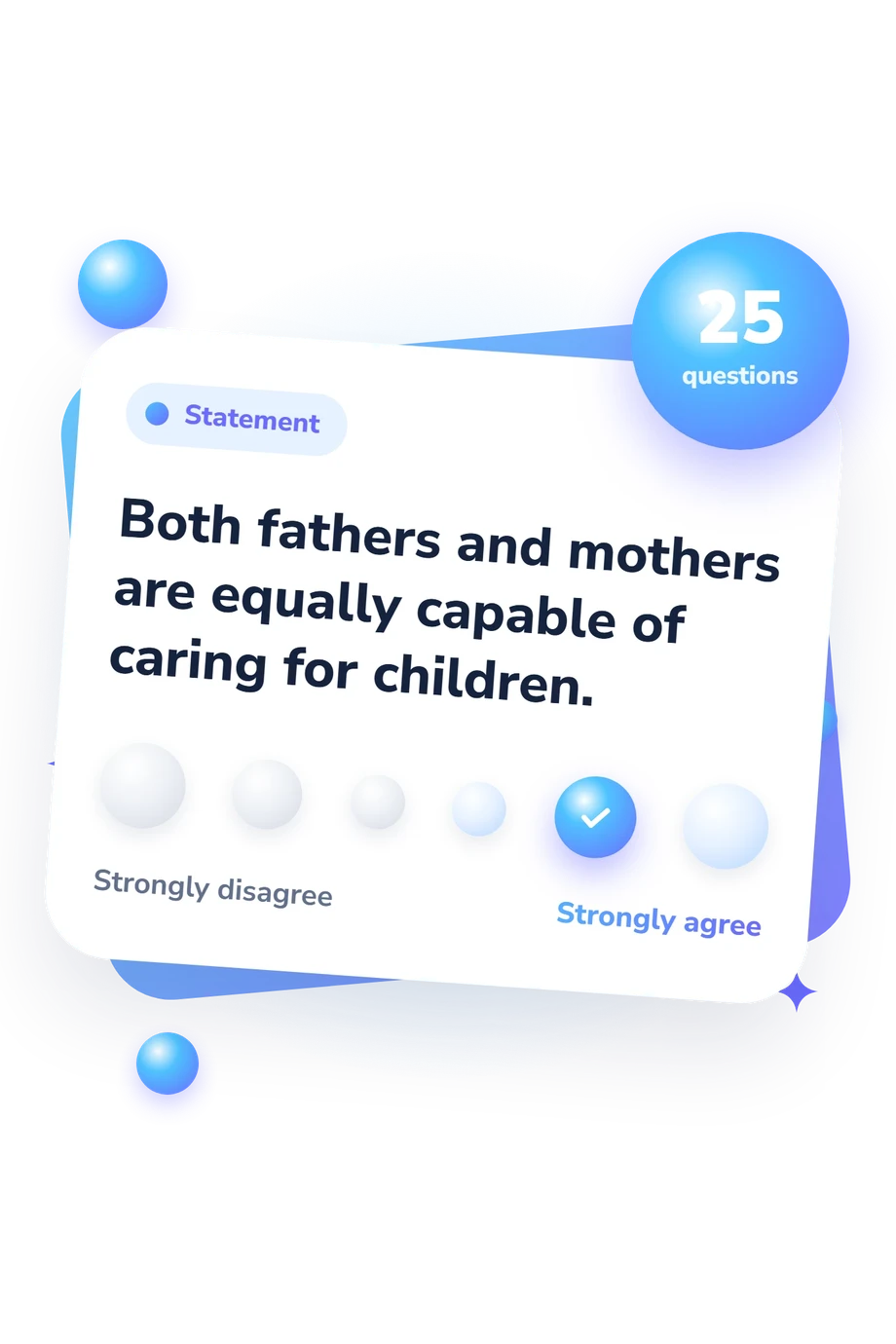
The statements below describe attitudes, feelings, and beliefs about the parenting experience. Consider each item in relation to your relationship with your child(ren). Indicate the extent to which you agree or disagree with each statement. Please note that there are no right or wrong answers.
    • Strongly disagree
    • Disagree
    • Somewhat disagree
    • Somewhat agree
    • Agree
    • Strongly agree
    • Strongly disagree
    • Disagree
    • Somewhat disagree
    • Somewhat agree
    • Agree
    • Strongly agree
    • Strongly disagree
    • Disagree
    • Somewhat disagree
    • Somewhat agree
    • Agree
    • Strongly agree
WHAT THE TEST MEASURES
About This Assessment

Intensive Parenting Attitudes Questionnaire (IPAQ) Test - Symptoms and Signs

motherhood
parental stance
family

This measure assesses attitudes consistent with an intensive parenting orientation. The Intensive Parenting Attitudes Questionnaire (IPAQ) is used to describe the extent to which individuals endorse beliefs that parenting should be highly effortful, closely managed, and prioritized over personal needs.

It is a self-report instrument consisting of 25 items and typically requires about 5 minutes to complete. Item responses are used to characterize the degree to which respondents emphasize extensive time, energy, and responsibility in childrearing, which may be relevant for understanding parenting-related expectations and potential sources of stress.

In clinical and research contexts, the Intensive Parenting Attitudes Questionnaire (IPAQ) can support case formulation by clarifying parenting standards and role demands that may influence daily decision-making, emotional burden, and perceived balance between caregiving, personal wellbeing, and work or other responsibilities.

Author: Diana Baumrind, Eleanor E. Maccoby
Literature: Bornstein, M. H. Handbook of parenting: Volume 3. Being and becoming a parent. Lawrence Erlbaum Associates. 2002.; Belsky, J. The determinants of parenting: A process model. Child Development. 1984.; Liss, M., Schiffrin, H. H., Mackintosh, V. H., Miles-McLean, H., & Erchull, M. J. Development and validation of a quantitative measure of intensive parenting attitudes. Journal of Child and Family Studies. 2013.
Popular tests
Comments
Leave a Comment