
Bicultural Identity Integration Scale, Version 2 (BIIS-2) Test
How the Scales are Structured
Who Usually Takes This Test?
See How You Compare
Below is a preview of how scores are typically distributed across each scale.
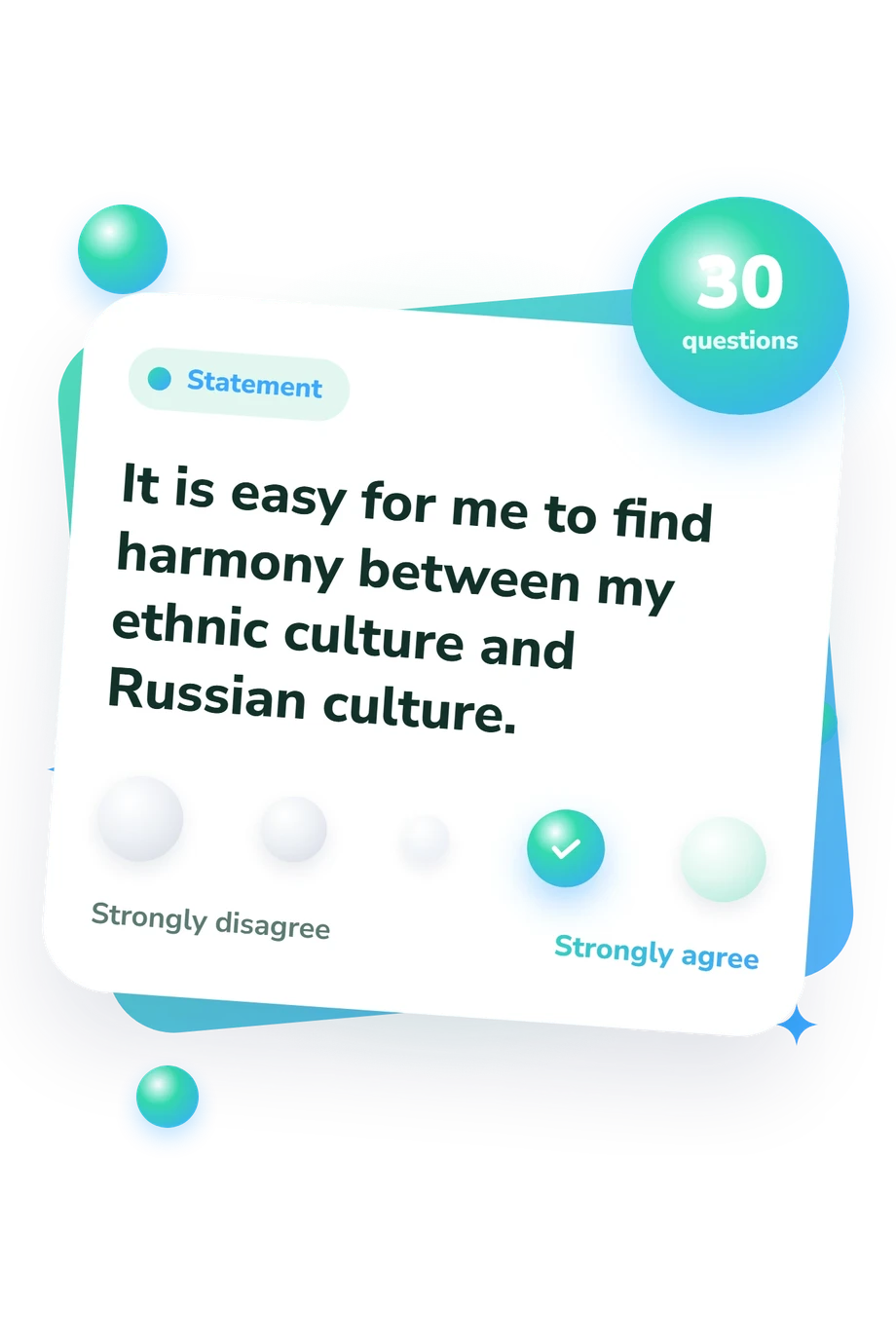
Example Questions From the Test
- Strongly disagree
- Somewhat disagree
- Neither agree nor disagree
- Somewhat agree
- Strongly agree
- Strongly disagree
- Somewhat disagree
- Neither agree nor disagree
- Somewhat agree
- Strongly agree
- Strongly disagree
- Somewhat disagree
- Neither agree nor disagree
- Somewhat agree
- Strongly agree
Bicultural Identity Integration Scale, Version 2 (BIIS-2) Test - Description and methodology of the test
People navigating two cultural backgrounds may want a clearer way to reflect on whether those identities feel compatible, separate, or difficult to combine. The Bicultural Identity Integration Scale, Version 2 (BIIS-2) Test is intended for anyone exploring that experience, especially when belonging, behavior, or self-definition shifts across cultural settings. As a bicultural identity test, it provides a structured profile rather than a single label.
What This Assessment Explores
The result describes two distinct experiences: whether cultural identities are integrated across various aspects of life or experienced as separate, and whether they feel harmonious or conflicted.
It is intended for people reflecting on belonging across family, community, language, values, or behavior.
The profile from this bicultural identity integration test can help clarify whether the two identities are experienced as integrated across aspects of life or separate, while also indicating harmony or conflict between them.
The two reported dimensions are:
- Cultural Blendedness vs. Cultural Compartmentalization (5-25) shows whether the two identities are experienced as blended across life or kept separate. Its bands are More disconnection (5-16) and More mixing (17-25).
- Cultural Harmony vs. Cultural Conflict (10-50) indicates whether the cultures feel compatible or pull the person toward tension. Its bands are More conflict (10-34), Mixed/variable (35-46), and More harmony (47-50).
Methodology and Evidence Base
Each statement uses five-point agreement, ranging from Strongly disagree to Strongly agree. Items address balance, inner conflict, cultural incompatibility, movement between settings, and whether identities are mixed or separate. This format creates ordered self-report data without a right answer.
Results are reported on the two dimensions. Interpretation should follow the score ranges and result bands; a range alone does not show how much any response contributes, so item-level scoring should not be inferred from the endpoints.
The online BIIS-2 questionnaire is conceptually consistent with the published Bicultural Identity Integration Scale-Version 2 (BIIS-2), examined by Huynh, Benet-Martínez, and Nguyen in 2018, but is not that published instrument or a documented adaptation. Its framework also aligns with Benet-Martínez and Haritatos (2005), which distinguishes harmony from conflict and blendedness from compartmentalization. Together, these sources provide the evidence base for the constructs, not standardization or validation of this online version.
Because answers depend on self-awareness, honesty, and current circumstances, scores describe perceived cultural experience at completion rather than a fixed identity; they may vary across social contexts, relationships, or periods of cultural change.
- Huynh, Que-Lam, Verònica Benet-Martínez, and Angela-MinhTu D. Nguyen. 2018. "Measuring Variations in Bicultural Identity Across U.S. Ethnic and Generational Groups: Development and Validation of the Bicultural Identity Integration Scale-Version 2 (BIIS-2)." Psychological Assessment, 30(12), 1581-1596. 10.1037/pas0000606
- Benet-Martínez, Verónica, and Jana Haritatos. 2005. "Bicultural Identity Integration (BII): Components and Psychosocial Antecedents." Journal of Personality, 73(4), 1015-1049. 10.1111/j.1467-6494.2005.00337.x
Updated: