
Personal Identity Assessment Test
How the Scales are Structured
Who Usually Takes This Test?
See How You Compare
Below is a preview of how scores are typically distributed across each scale.
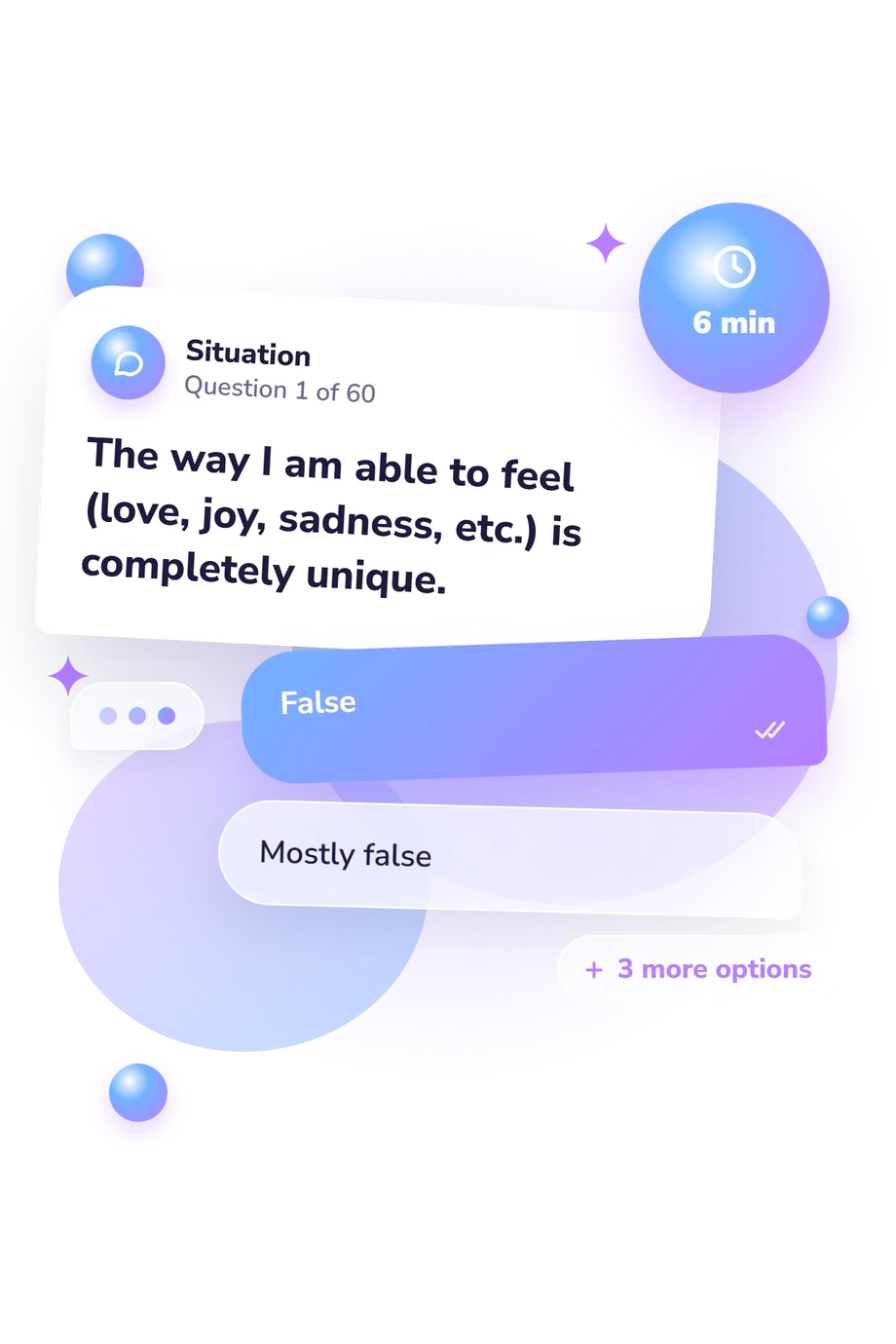
Example Questions From the Test
- Not true
- Somewhat untrue
- Neither true nor false
- Somewhat true
- True
- Untrue
- Mostly untrue
- Neither true nor untrue
- Mostly true
- True
- Untrue
- Mostly untrue
- Neither true nor untrue
- Mostly true
- True
Personal Identity Assessment Test - Description and methodology of the test
People who want to examine how they define themselves, experience continuity, and distinguish their perspective from others may find the Personal Identity Assessment Test a useful structured reflection. It turns everyday judgments about uniqueness, memories, appearance, goals, emotions, and social evaluation into an identity profile. This identity assessment questionnaire can help you notice which aspects of self-definition feel more established or less settled.
What This Assessment Explores
The questionnaire treats identity as a combination of distinctiveness, continuity, self-regard, and social reflection. Its statements cover difference from others, stable features across change, personal aims, memories, achievements, and the impact of evaluation. This personal identity test shows how these strands fit.
The four reported dimensions are:
- Reflected (7-35) measures comparison-based self-definition; Low 7-18 suggests doubt/tension, Moderate 19-24, and High 25-35 relates to confidence and self-respect.
- Unique (11-55) measures distinctiveness; Less expressed 11-37 means less uniqueness, Expressed 38-47, and Strongly expressed 48-55 indicates individuality.
- Personal (12-60) measures self-sameness and continuity, self-liking, and personal value; Low 12-32 may reflect doubts about significance and detachment, Moderate 33-48, and High 49-60 indicates stronger self-liking and value.
- Overall Identity Index (30-150) measures identity coherence and stability; Low 30-90 may reflect self-doubt/dissatisfaction, Moderate 91-119, and High 120-150 indicates a defined, confident, comfortable self.
Methodology and Scientific Basis
Each statement uses five ordered choices. Wording shifts between untrue-true, disagree-agree, and similar forms, but responses place respondents on a graded continuum rather than inviting narrative explanation. The questionnaire covers uniqueness, continuity, self-knowledge, and social comparison, while results are reported through displayed scales.
The closest published reference is the Personal Identity Diagnostic Technique, described by Makarevskaya and Ryabikina in 2023. This questionnaire is conceptually consistent with those identity parameters, and no standardization status is specified for its online version. Makarevskaya’s 2024 study and the 2020 study with Ryabikina provide background for interpreting identity content across life periods; they do not establish norms or validate this questionnaire. Erikson’s framework supports the broader idea of continuity and a developing sense of self; the items focus on identity content rather than assigning an identity status.
Scores describe patterns in the experiences covered by the statements. The displayed bands are this questionnaire’s reporting format, not universal clinical norms. Current circumstances, self-awareness, and response style can influence results, so a self-identity assessment is best used for reflection rather than as a permanent definition or diagnosis.
- Makarevskaya, Yuliya E., and Zinaida I. Ryabikina. "Operationalization of Parameters and Diagnostics of Personal Identity." Theoretical and Experimental Psychology, 2023, vol. 16, no. 3, pp. 25-49. 10.11621/TEP-23-18
- Makarevskaya, Yuliya E. "Content of Personal Identity in Different Age Periods of Life." South-Russian Journal of Social Sciences, 2024, vol. 25, no. 2, pp. 77-91. 10.31429/26190567-25-2-77-91
- Makarevskaya, Yuliya, and Zinaida Ryabikina. "Unconfirmed Identity as an Indicator of Social Failure of Personality in Different Age Periods." E3S Web of Conferences, vol. 210, 2020, article 17016. 10.1051/e3sconf/202021017016
- Erikson, Erik H. Identity: Youth and Crisis. New York: W. W. Norton, 1968.
Updated: