
Integrative Intercultural Competence Questionnaire Test
How the Scales are Structured
Who Usually Takes This Test?
See How You Compare
Below is a preview of how scores are typically distributed across each scale.
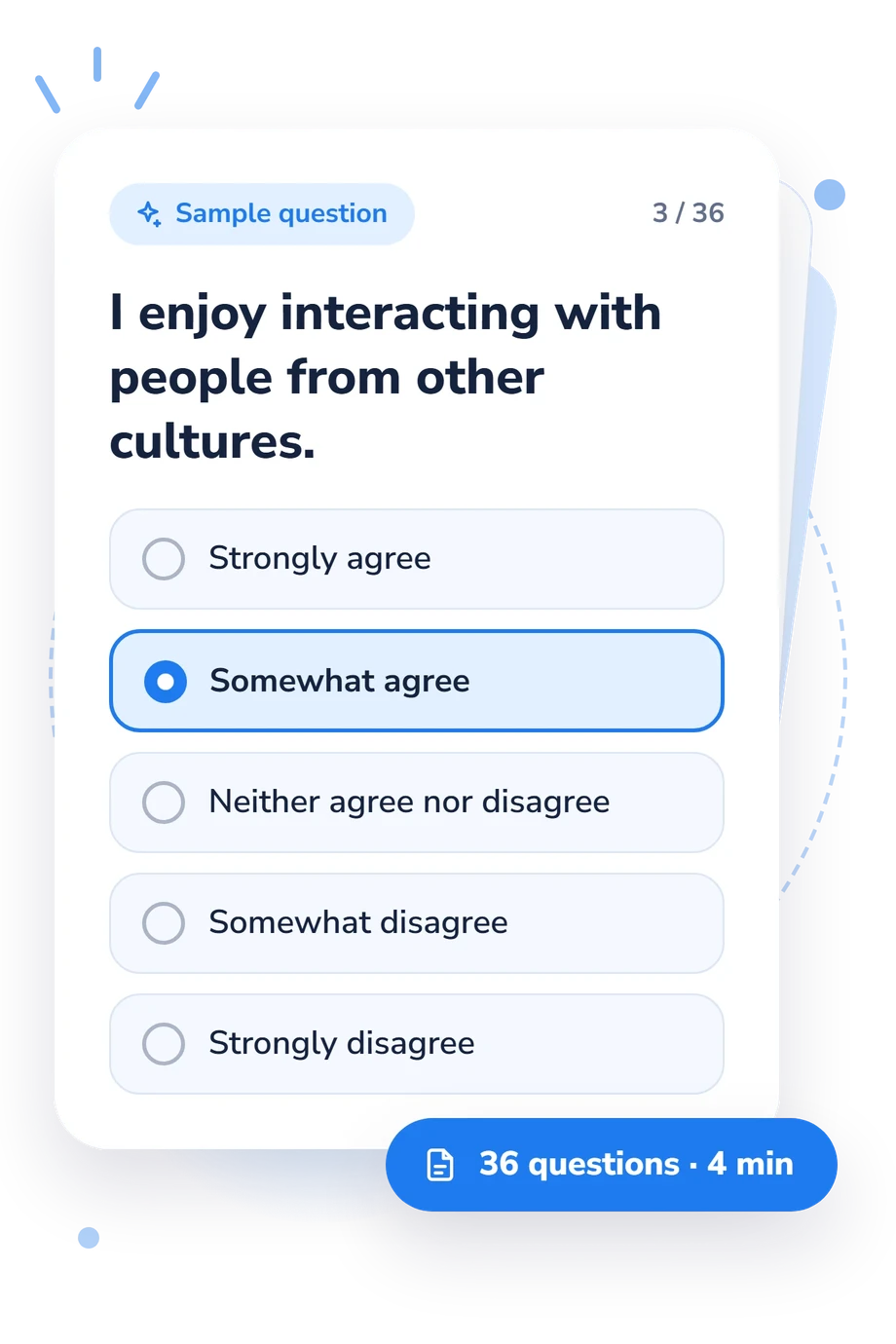
Example Questions From the Test
- Strongly agree
- Somewhat agree
- Neither agree nor disagree
- Somewhat disagree
- Strongly disagree
- Strongly agree
- Rather agree
- Neither agree nor disagree
- Rather disagree
- Strongly disagree
- Strongly agree
- Somewhat agree
- Neither agree nor disagree
- Somewhat disagree
- Strongly disagree
Integrative Intercultural Competence Questionnaire Test - Description and methodology of the test
People preparing for work, study, travel, or relationships across cultural boundaries may use this questionnaire when cultural expectations are likely to differ. The Integrative Intercultural Competence Questionnaire Test considers situations such as adapting to unfamiliar norms, checking assumptions, and staying composed when communication becomes difficult. Its intercultural competence questionnaire format organizes these responses around practical aspects of contact, giving readers a focused starting point for preparation.
What This Assessment Explores
The items examine confidence, openness, assumption-checking, stereotypes, and emotional reactions in intercultural contact. Responses in this intercultural communication test indicate whether a respondent tends toward adaptive communication, respect for diversity, sustained interest, and steadiness under strain. The scales are:
- Interaction Management (1-5) shows adaptation and mutual understanding; bands are Developing 1-3, Competent 3.1-4.4, High 4.5-5.
- Absence of Ethnocentrism (1-5) reflects respect for diversity without assuming cultural superiority; bands are More ethnocentric 1-2.4, Mixed stance 2.5-3.8, Low ethnocentrism 3.9-5.
- Intercultural Interest (1-5) indicates desire for contact and openness to cultural difference; bands are Low 1-3.1, Moderate 3.2-4.7, High 4.8-5.
- Intercultural Stability (1-5) indicates resilience and calm adaptation during stressful contact; bands are Low stability 1-2.4, Moderate stability 2.5-4, High stability 4.1-5.
Methodology and Scientific Basis
Each statement uses a five-point agreement response, with wording that covers constructive and uncomfortable reactions. The profile groups responses into four dimensions, but the online format does not state item weights, any reverse-scoring procedure, or a formula for converting answers into scale values. Displayed bands should therefore be read as reported interpretations, not as a scoring rule to recreate.
The questionnaire is conceptually consistent with the Integrative Intercultural Competence Survey, but the cited work does not establish this online version as the published instrument or a validated adaptation. That survey presents intercultural competence as multidimensional; Khukhlaev's related work links it with communication effectiveness, and his socio-psychological model describes the broader framework.
The result from this intercultural competence assessment describes tendencies across the stated situations, with bands indicating patterns of adaptation, openness, interest, and stability. Because self-report answers depend on self-awareness, honesty, and current stress, results may shift with circumstances and should be weighed with observed behavior or broader assessment when decisions carry significant consequences.
- Khukhlaev, O. E., Gritsenko, V. V., Makarchuk, A. V., Pavlova, O. S., Tkachenko, N. V., Usubian, S. A., and Shorokhova, V. A. (2021). Development and Adaptation of the Integrative Intercultural Competence Survey. Psychology. Journal of the Higher School of Economics, 18(1), 71-91. 10.17323/1813-8918-2021-1-71-91. In Russian.
- Khukhlaev, O. E., Gritsenko, V. V., Dagbaeva, S. B., Konstantinov, V. V., Kornienko, T. V., Kulesh, E. V., and Tudupova, T. T. (2022). Intercultural Competence and Effectiveness of Intercultural Communication. Experimental Psychology (Russia), 15(1), 88-102. 10.17759/exppsy.2022150106. In Russian.
- Khukhlaev, O. E. (2020). Integrative Socio-Psychological Model for Assessment and Forecasting the Effectiveness of Intercultural Interaction. Social Psychology and Society, 11(4), 26-41. 10.17759/sps.2020110403. In Russian.
Updated: