
Freudly+971 508685814hello@freudly.ai
Freudly
autism

Behavior Rating Inventory of Executive Function (BRIEF) Test
Take the online Behavior Rating Inventory of Executive Function (BRIEF) Test - AI psychologist FreudlyYou can take Behavior Rating Inventory of Executive Function (BRIEF) Testhere. Online version of a simple and accurate psychological test with interpretation.en
Understand a child’s day-to-day planning, attention, and self-control in about 16 minutes. Guides targeted supports and tracks progress across key executive skills.
Start Online Test
Questions: 8616 minutes
08:30
October 2, 2025
October 2, 2025
Material has been updated
October 2, 2025
Material has been published
18,632 views
2,479 completions
1,911 likes
Verified by Daniel Hall
Psychologist with 25 years of experience
Share
Scale Explorer

How the Scales are Structured

example score
3/9
Negativity Scale (NS)
Assesses response validity by detecting a tendency toward overly negative or biased ratings when completing the questionnaire.
Typical range
Elevated negativity
04: Typical range | 59: Elevated negativity
A score of 3 falls in the typical range, suggesting no notable negative response bias on this validity check.
example score
3/3
Cognitive Control (CC)
Assesses how well a child monitors and evaluates task performance and reflects on how their behavior affects others.
Low
Moderate
High
11.9: Low | 22.9: Moderate | 3: High
A score of 3 falls in the High range, suggesting strong day-to-day self-monitoring, reflection, and cognitive control in everyday situations.
example score
3/3
Organization of Materials (OoM)
Assesses how well the child maintains order and organization in their work or play environment.
Needs support
Well-organized
1: Needs support | 23: Well-organized
A score of 3 falls in the Well-organized range, suggesting strong everyday skills for keeping belongings and activities orderly.
example score
3/3
Plan/Organize (P)
The Planning scale measures the ability to anticipate events, set goals, and organize steps to achieve them in everyday situations.
Basic planning
Developing planning
Strong planning
1: Basic planning | 2: Developing planning | 3: Strong planning
A score of 3 suggests well-developed planning and organizational skills, with consistent ability to set goals and follow structured steps.
example score
2/3
Behavioral Regulation Index (BRI)
Measures how well a child can inhibit impulses, shift between activities, and regulate emotional responses in everyday situations.
Lower difficulties
Moderate difficulties
Higher difficulties
11.9: Lower difficulties | 22.4: Moderate difficulties | 2.53: Higher difficulties
A score of 2 indicates a moderate level of difficulty with behavior regulation, suggesting occasional challenges with impulse control, switching tasks, or managing emotions.
example score
2/3
General Executive Function Index (GEFI)
This index summarizes overall executive functioning, combining behavior regulation and metacognitive skills such as planning, flexibility, and self-control in everyday life.
Lower overall EF
Moderate overall EF
Higher overall EF
11.9: Lower overall EF | 22.9: Moderate overall EF | 3: Higher overall EF
A score of 2 indicates a moderate level of overall executive functioning, suggesting generally adequate self-regulation and planning with potential inconsistencies across situations.
example score
1/3
Emotional Control (EC)
Assesses how well a child regulates emotional responses to match the demands of the situation in everyday life.
Lower emotional control
Higher emotional control
11.9: Lower emotional control | 23: Higher emotional control
A score of 1 falls in the lower emotional control range, suggesting more difficulty adjusting emotional reactions to fit different situations.
example score
2/3
Shift (S)
Assesses how well a child can flexibly shift between tasks and adapt behavior when conditions or demands change.
Low switching
Moderate switching
High switching
11.9: Low switching | 22.4: Moderate switching | 2.53: High switching
A score of 2 suggests a moderate level of cognitive and behavioral flexibility, with some shifting skills present but not consistently strong across situations.
example score
3/3
Working Memory (WM)
This scale measures the child’s ability to hold and manipulate information in mind long enough to complete tasks and follow through on instructions.
Lower
Higher
1: Lower | 23: Higher
A score of 3 falls in the Higher range, suggesting comparatively strong working memory skills in everyday task demands as rated by the respondent.
example score
1/3
Inhibit (I)
The Braking scale measures a child's ability to inhibit impulses and stop inappropriate behavior when needed in everyday situations.
Lower self-control
Developing self-control
Strong self-control
11.9: Lower self-control | 22.4: Developing self-control | 2.53: Strong self-control
A score of 1 falls in the Lower self-control range, suggesting more frequent difficulty inhibiting impulses and stopping behavior at the right moment.
example score
2/3
Initiate (I)
The Initiative scale measures how independently a child starts tasks and generates ideas in everyday situations.
Low initiative
Moderate initiative
High initiative
11.9: Low initiative | 22.4: Moderate initiative | 2.53: High initiative
A score of 2 suggests a moderate level of initiative, with the child sometimes starting tasks and proposing ideas independently but not consistently across situations.
example score
3/3
Metacognition Index (MI)
The Metacognitive Index reflects how well a child can plan and organize tasks, sustain goal-directed activity, and hold information in working memory during problem solving.
Lower difficulties
Higher difficulties
1: Lower difficulties | 23: Higher difficulties
A score of 3 falls in the “Higher difficulties” range, suggesting more frequent challenges with planning/organization, sustaining activity, and working memory in everyday situations.
Start Online Test
just completed the test
DATA-BASED USER COHORTS

Who Usually Takes This Test?

Parents of school-age kids
46%OF USERS
Parents take it to understand daily struggles with attention, planning, and emotional control at home and school.
Teachers and school staff
32%OF USERS
Educators use it to document classroom behaviors like impulsivity, disorganization, and difficulty shifting between tasks to support learning plans.
Child psychologists and researchers
22%OF USERS
Specialists complete or collect the ratings to build an executive-function profile for monitoring progress and research comparisons.
BASED ON AGGREGATED, ANONYMIZED DATA FROM TENS OF THOUSANDS OF FREUDLY USERS.
Benchmarking

See How You Compare

Once you complete the test, your results are compared with real-world data from people in your country.
Below is a preview of how scores are typically distributed across each scale.
Negativity Scale (NS)
Average
6
Normal range
4.57.5
min.
0
max.
9
This curve shows how scores are typically distributed.
Once you complete the test, your result will appear on the scale so you can see how you compare.
Cognitive Control (CC)
Average
2.4
Normal range
2.12.7
min.
1
max.
3
This curve shows how scores are typically distributed.
Once you complete the test, your result will appear on the scale so you can see how you compare.
Order in Things (OiT)
Average
2.3
Normal range
1.92.6
min.
1
max.
3
This curve shows how scores are typically distributed.
Once you complete the test, your result will appear on the scale so you can see how you compare.
Planning (P)
Planning (P)
Average
2.5
Normal range
2.12.8
min.
1
max.
3
This curve shows how scores are typically distributed.
Once you complete the test, your result will appear on the scale so you can see how you compare.
Behavior Regulation Index (BRI)
Average
2.3
Normal range
1.92.6
min.
1
max.
3
This curve shows how scores are typically distributed.
Once you complete the test, your result will appear on the scale so you can see how you compare.
Overall Executive Function Index (OEFI)
Average
1.8
Normal range
1.42.1
min.
1
max.
3
This curve shows how scores are typically distributed.
Once you complete the test, your result will appear on the scale so you can see how you compare.
Emotional control (Ec)
Average
1.9
Normal range
1.52.2
min.
1
max.
3
This curve shows how scores are typically distributed.
Once you complete the test, your result will appear on the scale so you can see how you compare.
Switch (S)
Switch (S)
Average
2.2
Normal range
1.92.5
min.
1
max.
3
This curve shows how scores are typically distributed.
Once you complete the test, your result will appear on the scale so you can see how you compare.
Working Memory (WM)
Working Memory (WM)
Average
2.4
Normal range
22.7
min.
1
max.
3
This curve shows how scores are typically distributed.
Once you complete the test, your result will appear on the scale so you can see how you compare.
Braking (B)
Braking (B)
Average
2.4
Normal range
2.12.7
min.
1
max.
3
This curve shows how scores are typically distributed.
Once you complete the test, your result will appear on the scale so you can see how you compare.
Initiative (I)
Initiative (I)
Average
1.6
Normal range
1.31.9
min.
1
max.
3
This curve shows how scores are typically distributed.
Once you complete the test, your result will appear on the scale so you can see how you compare.
Metacognitive Index (MI)
Average
2
Normal range
1.72.4
min.
1
max.
3
This curve shows how scores are typically distributed.
Once you complete the test, your result will appear on the scale so you can see how you compare.
Featured On
SAMPLE QUESTIONS

Example Questions From the Test

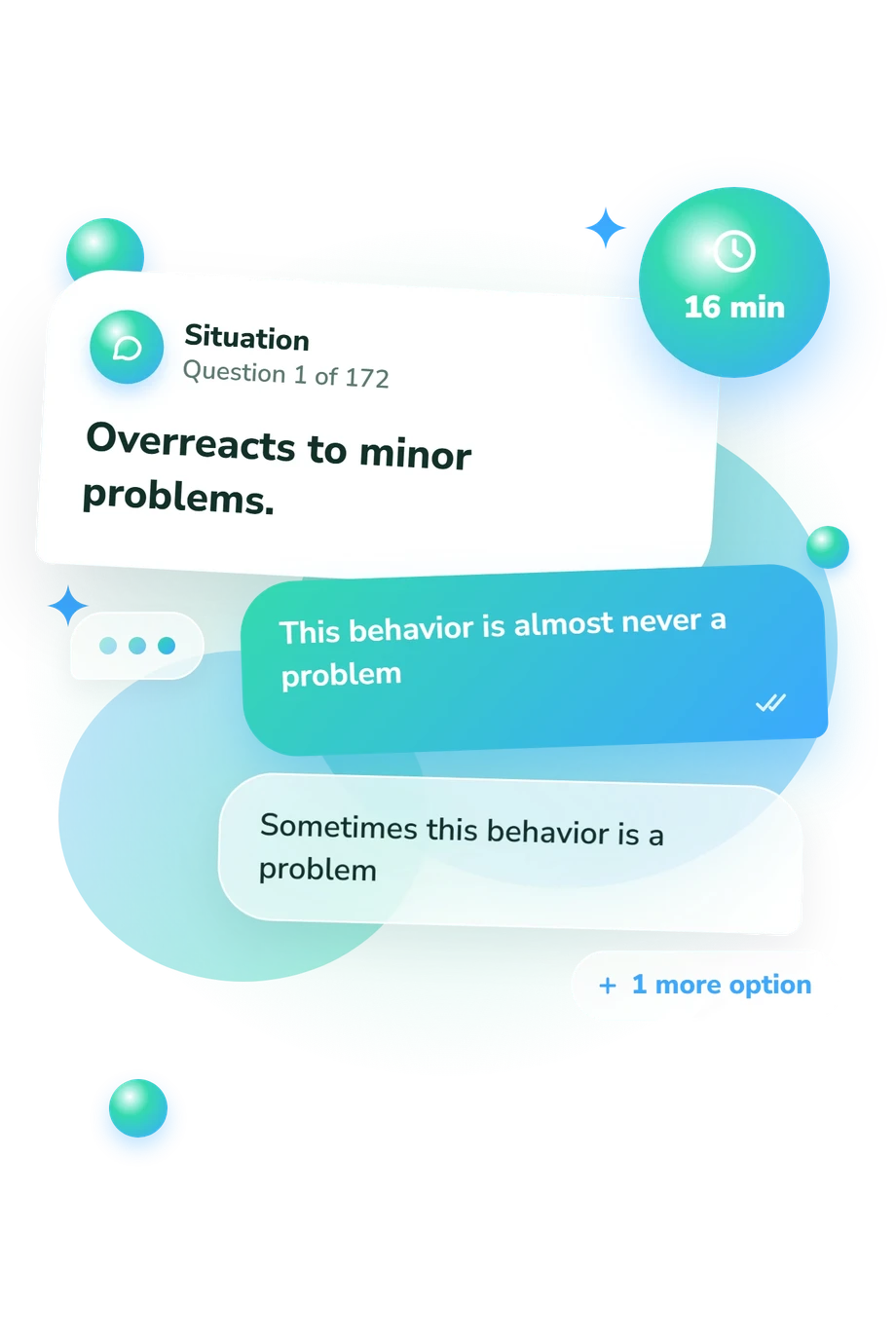
Below is a series of statements describing behavioral problems in children. We are interested in whether your student has exhibited these problems during the past 6 months. Please answer all questions honestly and do not skip any statements. After reading each statement, think about your student and mark your response.
    • This behavior is almost never a problem
    • Sometimes this behavior is a problem
    • This behavior is often a problem
    • This behavior is almost never a problem
    • This behavior is sometimes a problem
    • This behavior is often a problem
    • This is almost never a problem
    • Sometimes this is a problem
    • This is often a problem
WHAT THE TEST MEASURES
About This Assessment
Executive Function Assessment Questionnaire, BRIEF Test

Behavior Rating Inventory of Executive Function (BRIEF) Test - Symptoms and Signs

autism
deviations

This measure is designed to assess everyday manifestations of executive functioning in children and adolescents through standardized behavior ratings. The Behavior Rating Inventory of Executive Function (BRIEF) is commonly used to characterize difficulties with planning, organization, cognitive flexibility, and self-monitoring as observed in natural settings.

Informants typically include parents and/or teachers, who rate the frequency of specific behaviors. The questionnaire includes 86 items and takes about 16 minutes to complete. It yields a profile of executive function-related domains that can support clinical formulation, educational planning, and treatment monitoring when interpreted within the context of other assessment data.

The Behavior Rating Inventory of Executive Function (BRIEF) was developed by P. K. Isquith, G. A. Gioia, L. Kenworthy, and S. C. Guy. Interpretation should follow the test manual and appropriate normative references, and results should be integrated with developmental history, behavioral observations, and collateral information.

Author: G. A. Gioia, L. Kenworthy, P. K. Isquith, S. C. Guy
Literature: Miyake, A., Friedman, N. P., Emerson, M. J., Witzki, A. H., Howerter, A., & Wager, T. D. The unity and diversity of executive functions and their contributions to complex “frontal lobe” tasks: A latent variable analysis. Cognitive Psychology. 2000.; Gioia, G. A., Isquith, P. K., Guy, S. C., & Kenworthy, L. Behavior rating inventory of executive function. Psychological Assessment Resources. 2000.
Popular tests
Comments
Leave a Comment