
Digital Daily Life Self-Management Scale Test
How the Scales are Structured
Who Usually Takes This Test?
See How You Compare
Below is a preview of how scores are typically distributed across each scale.
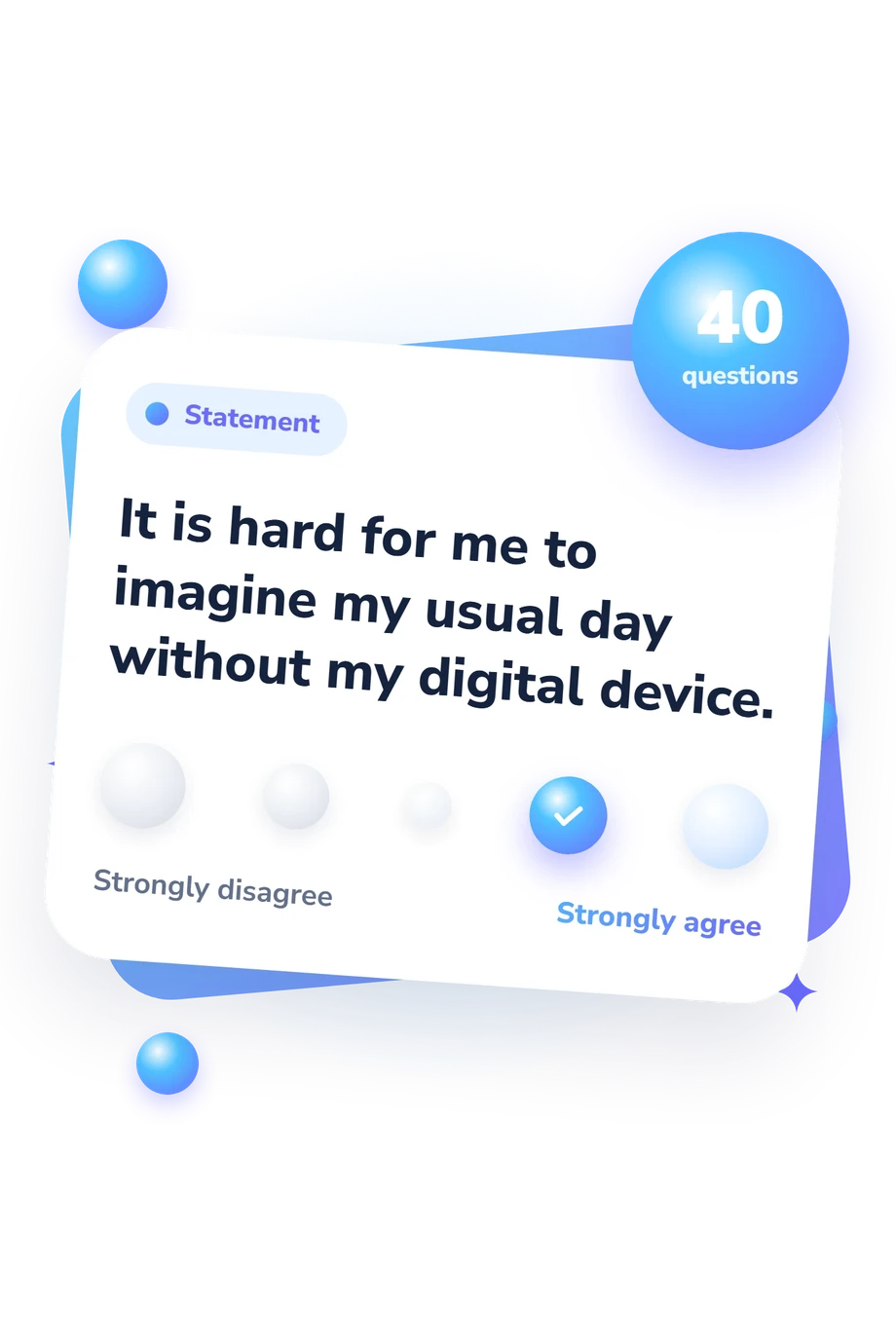
Example Questions From the Test
- Strongly disagree
- Disagree
- Neither agree nor disagree
- Agree
- Strongly agree
- Strongly disagree
- Disagree
- Neither agree nor disagree
- Agree
- Strongly agree
- Strongly disagree
- Disagree
- Neither agree nor disagree
- Agree
- Completely agree
Digital Daily Life Self-Management Scale Test - Description and methodology of the test
People who want to understand their relationship with connected technology may find the Digital Daily Life Self-Management Scale Test useful when habits, online identity, and privacy concerns feel intertwined. This digital self-management assessment is designed for reflective use: it organizes everyday experiences into a profile that can show where technology supports functioning and where reliance or risk awareness deserves closer attention.
What This Assessment Explores
Questions address identity, social feedback, device reliance, distraction, privacy, misinformation, algorithms, and cyber-risk. They suit readers examining digital habits.
The digital daily life scale links technology with identity, functioning, self-understanding, and self-regulation. It produces a profile, not a label. Three dimensions organize it:
- Digital Sociality (5-25) covers online identity, consistent online and offline self-presentation, and building and maintaining social connections and relational closeness; with Less integrated (5-11), Somewhat integrated (12-18), and Well integrated (19-25).
- Digital Daily Life Experience (7-35) covers device use for tasks, self-fulfillment, self-understanding, emotional device attachment, and seeing it as integral to life; with Low integration (7-16), Moderate integration (17-26), and High integration (27-35).
- Digital Device Management (8-40) covers awareness of communication, information, personal-data, and dependence risks, prevention strategies, online regulation, and digital-offline balance; with Needs Support (8-18), Developing Skills (19-29), and Strong Management (30-40).
Methodology and Evidence Base
In practice, this digital life questionnaire uses short self-report statements with five ordered agreement choices, from Strongly disagree to Strongly agree. Results are reported through the displayed scale bands. This format captures perceived habits and awareness rather than observed behavior.
This questionnaire is conceptually consistent with the Digital Daily Life Self-Management Scale, but it is not an adaptation of that published instrument. The questionnaire addresses digital identity, everyday technology use, and regulation of risks and dependence. The later DDLSM-2 work discusses integrity, adaptation, and well-being, but those are not dimensions reported by this questionnaire.
The questionnaire provides no population norms or documented rule for converting responses into scale scores, so its bands are descriptive categories rather than norm-referenced or diagnostic thresholds. Scores may also shift with mood, workload, social pressure, current access to devices, and willingness to report uncomfortable habits. Treat the pattern as a prompt to examine concrete situations and choose practical adjustments, not as a final judgment about personality or functioning.
- Soldatova, G.U., Chigarkova, S.V., & Ilyukhina, S.N. (2024). Digital extended personality: development and testing of a digital daily life self-management scale. Lomonosov Psychology Journal, 47(2), 175-200. 10.11621/LPJ-24-20
- Soldatova, G.U., Chigarkova, S.V., & Ilyukhina, S.N. (2025). Extended version of the Digital Daily Life Self-Management Scale (DDLSM-2): Integrity as a potential for adaptation and well-being. Cultural-Historical Psychology, 21(4), 25-37. 10.17759/chp.2025210403
Updated: