
Daily Stress Inventory (DSI) Test
How the Scales are Structured
Who Usually Takes This Test?
See How You Compare
Below is a preview of how scores are typically distributed across each scale.
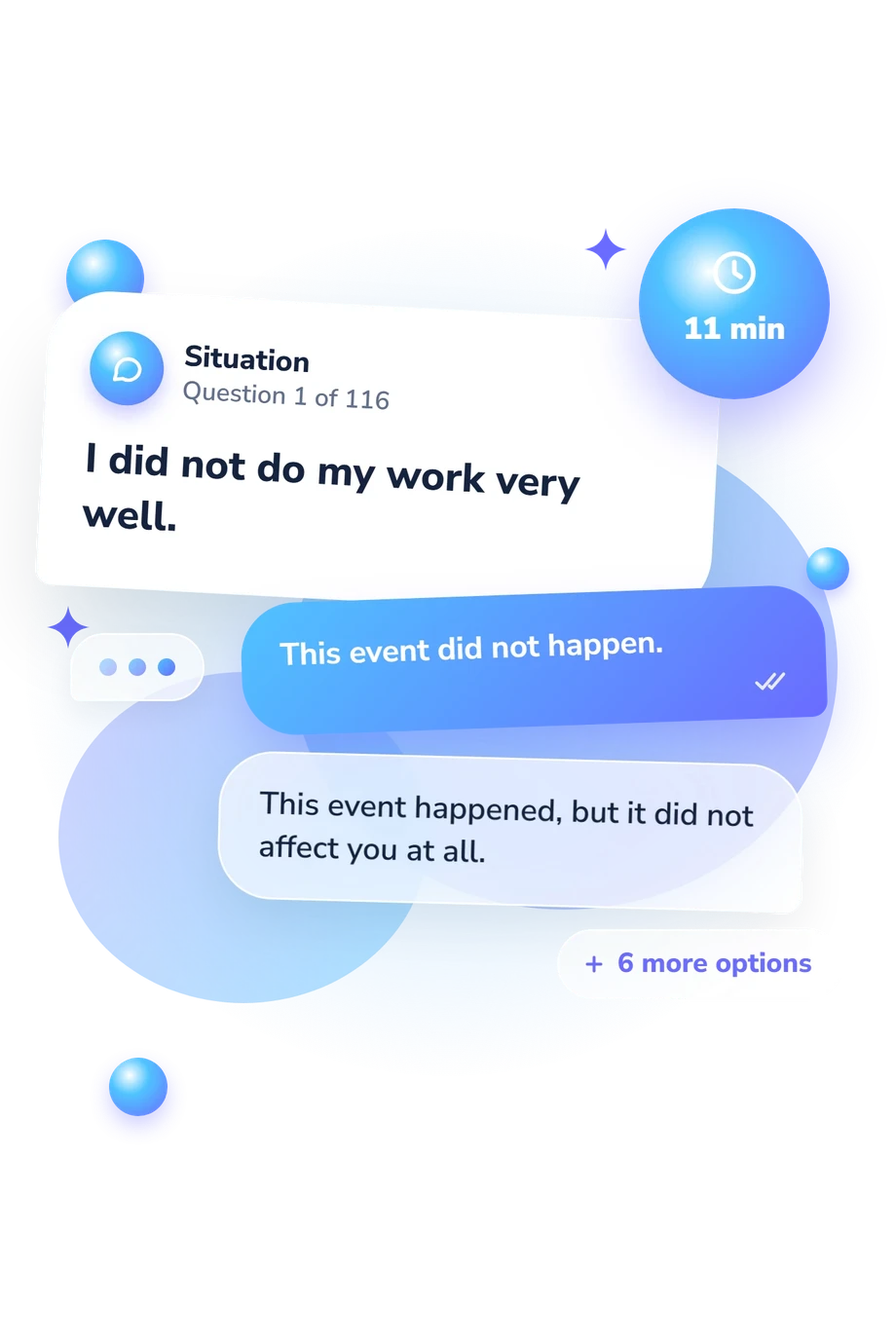
Example Questions From the Test
- This event did not happen to you.
- This event happened to you but did not affect you at all.
- This event affected you very slightly.
- This event was somewhat burdensome for you.
- This event affected you to a moderate degree.
- This event affected you strongly.
- This event affected you very strongly.
- This event was unbearable for you.
- This event did not happen to you.
- This event happened to you, but did not affect you at all.
- This event affected you very slightly.
- This event bothered you somewhat.
- This event affected you moderately.
- This event affected you a great deal.
- This event affected you very much.
- This event was unbearable for you.
- This event did not occur.
- This event occurred but did not affect you at all.
- This event affected you only a little.
- This event was slightly stressful for you.
- This event affected you moderately.
- This event affected you strongly.
- This event affected you very strongly.
- This event was unbearable for you.
Daily Stress Inventory (DSI) Test - Description and methodology of the test
People who want to observe patterns in everyday stress, including how often pressures arise and how strongly they are experienced, can use the Daily Stress Inventory (DSI) Test. It suits people reflecting on work, relationships, health, money, interruptions, and other everyday demands. As a daily stress questionnaire, it separates how often stressful events occur from how intensely they are experienced, giving the profile practical meaning for self-reflection.
What This Assessment Explores
These items cover everyday demands rather than one isolated symptom, including work problems, unfinished tasks, interruptions, social friction, relationship conflict, money worries, health concerns, delays, and mishaps. Each situation is considered through appraisal: whether it occurred and how strongly it affected the respondent.
The result distinguishes event frequency from perceived intensity. This stress level assessment shows how event frequency and perceived impact combine in daily burden.
The three scales are:
- Average Impact (0-7) shows average perceived intensity per event; bands are Low intensity (0-2.9) and Moderate to high intensity (3-7).
- Total Score (0-200) shows cumulative stress burden across events; bands are Low total stress (0-70) and High total stress (71-200).
- Frequency (0-58) shows the number of stressful events encountered; bands are Low frequency (0-25) and High frequency (26-58).
Methodology and Scientific Basis
Representative items use eight ordered choices. The first indicates an event did not occur; the second indicates it occurred without affecting the respondent; later choices progress from slight to unbearable impact. This separates exposure from appraisal before the profile is summarized.
In scoring, the questionnaire functions as a stress event inventory: it separates occurrence, perceived intensity, and cumulative burden. Its outputs summarize event frequency, average impact, and combined burden. Read results through displayed ranges and labels rather than assuming a point value for each response.
Its closest published reference is the Daily Stress Inventory (DSI), which examines everyday events through occurrence and perceived impact. The questionnaire is conceptually consistent with that event-and-impact approach. Related work examines validity and repeated administration, while a professional manual adds context for interpretation.
Lazarus and Folkman’s appraisal-and-coping framework explains why one event can receive different stress ratings. Memory, honesty, and current circumstances shape self-report; the online presentation does not establish the original instrument’s standardization or norms, so results capture perceived daily load at completion.
- Brantley, P. J., Waggoner, C. D., Jones, G. N., & Rappaport, N. B. (1987). A daily stress inventory: Development, reliability, and validity. Journal of Behavioral Medicine, 10(1), 61-74. 10.1007/BF00845128
- Brantley, P. J., Cocke, T. B., Jones, G. N., & Goreczny, A. J. (1988). The Daily Stress Inventory: Validity and effect of repeated administration. Journal of Psychopathology and Behavioral Assessment, 10(1), 75-81. 10.1007/BF00962987
- Brantley, P. J., & Jones, G. N. (1989). The Daily Stress Inventory: Professional manual. Odessa, FL: Psychological Assessment Resources.
- Lazarus, R. S., & Folkman, S. (1984). Stress, appraisal, and coping. New York, NY: Springer Publishing Company.
Updated: