
Freudly+971 508685814hello@freudly.ai
Freudly
self-efficacy

Professional Self-Attitude Questionnaire Test
Take the online Professional Self-Attitude Questionnaire Test - AI psychologist FreudlyYou can take Professional Self-Attitude Questionnaire Testhere. Online version of a simple and accurate psychological test with interpretation.en
Understand how you see yourself in your profession, what drives you, and how steady that mindset is in 8 minutes. Fast, focused insights support coaching, hiring, and targeted development.
Start Online Test
Questions: 398 minutes
08:30
October 2, 2025
October 2, 2025
Material has been updated
October 2, 2025
Material has been published
31,265 views
2,229 completions
1,794 likes
Verified by Daniel Hall
Psychologist with 25 years of experience
Share
Scale Explorer

How the Scales are Structured

example score
4/9
Professional Self-Deprecation (PSD)
Assesses the tendency to negatively evaluate and devalue oneself in the professional role.
Low
Moderate
High
03: Low | 46: Moderate | 79: High
A score of 4 falls in the Moderate range, suggesting occasional self-critical or self-devaluing views about one’s professional qualities without being strongly pronounced.
example score
1/9
Professional Self-Efficacy (PSE)
Measures how effectively a person consciously applies their individual qualities to achieve professional goals and grow within their profession.
Low
Moderate
High
03: Low | 46: Moderate | 79: High
A score of 1 indicates low perceived self-efficacy in the profession, suggesting limited confidence in using personal strengths to achieve professional goals and develop in the role.
example score
6/9
Self-Rated Personal Growth (SRPG)
Measures how strongly a person feels their profession supports self-realization and personal development.
Low growth value
Moderate growth value
High growth value
03: Low growth value | 46: Moderate growth value | 79: High growth value
A score of 6 suggests you generally see your profession as contributing to personal growth, though this perception may not be fully consistent or central.
example score
4/9
Professional Self-Leadership (PSL)
Assesses how confidently a person views themselves as a responsible, reliable professional who can overcome difficulties and achieve work goals.
Low self-guidance
Moderate self-guidance
High self-guidance
03: Low self-guidance | 46: Moderate self-guidance | 79: High self-guidance
A score of 4 indicates a moderate level of self-guidance in the profession, suggesting some confidence in professional reliability and goal pursuit with room to strengthen stability and optimism.
example score
4/9
Professional Self-Blame (PSB)
Assesses the tendency to self-criticize and blame oneself for professional setbacks and perceived failures.
Low self-blame
Moderate self-blame
High self-blame
03: Low self-blame | 46: Moderate self-blame | 79: High self-blame
A score of 4 indicates a moderate tendency toward self-criticism after work-related setbacks, with self-blame present but not dominant.
example score
4/9
Internal Conflict (IC)
Measures the degree of inner conflict in professional self-attitude arising from a mismatch between job demands and perceived personal capabilities.
Low
Moderate
High
03: Low | 46: Moderate | 79: High
A score of 4 indicates a moderate level of inner conflict, suggesting some tension between professional expectations and self-perceived resources that may appear in certain work situations.
example score
3/9
Professional Self-Attachment (PSA)
Measures how attached you feel to yourself as a professional and how stable your professional self-esteem is.
Growth-oriented
Balanced
Highly self-attached
03: Growth-oriented | 46: Balanced | 79: Highly self-attached
A score of 3 falls in the Growth-oriented range, suggesting relatively low self-attachment and a stronger focus on professional development than on maintaining a fixed self-view.
example score
3/9
Professional Self-Confidence (PSC)
Measures confidence in one’s professional competence and perceived significance in the professional role.
Low confidence
Moderate confidence
High confidence
03: Low confidence | 46: Moderate confidence | 79: High confidence
A score of 3 suggests low professional self-confidence, indicating doubts about one’s competence and significance in the professional role.
example score
2/9
Professional Self-Respect (PSR)
Measures self-respect and satisfaction with one’s professional achievements and perceived fit with the profession’s demands.
Low
Moderate
High
03: Low | 46: Moderate | 79: High
A score of 2 falls in the Low range, suggesting reduced professional self-respect and satisfaction with achievements, with possible doubts about meeting professional demands.
example score
6/9
Overall Professional Self-Attitude Positivity (OPSAP)
Measures how positive and confident a person’s overall attitude is toward themselves in their professional role.
Low positivity
Moderate positivity
High positivity
03: Low positivity | 46: Moderate positivity | 79: High positivity
A score of 6 indicates a generally positive but not fully stable professional self-attitude, with some room for strengthening confidence and clarity in the professional role.
Start Online Test
just completed the test
DATA-BASED USER COHORTS

Who Usually Takes This Test?

Career changers and seekers
41%OF USERS
People deciding on a new career path take it to clarify what kind of professional they see themselves as and what motivates them at work.
HR and hiring teams
34%OF USERS
Recruiters and HR specialists use it to assess a candidate’s professional self-attitude and predict fit, development potential, and onboarding needs.
Employees in burnout risk
25%OF USERS
Working professionals take it when they feel stuck, dissatisfied, or drained to understand their relationship to the job and where to adjust goals or motivation.
BASED ON AGGREGATED, ANONYMIZED DATA FROM TENS OF THOUSANDS OF FREUDLY USERS.
Benchmarking

See How You Compare

Once you complete the test, your results are compared with real-world data from people in your country.
Below is a preview of how scores are typically distributed across each scale.
Self-Denigration in the Profession (SitP)
Average
5.1
Normal range
3.86.5
min.
0
max.
9
This curve shows how scores are typically distributed.
Once you complete the test, your result will appear on the scale so you can see how you compare.
Self-efficacy in the Profession (SitP)
Average
4.6
Normal range
3.55.8
min.
0
max.
9
This curve shows how scores are typically distributed.
Once you complete the test, your result will appear on the scale so you can see how you compare.
Self-esteem of personal growth (Sopg)
Average
3.1
Normal range
1.74.5
min.
0
max.
9
This curve shows how scores are typically distributed.
Once you complete the test, your result will appear on the scale so you can see how you compare.
Self-Guidance in the Profession (SitP)
Average
5
Normal range
3.46.6
min.
0
max.
9
This curve shows how scores are typically distributed.
Once you complete the test, your result will appear on the scale so you can see how you compare.
Self-Blame in the Profession (SitP)
Average
3.4
Normal range
2.24.6
min.
0
max.
9
This curve shows how scores are typically distributed.
Once you complete the test, your result will appear on the scale so you can see how you compare.
Inner Conflict (IC)
Inner Conflict (IC)
Average
4.2
Normal range
35.3
min.
0
max.
9
This curve shows how scores are typically distributed.
Once you complete the test, your result will appear on the scale so you can see how you compare.
Self-Attachment in the Profession (SitP)
Average
2.9
Normal range
1.84
min.
0
max.
9
This curve shows how scores are typically distributed.
Once you complete the test, your result will appear on the scale so you can see how you compare.
Self-Confidence in the Profession (SitP)
Average
2.6
Normal range
0.94.3
min.
0
max.
9
This curve shows how scores are typically distributed.
Once you complete the test, your result will appear on the scale so you can see how you compare.
Self-Esteem in the Profession (SitP)
Average
3.1
Normal range
1.64.6
min.
0
max.
9
This curve shows how scores are typically distributed.
Once you complete the test, your result will appear on the scale so you can see how you compare.
Overall positivity indicator of professional self-attitude (Opiops)
Average
3.8
Normal range
2.55.2
min.
0
max.
9
This curve shows how scores are typically distributed.
Once you complete the test, your result will appear on the scale so you can see how you compare.
Featured On
SAMPLE QUESTIONS

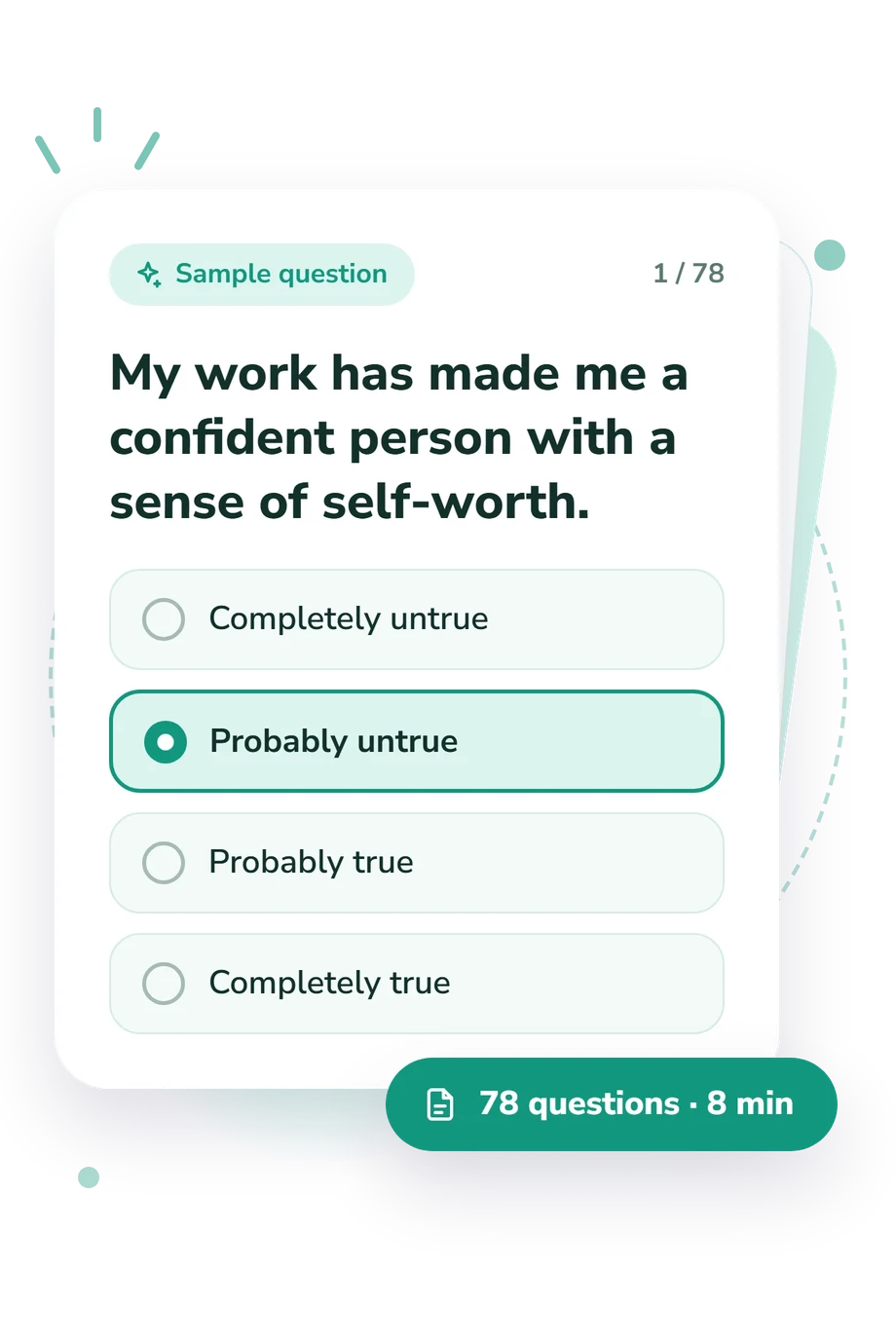
Example Questions From the Test

Please read each statement carefully and indicate the extent to which it describes you personally. Do not spend too much time thinking about your responses. Provide the answer that comes to mind first. Remember that there are no right or wrong answers, and no good or bad answers.
    • Completely untrue
    • Probably untrue
    • Probably true
    • Completely true
    • Completely untrue
    • Probably untrue
    • Probably true
    • Completely true
    • Completely untrue
    • Probably untrue
    • Probably true
    • Completely true
WHAT THE TEST MEASURES
About This Assessment
Questionnaire on Professional Self-Relation of the Individual Test

Professional Self-Attitude Questionnaire Test - Symptoms and Signs

self-efficacy
self-attitude
self-confidence
internal conflict

This measure is designed to assess an individual’s self-evaluative attitudes and perceived identity in relation to work roles. The Professional Self-Attitude Questionnaire provides a brief, structured self-report format for describing how a person appraises themselves as a worker or professional and how they relate emotionally and cognitively to their occupation.

It consists of 39 items and typically takes about 8 minutes to complete. Content is intended to support clinical or counseling formulations in vocational contexts by clarifying perceived competence, self-worth, and motivational orientation as they pertain to work.

Results from the Professional Self-Attitude Questionnaire may be used to inform career counseling, workplace coaching, or broader psychosocial assessment when work-related self-concept is clinically relevant. When interpreted alongside history and other measures, findings can help identify areas for further evaluation or intervention planning. Authors: Donald E. Super and John L. Holland.

Author: Donald E. Super, John L. Holland
Literature: Super, D. E. A life-span, life-space approach to career development. Journal of Vocational Behavior. 1980.
Popular tests
Comments
Leave a Comment