
Freudly+971 508685814hello@freudly.ai
Freudly
close relationships

Communicative Responses to Jealousy (CRJ) Test
Take the online Communicative Responses to Jealousy (CRJ) Test - AI psychologist FreudlyYou can take Communicative Responses to Jealousy (CRJ) Testhere. Online version of a simple and accurate psychological test with interpretation.en
Understand how you communicate when jealousy hits and what keeps you close in 10 minutes. Get a clear, practical profile to guide healthier conflict talks and relationship repair.
Start Online Test
Questions: 5210 minutes
08:30
October 2, 2025
October 2, 2025
Material has been updated
October 2, 2025
Material has been published
31,309 views
1,912 completions
1,609 likes
Verified by Daniel Hall
Psychologist with 25 years of experience
Share
Scale Explorer

How the Scales are Structured

example score
9/21
Contact With Rival (CWR)
This scale measures the tendency to directly contact or confront a perceived romantic rival during episodes of jealousy.
Low
Moderate
High
38: Low | 915: Moderate | 1621: High
A score of 9 falls in the Moderate range, suggesting some readiness to interact with a perceived rival, though it is not a dominant strategy.
example score
21/28
Manipulation (M)
Measures the tendency to influence a partner’s feelings or behavior through indirect, covert, or strategic communication when jealousy arises.
Low
Moderate
High
412: Low | 1320: Moderate | 2128: High
A score of 21 falls in the High range, suggesting you often rely on indirect or covert tactics to shape your partner’s reactions during jealous moments.
example score
18/35
Compensation/Substitution (C)
Measures the extent to which jealousy is handled by compensating through pleasing gestures or doing something nice for the partner.
Low
Moderate
High
514: Low | 1524: Moderate | 2535: High
A score of 18 falls in the Moderate range, suggesting you sometimes respond to jealousy by trying to restore closeness through positive actions toward your partner.
example score
34/49
Control/Restrictions (C)
Measures the tendency to respond to jealousy by monitoring a partner and imposing limits on their autonomy through communication and rules.
Low
Moderate
High
720: Low | 2134: Moderate | 3549: High
A score of 34 falls in the Moderate range, suggesting a noticeable but not extreme tendency to use checking, rules, or restrictions when feeling jealous.
example score
13/35
Violence/Threats (V)
Measures the extent to which jealousy is expressed through coercive interaction, threats, or aggressive behavior toward a partner.
Low
Moderate
High
515: Low | 1625: Moderate | 2635: High
A score of 13 falls in the Low range, suggesting threats or coercive/aggressive reactions to jealousy are generally infrequent in communication with a partner.
example score
26/35
Avoidance/Denial (A)
Measures the tendency to avoid or deny jealousy-related concerns rather than discussing them directly.
Direct engagement
Mixed approach
Avoidance/denial
515: Direct engagement | 1625: Mixed approach | 2635: Avoidance/denial
A score of 26 suggests you are more likely to cope with jealousy by minimizing, avoiding, or postponing discussion of the issue.
example score
30/42
Distributive Communication (DC)
Measures the extent to which jealousy is communicated through accusations, arguments, and confrontational exchanges with a partner.
Low confrontationality
Moderate confrontationality
High confrontationality
617: Low confrontationality | 1829: Moderate confrontationality | 3042: High confrontationality
A score of 30 falls in the High confrontationality range, suggesting you are relatively likely to respond to jealousy with accusatory or argumentative communication.
example score
21/28
Integrative Communication (IC)
Measures how actively a person uses open, collaborative dialogue with a partner to address jealousy-related concerns.
Low
Moderate
High
412: Low | 1320: Moderate | 2128: High
A score of 21 indicates a high tendency to discuss jealousy openly and work with the partner toward a shared solution.
example score
41/49
Negative Affective Expression (NAE)
Measures how strongly a person communicates jealousy through openly expressed negative emotions (e.g., irritation, hurt, anger) toward a partner.
Low expression
Moderate expression
High expression
721: Low expression | 2235: Moderate expression | 3649: High expression
A score of 41 falls in the High expression range, suggesting a tendency to openly show negative feelings toward a partner when experiencing jealousy.
example score
22/42
Active Distancing (AD)
Measures how strongly a person tends to pull away and reduce contact with a partner in response to jealousy.
Low distancing
Moderate distancing
High distancing
617: Low distancing | 1830: Moderate distancing | 3142: High distancing
A score of 22 falls in the Moderate distancing range, suggesting a noticeable tendency to withdraw or create space during jealousy rather than directly discussing the issue.
Start Online Test
just completed the test
DATA-BASED USER COHORTS

Who Usually Takes This Test?

Jealousy after a trigger
41%OF USERS
People in a relationship who recently felt jealous after something like flirting, social media activity, or a sudden change in attention and want to understand their reactions.
Couples in active conflict
34%OF USERS
Partners dealing with recurring arguments about trust, boundaries, or control who want a clearer picture of their communication patterns during jealousy.
Clients in couples therapy
25%OF USERS
Individuals completing the questionnaire as part of counseling to identify their typical jealousy coping style and set specific communication goals.
BASED ON AGGREGATED, ANONYMIZED DATA FROM TENS OF THOUSANDS OF FREUDLY USERS.
Benchmarking

See How You Compare

Once you complete the test, your results are compared with real-world data from people in your country.
Below is a preview of how scores are typically distributed across each scale.
Contact with a rival (Cwar)
Average
14.9
Normal range
11.518.2
min.
3
max.
21
This curve shows how scores are typically distributed.
Once you complete the test, your result will appear on the scale so you can see how you compare.
Manipulation (M)
Manipulation (M)
Average
11.9
Normal range
7.915.9
min.
4
max.
28
This curve shows how scores are typically distributed.
Once you complete the test, your result will appear on the scale so you can see how you compare.
Compensation/Substitution (C)
Average
15.6
Normal range
1021.2
min.
5
max.
35
This curve shows how scores are typically distributed.
Once you complete the test, your result will appear on the scale so you can see how you compare.
Control/Restrictions (C)
Average
18.1
Normal range
1224.3
min.
7
max.
49
This curve shows how scores are typically distributed.
Once you complete the test, your result will appear on the scale so you can see how you compare.
Violence/Threats (V)
Average
27.5
Normal range
23.831.1
min.
5
max.
35
This curve shows how scores are typically distributed.
Once you complete the test, your result will appear on the scale so you can see how you compare.
Avoidance/Denial (A)
Average
13.3
Normal range
8.717.8
min.
5
max.
35
This curve shows how scores are typically distributed.
Once you complete the test, your result will appear on the scale so you can see how you compare.
Distributive Communication (DC)
Average
19.7
Normal range
14.924.4
min.
6
max.
42
This curve shows how scores are typically distributed.
Once you complete the test, your result will appear on the scale so you can see how you compare.
Integrative Communication (IC)
Average
16.2
Normal range
12.220.2
min.
4
max.
28
This curve shows how scores are typically distributed.
Once you complete the test, your result will appear on the scale so you can see how you compare.
Negative affective expression (Nae)
Average
24.6
Normal range
17.232.1
min.
7
max.
49
This curve shows how scores are typically distributed.
Once you complete the test, your result will appear on the scale so you can see how you compare.
Active distancing (Ad)
Average
15.1
Normal range
8.821.5
min.
6
max.
42
This curve shows how scores are typically distributed.
Once you complete the test, your result will appear on the scale so you can see how you compare.
Featured On
SAMPLE QUESTIONS

Example Questions From the Test

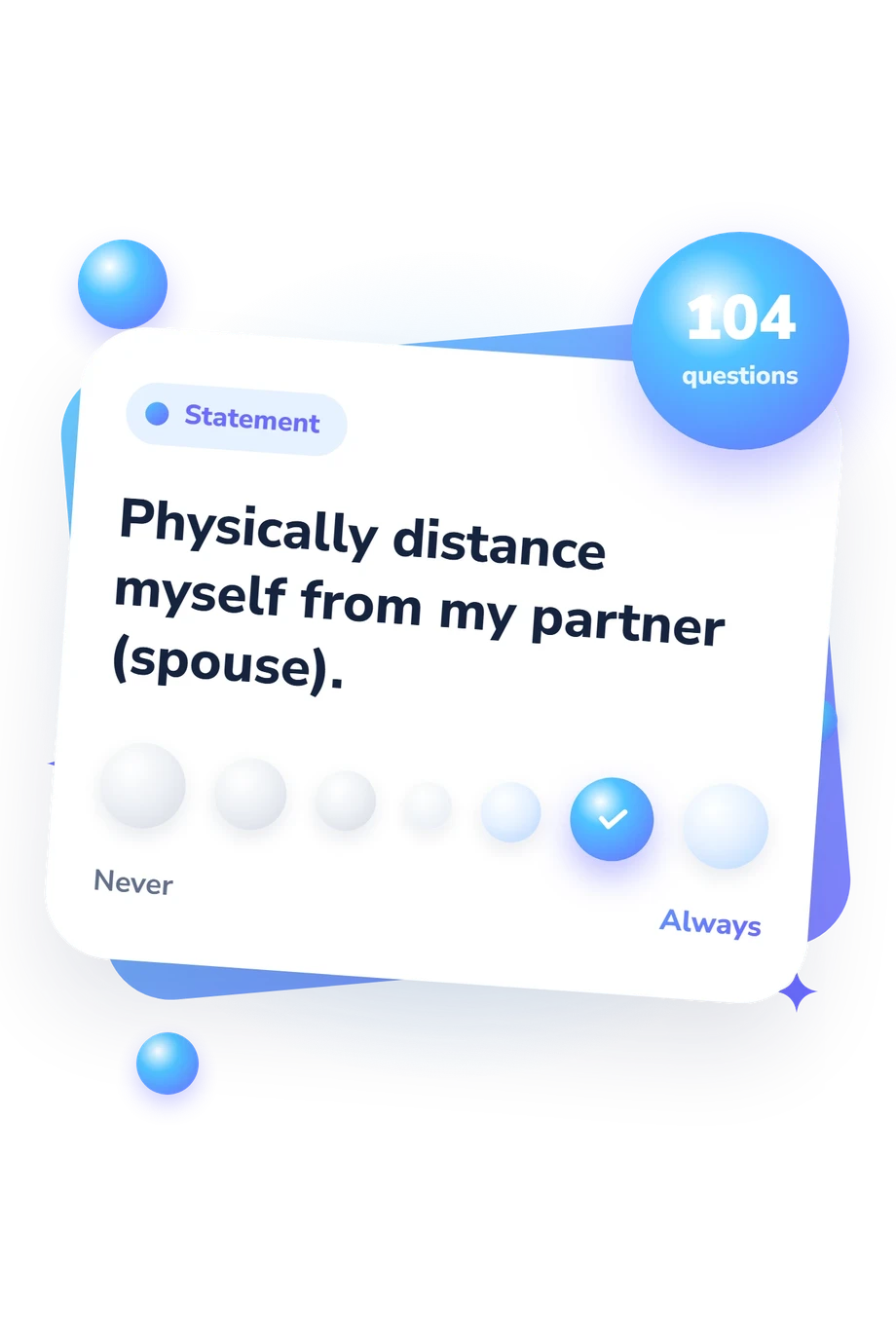
Jealousy is a common human emotion. In fact, most people in romantic relationships experience jealousy at times. Jealousy occurs when an individual believes that a third party (sometimes referred to as a “rival”) poses a threat to the romantic relationship in some way. Please think about occasions during the past six months when you have felt jealous in your current romantic relationship. Read each item and indicate how often you engaged in different types of behavior in response to jealousy during this time period. Please respond as honestly as possible.
    • Never
    • Very rarely
    • Rarely
    • Sometimes
    • Often
    • Very often
    • Always
    • Never
    • Very rarely
    • Rarely
    • Sometimes
    • Often
    • Very often
    • Always
    • Never
    • Very rarely
    • Rarely
    • Sometimes
    • Often
    • Very often
    • Always
WHAT THE TEST MEASURES
About This Assessment
Communicative Reactions to Jealousy, CRJ Test

Communicative Responses to Jealousy (CRJ) Test - Symptoms and Signs

close relationships
jealousy

Jealousy in intimate relationships can be associated with distinct communication patterns that affect closeness and conflict. Communicative Responses to Jealousy (CRJ) is a self-report questionnaire designed to assess how individuals typically respond behaviorally and verbally when experiencing jealousy in a romantic context.

The measure presents a range of situations and possible reactions to help characterize predominant response styles, such as direct expression, withdrawal or avoidance, monitoring or controlling behaviors, and attempts to restore intimacy. It contains 52 items and typically takes about 10 minutes to complete.

Results from the Communicative Responses to Jealousy (CRJ) can be used to support clinical formulation and guide discussion in individual or couples work by clarifying recurring interaction strategies that may escalate or de-escalate jealousy-related conflict.

Author: Clyde Hendrick, Susan S. Hendrick
Literature: Guerrero, L. K., Andersen, P. A., Jorgensen, P. F., Spitzberg, B. H., & Eloy, S. V. Coping with the green-eyed monster: conceptualizing and measuring communicative responses to romantic jealousy. Western Journal of Communication. 1995.
Popular tests
Comments
Leave a Comment