
Parent Attachment Questionnaire for Older Adolescents Test
How the Scales are Structured
Who Usually Takes This Test?
See How You Compare
Below is a preview of how scores are typically distributed across each scale.
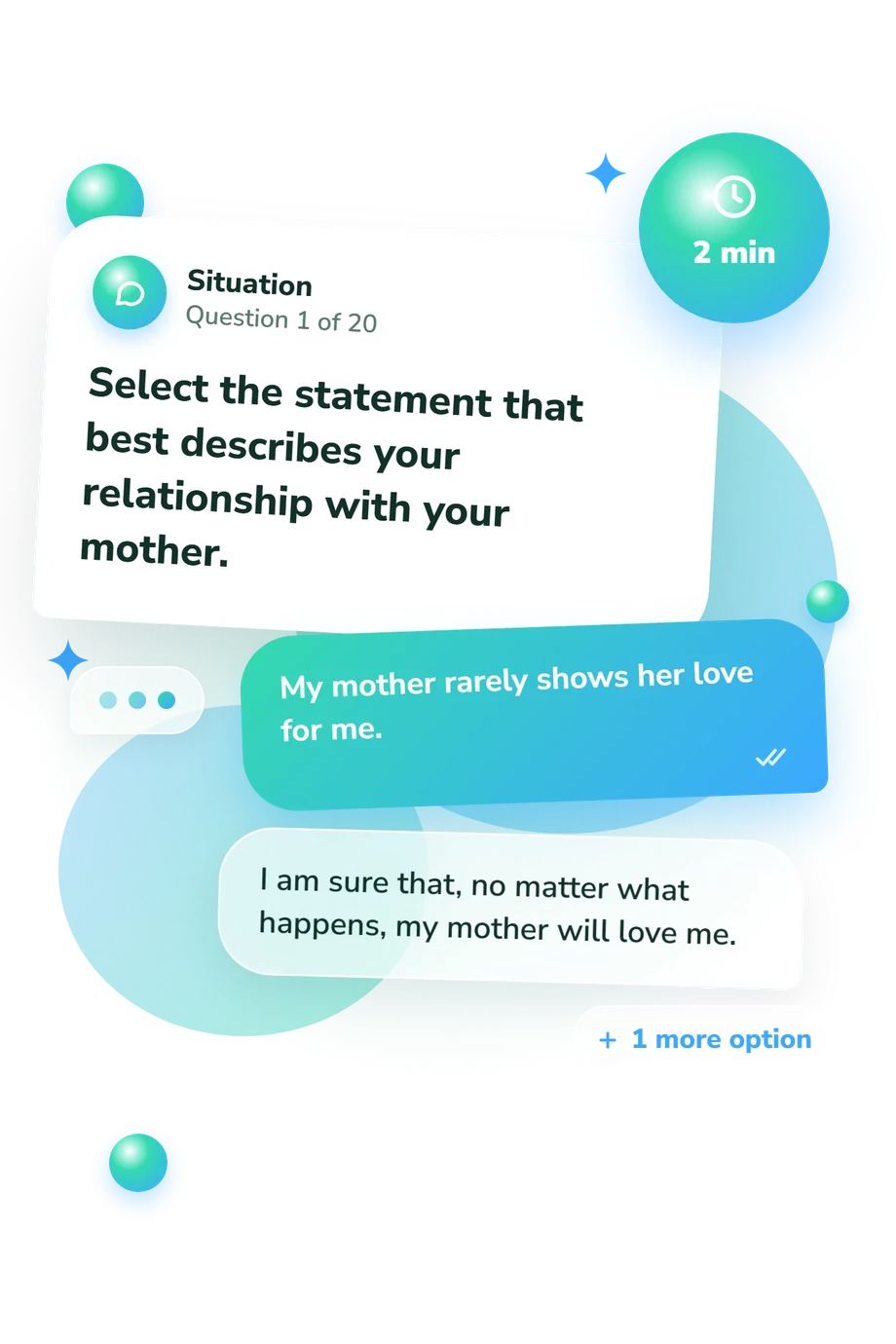
Example Questions From the Test
- My mother supports and approves of my own decisions.
- My mother lets me make my own decisions and does not take an interest in them.
- My mother sometimes strongly controls my decisions and at other times hardly controls them; I often cannot understand why.
- My mother values and respects my personal goals and interests.
- My mother is skeptical about my personal goals and interests.
- My mother has very little understanding of my goals and interests.
- unstable.
- distant.
- close.
Parent Attachment Questionnaire for Older Adolescents Test - Description and methodology of the test
Readers who want to understand how an older adolescent experiences a relationship with the mother can use this parent-adolescent relationship assessment to organize observations about closeness, help, independence, and consistency. The Parent Attachment Questionnaire for Older Adolescents Test presents a profile rather than a single global judgment. It focuses on recurring expectations and interactions, giving families, educators, or counselors a clearer starting point for discussing support and emotional connection.
What This Assessment Explores
Items address maternal love, help, advice, privacy, control, emotional sharing, and consistency. They show whether support is dependable, autonomy respected, and involvement distant, hostile, intrusive, or unpredictable. This adolescent attachment assessment focuses on relationship experiences, not identity.
The result profile shows three dimensions:
- Avoidant (0-10) measures reduced positive maternal interest and increased maternal hostility, distinguishing it from secure attachment; bands: Low avoidant 0-3, Moderate avoidant 4-6, and High avoidant 7-10.
- Anxious (0-10) measures greater maternal directiveness, low positive involvement, high hostility, and inconsistency; bands: Low 0-3, Moderate 4-6, and High 7-10.
- Secure (0-10) measures secure attachment to the mother through positive involvement, support for autonomy, consistent parenting, low hostility, and minimal inconsistency; bands: Low reliability 0-3, Moderate reliability 4-6, and High reliability 7-10.
Together, the profile indicates which tendencies are more prominent in the respondent's account.
Methodology and Scientific Basis
Each item gives a statement or contrasting description of the relationship. The respondent selects the option that best fits experiences of support, independence, emotional sharing, advice, and maternal involvement. This self-report format covers varied situations without requiring a label.
The questionnaire displays three scale scores. It does not state the option weights or reverse-scoring rules, so the scores function as profile indicators. Its displayed bands are the low, moderate, and high result categories.
Vivona (2000) is the closest published comparison for attachment relationships in late adolescence and adjustment. Armsden and Greenberg (1987) offer a parental and peer attachment framework involving communication, trust, and alienation. The questionnaire is conceptually consistent with these works, but is not established as either source instrument or a validated adaptation of them.
That distinction matters when interpreting parent-child attachment patterns. Results may reflect current mood, remembered interactions, self-awareness, or a wish to present the relationship favorably. Use them to organize reflection and conversation; broader contextual or professional assessment is needed to draw conclusions about family functioning.
- Vivona, J. M. (2000). Parental attachment styles of late adolescents: Qualities of attachment relationships and consequences for adjustment. Journal of Counseling Psychology, 47(3), 316-329. 10.1037/0022-0167.47.3.316
- Armsden, G. C., & Greenberg, M. T. (1987). The inventory of parent and peer attachment: Individual differences and their relationship to psychological well-being in adolescence. Journal of Youth and Adolescence, 16(5), 427-454. 10.1007/BF02202939
Updated: