
Adult Attachment Scale (AAS) Test
How the Scales are Structured
Who Usually Takes This Test?
See How You Compare
Below is a preview of how scores are typically distributed across each scale.
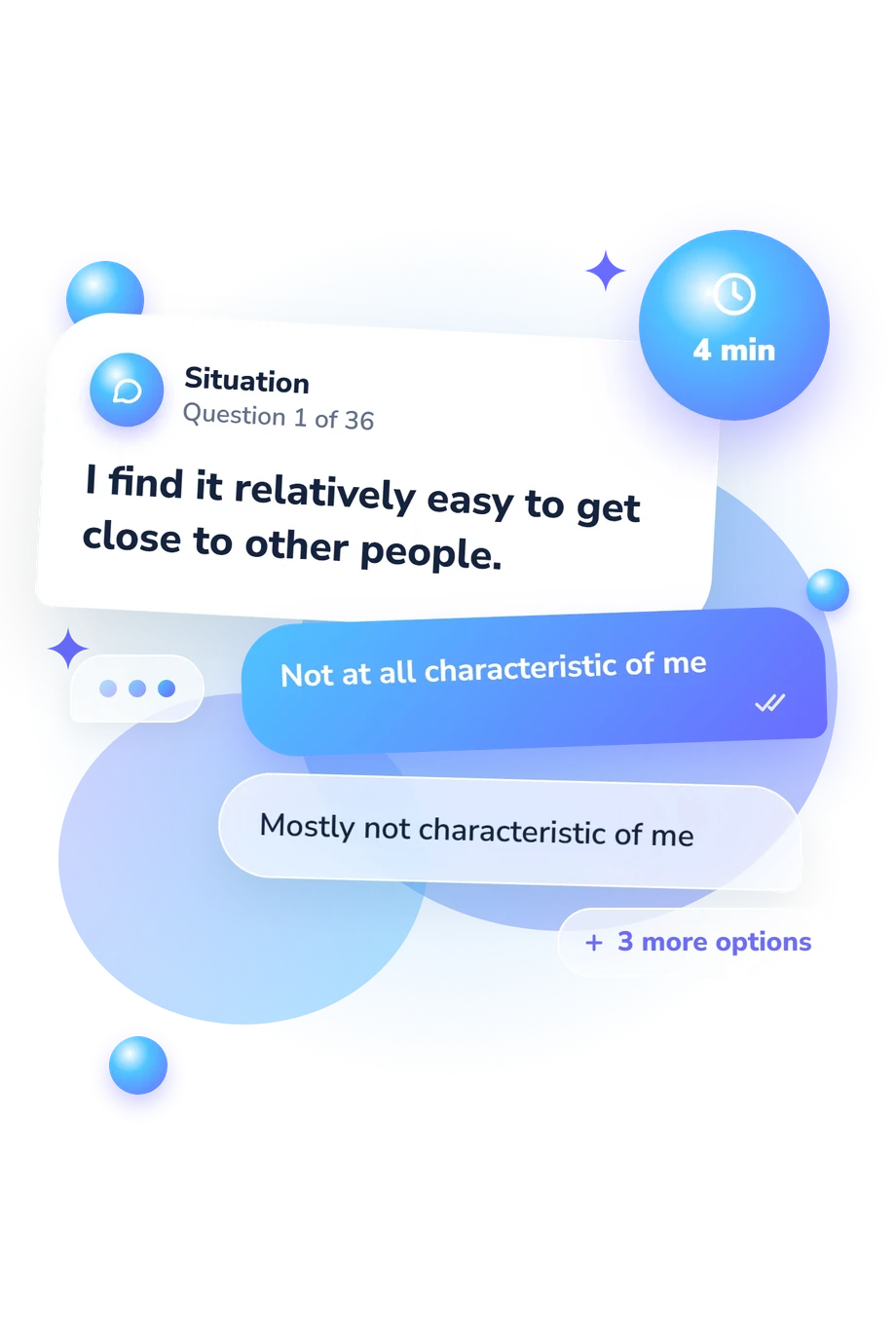
Example Questions From the Test
- Not at all characteristic of me
- Mostly not characteristic of me
- Somewhere in between
- Mostly characteristic of me
- Very characteristic of me
- Not at all characteristic of me
- Mostly not characteristic of me
- Somewhat characteristic of me
- Mostly characteristic of me
- Very characteristic of me
- Not at all characteristic of me
- Mostly not characteristic of me
- Somewhat in between
- Mostly characteristic of me
- Very characteristic of me
Adult Attachment Scale (AAS) Test - Description and methodology of the test
People seeking a clearer picture of reactions to intimacy, trust, and emotional dependence may find the Adult Attachment Scale (AAS) Test a useful self-reflection exercise. As an adult attachment test, this questionnaire provides a structured way to examine relational expectations, helping readers compare responses across situations and identify themes for reflection. The result presents a profile that can clarify how expectations operate across relationships.
What This Assessment Explores
For adults, it covers closeness, trust, reliance, emotional safety, and rejection fears:
- Avoidance (1-5) reflects relationship-closeness avoidance: Low avoidance 1-2.3; Moderate avoidance 2.4-3.6; High avoidance 3.7-5.
- Anxiety (1-5) reflects closeness anxiety and fears of abandonment or being unloved: Low anxiety 1-2.3; Moderate anxiety 2.4-3.6; High anxiety 3.7-5.
- Dependence (1-5) shows reliance when needed: Low reliance 1-2.4; Moderate reliance 2.5-3.6; High reliance 3.7-5.
- Closeness (1-5) shows comfort with intimacy: Low comfort 1-2.4; Moderate comfort 2.5-3.5; High comfort 3.6-5.
The Adult Attachment Scale questionnaire, an attachment style test, reports tendencies rather than one fixed style. Lower scores on the first two indicate greater security; others add context about reliance and intimacy.
Methodology and Scientific Basis
Each statement uses a five-point self-report response, ranging from not characteristic or true to very characteristic or true. Respondents rate how well each belief or situation describes them, so the format captures perceived relationship patterns rather than observed behavior.
The online result reports separate dimensions rather than one total score. Responses produce the displayed profile, but the online version has no documented item-weighting formula, reversal procedure, normative basis, or clinical cutoffs. The bands organize results for interpretation, not fixed categories.
The 18-item Adult Attachment Scale (AAS), developed by Collins and Read (1990), is the closest source instrument for these items; its Close, Depend, and Anxiety subscales correspond to the questionnaire's themes. The online questionnaire uses wording from this AAS item set, but evidence for the published instrument should not be transferred automatically to the questionnaire's four-scale display or scoring. Collins's 1996 account links working models with expectations, emotions, and behavior in close relationships.
This adult attachment questionnaire is a current self-report snapshot: mood, a partner, recent conflict, cultural expectations, self-awareness, and relationship context can influence answers, so responses may differ over time.
- Collins, N. L. (2013). Revised Adult Attachment Scale (RAAS) [Database record]. APA PsycTests. 10.1037/t19162-000
- Collins, N. L., & Read, S. J. (1990). Adult attachment, working models, and relationship quality in dating couples. Journal of Personality and Social Psychology, 58(4), 644-663. 10.1037/0022-3514.58.4.644
- Collins, N. L. (1996). Working models of attachment: Implications for explanation, emotion, and behavior. Journal of Personality and Social Psychology, 71(4), 810-832. 10.1037/0022-3514.71.4.810
Updated: