
Was I Emotionally Neglected as a Child Quiz
How the Scales are Structured
Who Usually Takes This Test?
See How You Compare
Below is a preview of how scores are typically distributed across each scale.
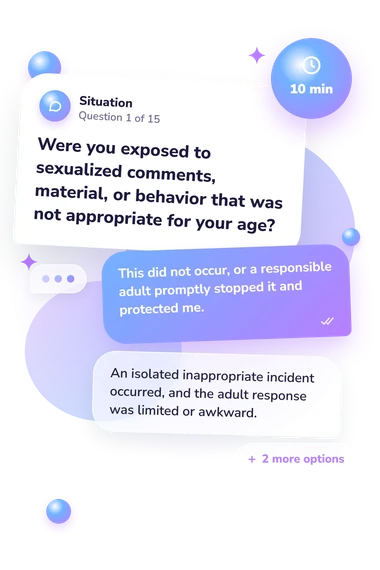
Example Questions From the Test
- This did not occur, or a responsible adult promptly stopped it and protected me.
- An isolated inappropriate incident occurred, and the adult response was limited or awkward.
- Sexualized comments, material, or behavior occurred repeatedly without adequate protection.
- An adult or peer used threats, grooming, coercion, or exploitation to involve me.
- I was not asked to keep this kind of secret.
- I was asked to keep an uncomfortable personal secret, but there was no threat or sexual demand.
- Gifts, favors, special treatment, or emotional pressure were tied to sexualized secrecy.
- Threats, blackmail, force, or exploitation were used to secure secrecy or compliance.
- There was usually discussion, proportionate correction, and some form of reconnection.
- A caregiver sometimes became distant while cooling down, then resumed contact.
- Affection or communication was repeatedly withheld to control my behavior.
- I was threatened with abandonment, rejection, or removal from the family.
Was I Emotionally Neglected as a Child Quiz - Description and methodology of the test
Adults making sense of inconsistent care, dismissed feelings, unsafe responsibilities, or boundary violations can use the Was I Emotionally Neglected as a Child Quiz to organise memories without reducing them to one label. It suits readers who want to identify caregiving patterns and decide which experiences merit attention. As a childhood emotional neglect quiz, this questionnaire spans emotional support, physical safety, and personal boundaries.
What This Assessment Explores
Rather than asking for one judgment, the questionnaire groups experiences involving emotional availability, practical protection, and boundaries. Items address comfort after distress, adult conflict, supervision, care, physical treatment, privacy, sexualized exposure, secrecy, unwanted contact, and responses to disclosure. This emotional neglect quiz considers both what happened and whether a responsible adult protected the child.
The three dimensions are:
- Emotional Responsiveness and Control (0-15) captures endorsed indicators of limited emotional support or control around feelings; bands: No scored experiences (0), Concern worth exploring (1-2), Action-worthy concern (3-15).
- Physical Care and Safety (0-15) shows supervision, protection, healthcare, physical treatment, and basic needs; bands: No scored experiences (0), Concern worth exploring (1-2), Action-worthy concern (3-15).
- Sexual and Personal Boundaries (0-15) shows exposure, secrecy, contact, privacy, and protection after disclosure; bands: No scored experiences (0), Concern worth exploring (1-2), Action-worthy concern (3-15).
Methodology and Evidence Base
Each item offers four responses, from no occurrence or adequate protection through limited concern to repeated, coercive, or severe experiences. The format captures frequency, adult response, safety, and context. Any concerning endorsed experience matters independently of the total, and a single red-flag response overrides it.
The questionnaire is retrospective self-report. The Childhood Trauma Questionnaire-Short Form, Carmel-Widom measure, and CECA.Q are related published measures that provide context for its domains; they do not validate this questionnaire.
As a quiz about emotionally neglectful parents, this test covers childhood caregivers, adults, peers, safety, and boundaries, so its profile can clarify whether concerns involve emotional care alone or more than one domain. It can show whether one area deserves discussion before patterns are considered. Readers asking whether they are being neglected by their parents can use the result to choose a topic for supportive discussion. Because answers depend on memory, current context, and self-awareness, the displayed bands are unvalidated reflective summaries, not validated severity, legal, or clinical cutoffs; poverty, disability, inaccessible services, and unavailable care can shape physical-care responses, and the result does not establish intent or legal neglect.
- Bernstein, David P., Judith A. Stein, Michael D. Newcomb, Edward Walker, David Pogge, Taruna Ahluvalia, John Stokes, Leonard Handelsman, Martha Medrano, David Desmond, and William Zule. “Development and validation of a brief screening version of the Childhood Trauma Questionnaire.” Child Abuse & Neglect, 27(2), 169-190, 2003. 10.1016/S0145-2134(02)00541-0
- Carmel, Tomer, and Cathy Spatz Widom. “Development and validation of a retrospective self-report measure of childhood neglect.” Child Abuse & Neglect, 106, 104555, 2020. 10.1016/j.chiabu.2020.104555
- Bifulco, Antonia, O. Bernazzani, P. M. Moran, and C. Jacobs. “The childhood experience of care and abuse questionnaire (CECA.Q): Validation in a community series.” British Journal of Clinical Psychology, 44(4), 563-581, 2005. 10.1348/014466505X35344
- Bernstein, David P., Ludwig Fink, Leonard Handelsman, Jeffrey Foote, M. Christine Lovejoy, Kevin Wenzel, Elizabeth Alice Sapareto, and Jeanne S. Ruggiero. “Initial reliability and validity of a new retrospective measure of child abuse and neglect.” American Journal of Psychiatry, 151(8), 1132-1136, 1994. 10.1176/ajp.151.8.1132
Updated: