
Social Intelligence Test

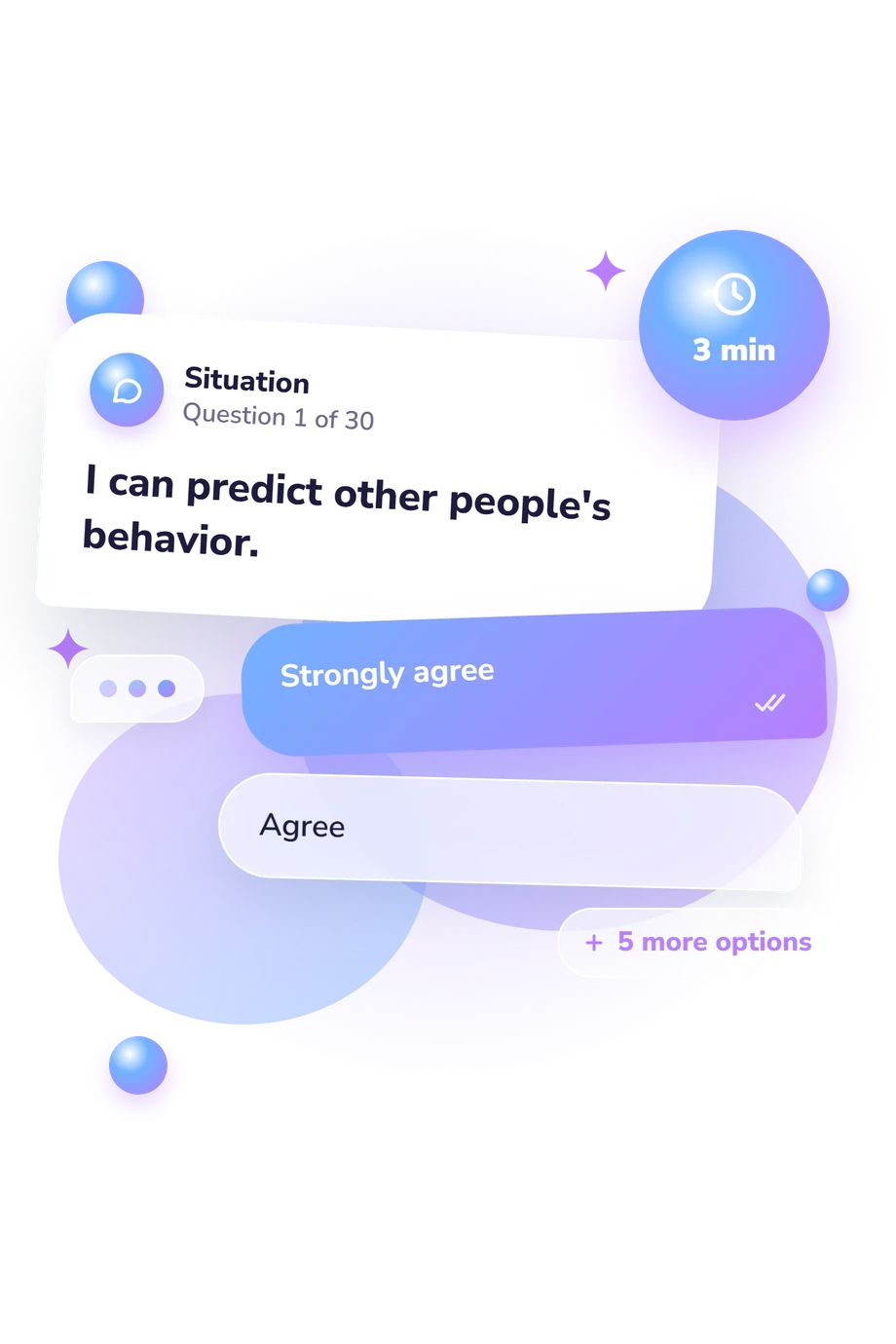
Understand how you read social cues and navigate everyday interactions in about 3 minutes. Take this Social Intelligence Test — the validated 15-item Tromsø Social Intelligence Scale (TSIS) — to get a clear picture of your social awareness and confidence in social situations.
Start Online Test
Questions153 minutes
Hi! My name is Freudly, i am an AI therapist, I will give you an interpretation of the test after you complete it.
08:30
October 2, 2025
October 2, 2025
Material has been updated
29,680 views
3,061 completion
2,411 likes
Verified by Daniel Hall
Psychologist with 25 years of experience
Share
Scale Explorer

How the Scales are Structured

example score
5/10
Social Skills (SS)
Assesses how confidently and appropriately a child or adolescent interacts with others and handles common social challenges through communication.
Low
Moderate
High
04Low57Moderate810High
A score of 5 falls in the Moderate range, suggesting generally adequate social interaction skills with some situations where confidence or appropriateness may vary.
example score
7/10
Social Awareness (SA)
Measures how well a person notices, understands, and empathically responds to others’ verbal and nonverbal cues.
Low
Moderate
High
03Low47Moderate810High
A score of 7 indicates a moderate level of social awareness, suggesting generally good sensitivity to others’ emotions and signals with some room for further development.
Start Online Test
just completed the test
DATA-BASED USER COHORTS

Who Usually Takes This Test?

School psychologists and counselors
41%OF USERS
Use it for quick screening of a student’s social awareness and interaction skills to plan support or track progress.
Teachers and class tutors
34%OF USERS
Take it to better understand classroom dynamics and identify which students need help with communication and empathy.
Parents of 7–16 year olds
25%OF USERS
Use it to see how their child reads others and behaves in social situations, especially during stressful school transitions.
BASED ON AGGREGATED, ANONYMIZED DATA FROM TENS OF THOUSANDS OF FREUDLY USERS.
Benchmarking

See How You Compare

Once you complete the test, your results are compared with real-world data from people in your country.
Below is a preview of how scores are typically distributed across each scale.
Social Skills (SS)
Average
3.9
Normal range
2.25.6
min.
0
max.
10
Majority
This curve shows how scores are typically distributed.
Once you complete the test, your result will appear on the scale so you can see how you compare.
Social Awareness (SA)
Average
5
Normal range
3.36.7
min.
0
max.
10
Majority
This curve shows how scores are typically distributed.
Once you complete the test, your result will appear on the scale so you can see how you compare.
Featured On
CLEAR ANSWERS TO COMMON QUESTIONS

Frequently Asked Questions

What does this Social Intelligence Test measure?
It measures perceived social intelligence across three dimensions: social information processing (understanding others' feelings and intentions), social skills (practical ability to navigate interactions), and social awareness (attentiveness to social context and one's own impact on others). Higher scores indicate stronger perceived social competence.
How is this different from a general social IQ test?
Social intelligence and social IQ describe the same underlying construct — this test uses that terminology interchangeably. The TSIS was specifically designed to be short, reliable, and free of the definitional overlap that made earlier social intelligence measures hard to distinguish from general or emotional intelligence.
How long does it take and how many items are included?
Completion typically takes about 3 minutes. The questionnaire includes 15 items. Select the response that best matches your typical behavior in social situations, rather than an idealized version of yourself, and answer all items honestly for the most accurate picture.
Can this Social Intelligence Test be used for a child or teen?
Yes, parents and educators often use it to understand how a child or teen reads others and behaves in social situations, particularly during stressful transitions like starting a new school. Results can help identify specific areas where a young person might benefit from targeted social skills support.
Is this social IQ test a diagnostic tool?
No. This is a screening measure of perceived social intelligence, not a diagnostic instrument. Results should be interpreted alongside other clinical or contextual information rather than as a standalone conclusion about someone's abilities or character.
Can social intelligence improve over time?
Yes. Unlike some fixed cognitive traits, social intelligence skills — reading social cues, initiating conversations, adjusting behavior based on others' reactions — respond well to deliberate practice and feedback. Retaking this test for social intelligence after focused effort on a specific area can reflect genuine improvement.
How should I use my Social Intelligence Test results?
Use your scores across the three dimensions to identify which specific skills are strongest and which could use more attention — for example, focusing on social awareness if that score is lower than social skills. Educators, counselors, and coaches use this same profile to tailor support and development plans to the specific area that needs the most work.
WHAT THE TEST MEASURES
About This Assessment
Tromsø Social Intelligence Scale Test

This brief self-report measure is used to screen perceived social intelligence in everyday interpersonal situations. Developed by D. H. Silvera, M. Martinussen, and T. Dahl, the Social Intelligence Test uses the Tromsø Social Intelligence Scale (TSIS) to assess how well a person understands social cues and navigates interactions with others. It consists of 15 items and typically takes about 3 minutes to complete.

Why Take a Social Intelligence Test

Social intelligence is often taken for granted until it becomes a source of friction — misreading a colleague's tone, missing that a friend needed support rather than advice, or feeling unsure how to navigate a new social situation confidently. These moments are usually more about specific, learnable skills than fixed personality traits, which is exactly why a structured social IQ test is useful: it identifies which particular skills are strong and which could use more attention, rather than leaving someone with a vague sense of being "good" or "bad" with people.

This test for social intelligence was designed specifically to address gaps in earlier social intelligence measures, which were often overly complex or hard to distinguish from related constructs like general intelligence or emotional intelligence. The TSIS focuses on concrete, observable social competencies — attention to others' feelings and behavior, and confidence in social engagement — making results genuinely actionable.

This assessment is especially useful for anyone navigating a new social environment, professionals who rely heavily on reading colleagues and clients accurately, and parents wanting to understand how their child or teen reads others and behaves in social situations, particularly during stressful transitions like starting a new school.

What the Assessment Measures

The TSIS assesses social intelligence across dimensions consistently identified in the research literature:

  • Social information processing — the ability to understand and interpret social cues, including others' intentions, feelings, and likely reactions
  • Social skills — practical competence in initiating, maintaining, and navigating social interactions smoothly and effectively
  • Social awareness — attentiveness to the social environment and sensitivity to how one's own behavior affects others

Higher scores indicate a stronger perceived ability to understand social cues and navigate interactions confidently. Results can help identify areas for targeted skills support when interpreted alongside other relevant information.

Who This Assessment Is For

This Social Intelligence Test is appropriate for anyone who wants a clearer picture of their social awareness and skills — whether for personal development, workplace relationships, or general self-understanding. It is also used by parents wanting to see how their child or teen reads others and behaves in social situations, especially during stressful transitions such as starting a new school. Educators and counselors use it in educational or clinical contexts to support case formulation and monitor change over time.

Clinical Validity and Use in Practice

The TSIS was developed and validated by Silvera, Martinussen, and Dahl and is widely used in research and applied settings as a reliable, easy-to-administer measure of social intelligence. Results from this social IQ test are descriptive — they reflect perceived social competence and should be interpreted alongside other clinical or contextual information rather than as a standalone conclusion. It is not a diagnostic instrument.

Author: daniel-goleman, ronald-e-riggio
Literature: Silvera, D. H., Martinussen, M., & Dahl, T. The Tromsø social intelligence scale, a self-report measure of social intelligence. Scandinavian Journal of Psychology. 2001.
Test Question Form
You Might Also Like
Social Intelligence Scale
This brief self-report measure is designed to support rapid screening of in…
Start Test
Emotional Intelligence Test
This measure is designed to assess perceived emotional functioning relevant…
Start Test
Marital Intelligence Scale
This self-report measure is designed to assess perceived capacities related…
Start Test
Popular tests
Narcissistic Personality Inventory (NPI)
This self-report measure is used to assess narcissism as a personality trai…
Start Test
Yale-Brown Obsessive Compulsive Scale (Y-BOCS)
This measure is used to rapidly quantify the current severity of obsessive…
Start Test
CRAFFT Screening Test (CRAFFT 2.1)
This brief screening measure is designed to identify potential alcohol and…
Start Test
Patient Health Questionnaire-9 (PHQ-9)
This measure is commonly used to quickly screen for the presence and severi…
Start Test
Maslach Burnout Inventory (MBI)
This self-report measure is used to assess occupational burnout symptoms in…
Start Test
Adolescent Anxiety Questionnaire
This measure is designed to support a brief appraisal of anxiety symptoms a…
Start Test
Emotional Creativity Inventory (ECI)
This self-report measure assesses individual differences in the originality…
Start Test
Horne–Ostberg Morningness–Eveningness Questionnaire (MEQ)
Circadian preferences influence typical patterns of alertness and sleep tim…
Start Test
Ambivalent Sexism Inventory (ASI)
This measure is designed to assess attitudes toward women, including both o…
Start Test
Internalized Misogyny Scale (IMS)
This measure is designed to assess internalized negative beliefs and stereo…
Start Test
Perceived Stress Scale (PSS-10)
This self-report measure assesses the degree to which individuals appraise…
Start Test
Impulsive Behavior Scale (SUPPS-P)
Impulsivity is a multidimensional construct that is often assessed with bri…
Start Test
Clinical Institute Withdrawal Assessment for Alcohol, Revised (CIWA-Ar)
This rating scale is used to rapidly assess the severity of alcohol withdra…
Start Test
Positive and Negative Affect Schedule (PANAS)
This measure provides a brief self-report assessment of current or typical…
Start Test
Light Triad Scale (LTS)
This self-report measure assesses prosocial personality tendencies and orie…
Start Test
Suicidal Ideation Scale
In clinical settings, the Suicidal Ideation Scale is used to structure an i…
Start Test
Body Dysmorphic Disorder Scale (BDD-D)
This brief self-report measure is designed to screen for and quantify distr…
Start Test
Beck Anxiety Inventory (BAI)
This measure is a brief self-report inventory used to screen for anxiety sy…
Start Test
Differential Test of Perfectionism
This instrument is used to screen for perfectionism-related attitudes and t…
Start Test
Locus of Control Scale
This measure assesses generalized expectancies regarding the degree to whic…
Start Test
New Apathy Scale
This brief self-report measure is used to screen for apathy-related symptom…
Start Test
Perth Alexithymia Questionnaire (PAQ)
This measure assesses individual differences in alexithymia, including diff…
Start Test
Social Intelligence Scale
This brief self-report measure is designed to support rapid screening of in…
Start Test
Fear Test
This measure is designed to evaluate individual differences in fear-related…
Start Test
Neuroticism Level Scale
The measure is intended for brief screening of an individual’s propensity t…
Start Test
Aggressiveness Indicators Screening Questionnaire
This screening tool is designed to quickly identify behavioral indicators a…
Start Test
Comments
Leave a Comment