
Should I File Bankruptcy Quiz
How the Scales are Structured
Who Usually Takes This Test?
See How You Compare
Below is a preview of how scores are typically distributed across each scale.
Example Questions From the Test
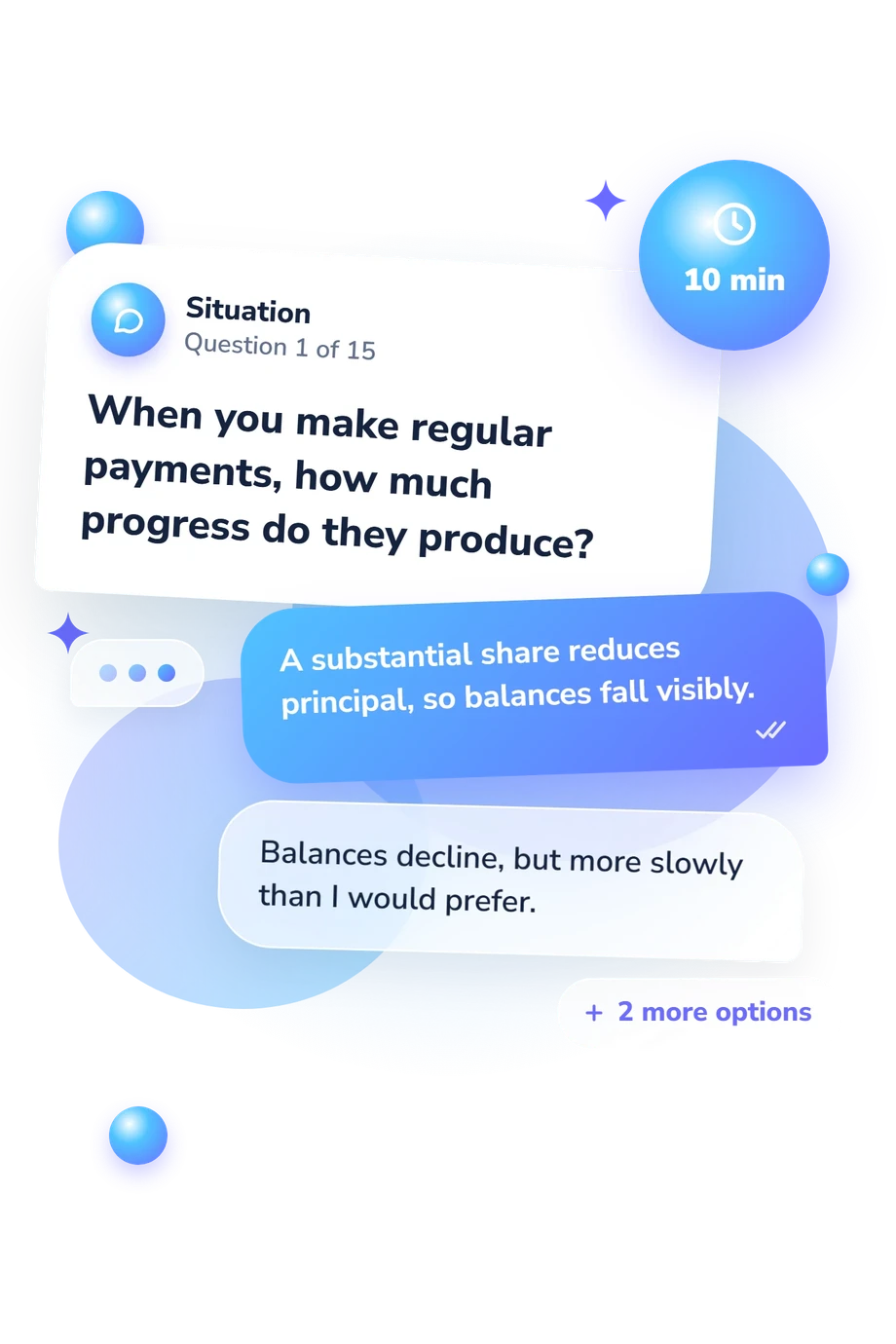
- A substantial share reduces principal, so balances fall visibly.
- Balances decline, but more slowly than I would prefer.
- Most of the payment is absorbed by interest or fees.
- Even with payments, interest, fees, or new borrowing cause balances to rise.
- I have not yet assembled a reliable overview.
- I have rough totals from memory or a few recent accounts.
- I have most statements and can estimate the missing details.
- I have organized, current records covering the main categories.
- I can cover them consistently without relying on new debt.
- I usually cover them, but the margin is narrow.
- I miss or delay some payments to cover others.
- I routinely cannot cover the required minimums.
Should I File Bankruptcy Quiz - Description and methodology of the test
People facing persistent debt can use the Should I File Bankruptcy Quiz to organize the facts that matter before seeking individualized guidance. It is intended for anyone reviewing payment strain, repayment prospects, collections, and possible next steps. This bankruptcy quiz can turn a broad concern into focused questions about affordability, records, deadlines, and the kind of help to pursue.
What This Assessment Explores
Your responses are organized into distinct areas for review rather than a yes-or-no filing instruction. For someone asking whether they should declare bankruptcy, this is a should i declare bankruptcy quiz designed to identify records, tradeoffs, and questions for case-specific advice. It is suited to a person trying to turn scattered bills, collection contacts, or uncertain payoff prospects into a clearer agenda for next steps.
The displayed result organizes your answers into these practical areas:
- Bankruptcy Consultation Readiness (0-15) measures preparation for case-specific guidance: Early exploration (0-5), Building clarity (6-10), or Ready for detailed review (11-15).
- Immediate Debt Pressure (0-15) reflects current payment and collection strain: Limited pressure (0-5), Significant strain (6-10), or Intense pressure (11-15).
- Repayment Feasibility Barriers (0-15) reflects obstacles to repaying debt while covering essentials: Plausible repayment path (0-5), Uncertain repayment path (6-10), or Major repayment barriers (11-15).
Methodology and Evidence Base
Each self-report item offers four choices, so this bankruptcy readiness quiz moves from manageable circumstances to greater pressure, fewer resources, or stronger preparation. Topics include payment progress, unexpected expenses, debt changes, essentials, collections, records, past efforts, and bankruptcy tradeoffs. Across the dimensions, choices indicate manageable repayment, growing barriers, current strain, or preparation to use advice.
Responses are organized into the displayed dimensions, but the questionnaire does not document a scoring algorithm or standardized norms. Because it is a current self-report with unvalidated bands, context, record accuracy, and self-awareness can affect the result, which cannot establish eligibility, a filing recommendation, or legal, financial, or court outcomes.
Conceptually, its debt-related themes are consistent with Fay, Hurst, and White (2002) on household bankruptcy decisions, Gross and Souleles (2002) on delinquency and bankruptcy behavior, and Anderloni, Bacchiocchi, and Vandone (2012) on household financial vulnerability. Those studies contextualize debt pressure, delinquency, and vulnerability; they do not validate this questionnaire or its consultation-readiness organization as a published readiness instrument.
Use the result to prioritize records and questions about assets, debts, income, exemptions, local law, and deadlines.
- Fay, Scott, Erik Hurst, and Michelle J. White. 2002. "The Household Bankruptcy Decision." American Economic Review 92(3): 706-718. 10.1257/00028280260136327
- Gross, David B., and Nicholas S. Souleles. 2002. "An Empirical Analysis of Personal Bankruptcy and Delinquency." Review of Financial Studies 15(1): 319-347. 10.1093/rfs/15.1.319
- Anderloni, Luisa, Emanuele Bacchiocchi, and Daniela Vandone. 2012. "Household Financial Vulnerability: An Empirical Analysis." Research in Economics 66(3): 284-296. 10.1016/j.rie.2012.03.001
Updated: