
Sexual Harassment Quiz
How the Scales are Structured
Who Usually Takes This Test?
See How You Compare
Below is a preview of how scores are typically distributed across each scale.
Example Questions From the Test
- Only a direct supervisor who controls pay or promotion decisions
- People in different workplace roles, including coworkers, supervisors, clients, customers, or contractors
- Only employees who work at the same physical location
- Only someone who has previously received a formal warning
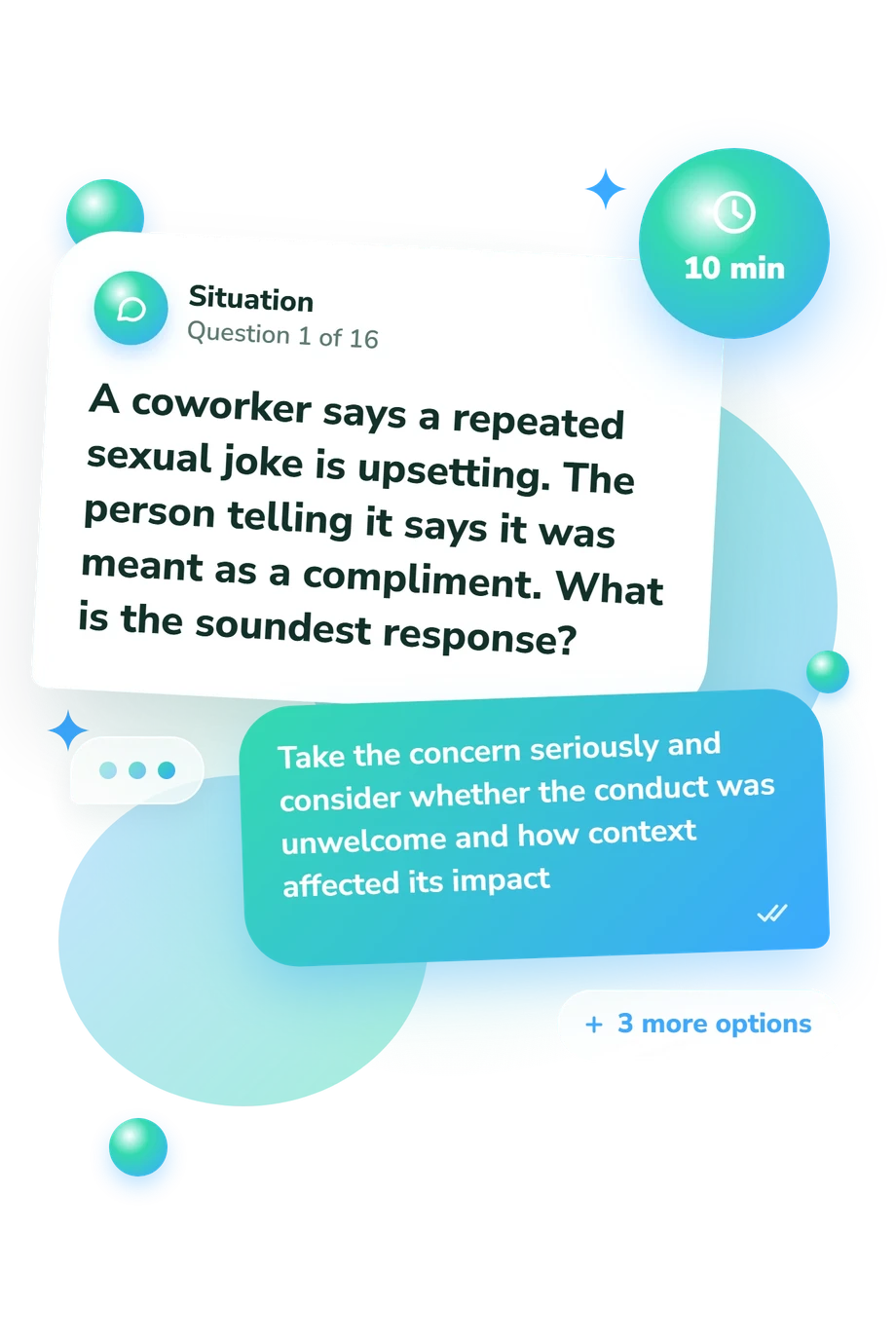
- Take the concern seriously and consider whether the conduct was unwelcome and how context affected its impact
- Treat the positive intention as decisive unless the joke included a threat
- Wait to respond until several other employees raise the same concern
- Assume the issue is only a personality conflict because no insult was intended
- Ordinary performance management
- Quid pro quo harassment involving a work benefit and requested sexual or romantic cooperation
- A consensual workplace friendship
- A hostile environment caused only by repeated offensive jokes
Sexual Harassment Quiz - Description and methodology of the test
People who want to test how they would reason through ambiguous workplace situations can use this workplace sexual harassment assessment for learning or personal reflection. The sexual harassment quiz presents scenarios about boundaries, reporting, and prevention, asking readers to weigh context rather than rely on intent alone. Its broad knowledge band can point to workplace-prevention topics worth revisiting.
What This Assessment Explores
These questions examine unwelcome sexual or sex-based behavior in context: power, repeated conduct, digital communication, working conditions, and support options. Together, they make the assessment a sexual harassment training quiz for readers seeking prevention knowledge.
The single result is Sexual Harassment Knowledge (0-16), giving a broad level rather than a score for each topic: Foundations to build (0-6), Developing knowledge (7-12), and Strong knowledge (13-16). The total shows broad knowledge, while questions prompt review of context, consent, authority, and reporting. This educational score is not a legal conclusion; laws and policies vary.
The result covers three connected areas:
- Recognition and context: it weighs setting, frequency, severity, impact, and the gap between intent and effect.
- Power, boundaries, and retaliation: it reflects authority differences, pressure for benefits, later boundaries, and adverse treatment after reporting.
- Bystander, documentation, and reporting: it reflects supportive action, accurate records, alternative routes, and digital conduct at work.
Methodology and Scientific Basis
The questionnaire uses short workplace scenarios and definitions with multiple answer choices, asking respondents to apply principles to context.
Its coverage is conceptually consistent with the sexual-harassment education study by Bingham and Scherer, harassment-myths work by Lonsway, Cortina, and Magley, bystander-intervention research by Liang and Park, and the EEOC framework. It is not an adaptation or validation of those works.
The answer choices contrast plausible but incomplete readings with responses that account for context, boundaries, and available support. Used as a workplace sexual harassment test, the format invites review of why one option fits better than another.
It presents educational score bands and does not state how answer options contribute to the total. Prior training, interpretations of ambiguous scenarios, guessing, and the lack of a separate score for each topic can affect the result. No item-level profile is displayed, so the total cannot show which single topic produced an error. A single experience may still warrant documentation and support.
- Bingham, Shereen G., and Lisa L. Scherer. (2001). The Unexpected Effects of a Sexual Harassment Educational Program. The Journal of Applied Behavioral Science, 37(2), 125-153. 10.1177/0021886301372001
- Lonsway, Kimberly A., Lilia M. Cortina, and Vicki J. Magley. (2008). Sexual Harassment Mythology: Definition, Conceptualization, and Measurement. Sex Roles, 58(9-10), 599-615. 10.1007/s11199-007-9367-1
- Liang, Yijue, and YoungAh Park. (2025). A Spectrum of Bystander Actions: Latent Profile Analysis of Sexual Harassment Intervention Behavior at Work. Journal of Applied Psychology, 110(9), 1198-1224. 10.1037/apl0001280
- Feldblum, Chai R., and Victoria A. Lipnic. (2016). Final Report of the EEOC Select Task Force on the Study of Harassment in the Workplace. U.S. Equal Employment Opportunity Commission.
Updated: