
Vividness of Visual Imagery Scale (VVIQ) Test
How the Scales are Structured
Who Usually Takes This Test?
See How You Compare
Below is a preview of how scores are typically distributed across each scale.
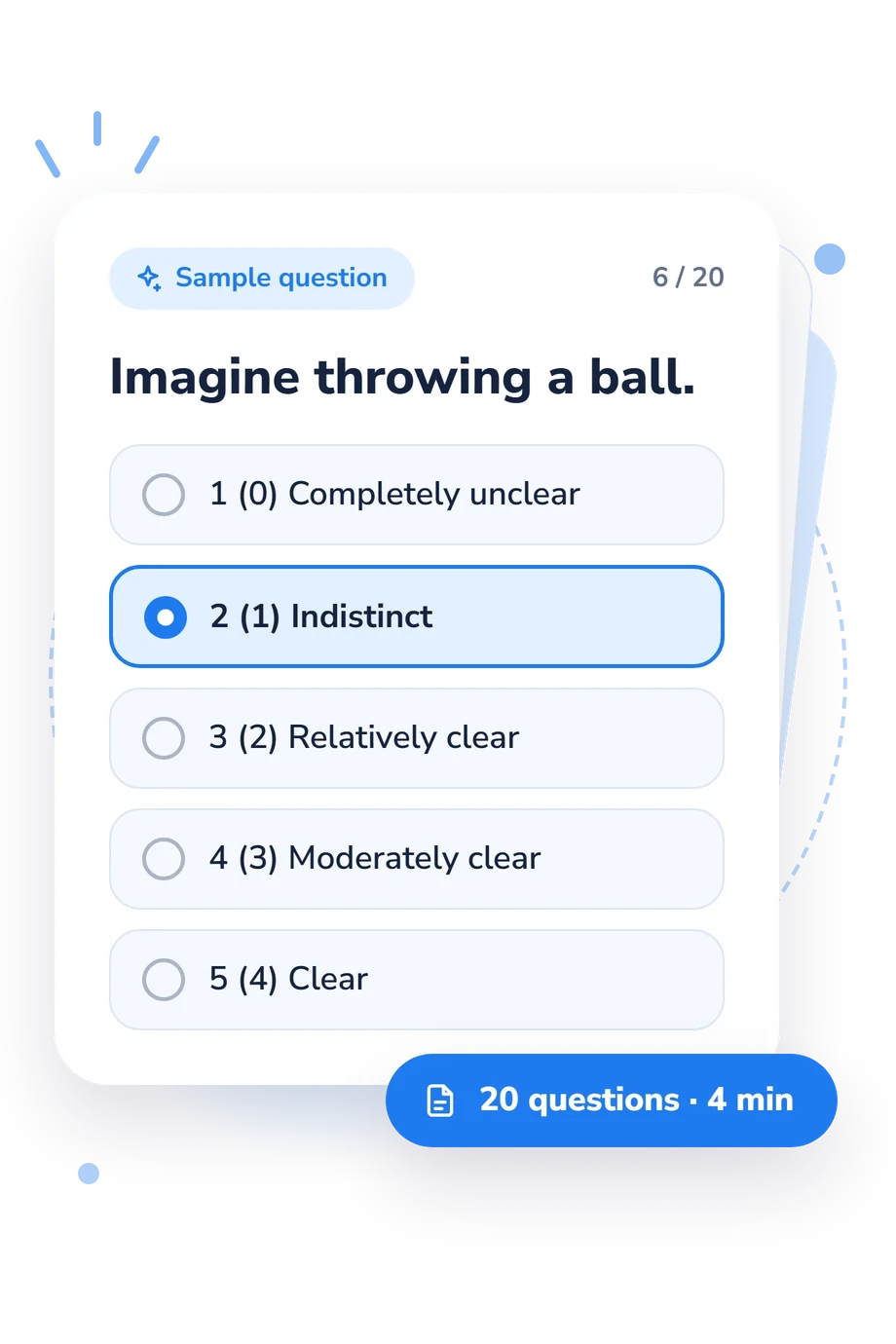
Example Questions From the Test
- (0) No image at all
- (1) Vague and dim
- (2) Moderately clear and vivid
- (3) Clear and reasonably vivid
- (4) Perfectly clear and as vivid as normal vision
- 1 (0) No image at all
- 2 (1) Dim and vague
- 3 (2) Moderately clear
- 4 (3) Clear
- 5 (4) Perfectly clear and as vivid as normal vision
- 1 (0) No image at all / completely unclear
- 2 (1) Vague and dim
- 3 (2) Moderately clear
- 4 (3) Clear
- 5 (4) Perfectly clear and as vivid as normal vision
Vividness of Visual Imagery Scale (VVIQ) Test - Description and methodology of the test
People who want to understand how readily they can construct inner scenes, sounds, sensations, tastes, and smells may find this questionnaire useful for structured self-reflection. The Vividness of Visual Imagery Scale (VVIQ) Test places those experiences on a common response continuum. As a mental imagery test, it offers an overall indication of clarity rather than a judgment about creativity, intelligence, or mental health.
What This Assessment Explores
Prompts cover people and objects, remembered places, imagined movement, and sensory experiences. They ask how clearly a person can generate and maintain representations without the real stimulus. The focus is subjective vividness, not artistic skill or factual detail.
The item groups provide different situations in which imagery vividness is rated:
- Visual scenes and people provide situations for rating the clarity of faces, objects, and places in the mind.
- Auditory experiences provide situations for rating the clarity of imagined sounds.
- Tactile and bodily experiences provide situations for rating imagined touch, temperature, weight, and movement.
- Taste and smell provide situations for rating imagined flavors and odors.
Vividness of Visual Imagery: 0-80 assesses the ability to generate and maintain vivid, clear mental images. Results are Low clarity (0-30), Moderate clarity (31-60), or High clarity (61-80). As a visual imagery assessment, it estimates individual differences in imagery-based thinking.
Methodology and Scientific Basis
Each prompt asks the respondent to imagine an experience and choose one of five descriptions, from no image to an experience as vivid as normal perception. The response values are ordered from 0 to 4; the result expresses reported vividness rather than a measured amount of sensory intensity.
Betts' Questionnaire upon Mental Imagery (QMI) and Sheehan's shortened QMI provide conceptual comparisons for its varied sensory prompts, not a stated source or structural template for this online questionnaire. White, Ashton, and Brown reported normative and modality differences, while White, Ashton, and Law examined presentation format and item order. Paivio's imagery-and-verbal framework provides theoretical context for treating mental representations as relevant to thought.
This mental imagery questionnaire is a self-report estimate, with no documented norms or standardization for this form. Interpret the result as a self-report estimate of vividness of mental images in the situations prompted. Attention, memory, mood, familiarity, and response style can affect ratings. The displayed bands are descriptive labels rather than validated normative categories, so consider the score alongside the person's own examples and context rather than as a diagnosis.
- Sheehan, Peter Winston (1967). A shortened form of Betts' Questionnaire upon Mental Imagery. Journal of Clinical Psychology, 23(3), 386-389. 10.1002/1097-4679%28196707%2923%3A3%3C386%3A%3AAID-JCLP2270230328%3E3.0.CO%3B2-S
- White, K. D., Ashton, R., and Brown, R. M. D. (1977). The measurement of imagery vividness: Normative data and their relationship to sex, age, and modality differences. British Journal of Psychology, 68(2), 203-211. 10.1111/j.2044-8295.1977.tb01576.x
- White, K. D., Ashton, R., and Law, H. (1978). The measurement of imagery vividness: Effects of format and order on the Betts' Questionnaire Upon Mental Imagery. Canadian Journal of Behavioural Science, 10(1), 68-78. 10.1037/h0081537
- Paivio, Allan (1971). Imagery and Verbal Processes. New York: Holt, Rinehart and Winston.
Updated: