
Self-Development Reflection Scale Test
How the Scales are Structured
Who Usually Takes This Test?
See How You Compare
Below is a preview of how scores are typically distributed across each scale.
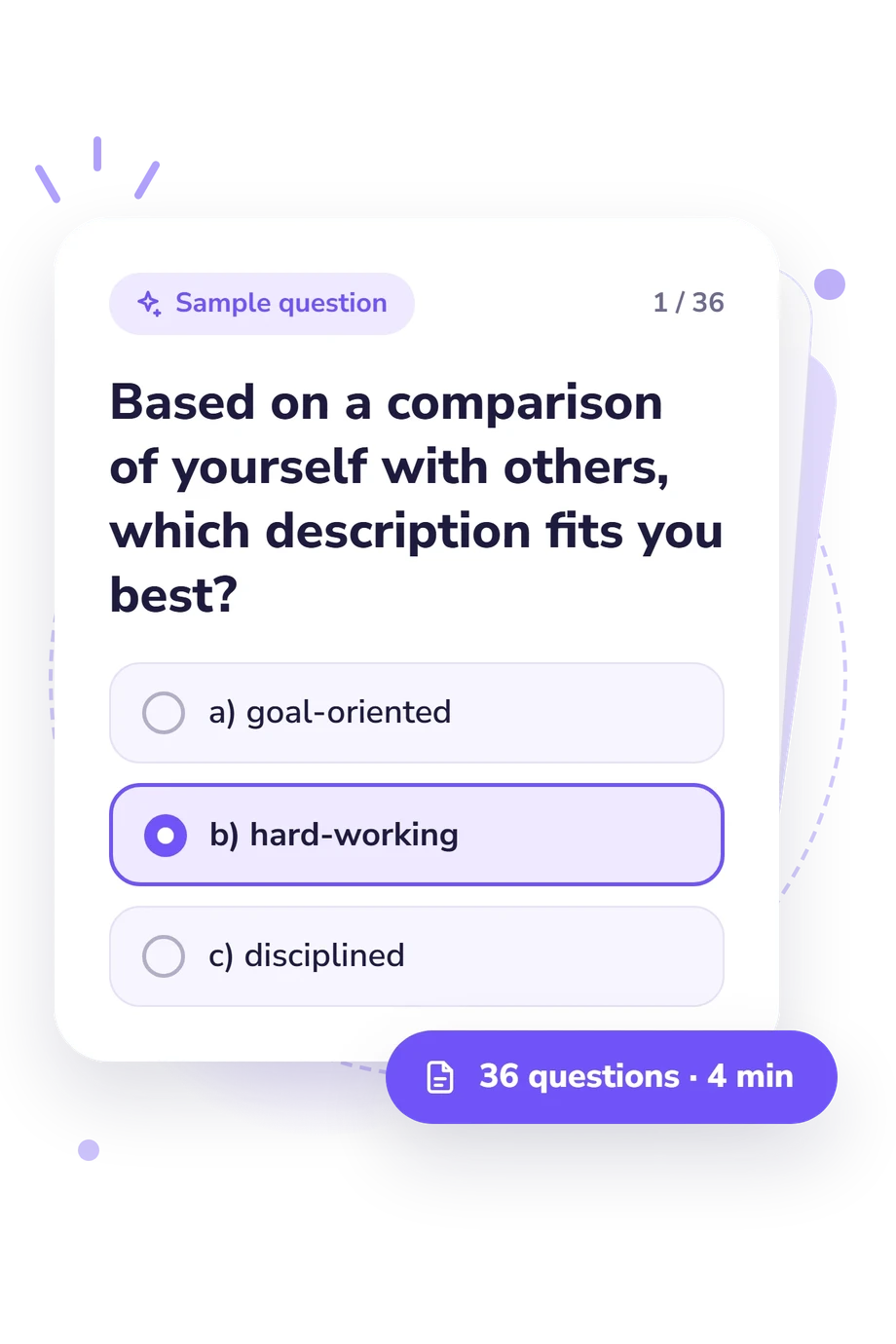
Example Questions From the Test
- Goal-oriented
- Hardworking
- Disciplined
- For being responsible
- For standing my ground and not changing my decisions
- For being knowledgeable and an interesting conversational partner
- I think it is a waste of time
- I have not looked into the issue in depth
- I feel positive about it and actively take part in the project
Self-Development Reflection Scale Test - Description and methodology of the test
People considering a new professional direction can use this self-development questionnaire to examine how motivation, self-evaluation, and attitudes toward educational or professional activity shape their view of development. The Self-Development Reflection Scale Test helps a respondent connect everyday choices, aspirations, and perceived obstacles with a clearer personal profile. The profile can support structured reflection before setting learning or career goals.
What This Assessment Explores
This assessment links self-evaluation with readiness to grow through educational or professional activity. The items address personal qualities, obstacles, interests, future potential, and attitudes toward a teacher-support project. The three-dimensional self-development profile combines project appraisal, self-esteem, and striving for self-development rather than measuring one isolated ability.
Three dimensions organize the result:
- Pedagogical Support Project Appraisal (5-15) describes whether the project is seen as a promising opportunity for professional self-realization: Skeptical (5-8), Mixed/Neutral (9-11), or Positive (12-15).
- Self-Esteem (6-18) measures confidence in qualities supporting development: Low/Uncertain (6-12), Moderate (13-15), or High (16-18).
- Level of Striving for Self-Development (18-56) measures the desire to improve and realize potential: Low (18-35), Moderate (36-45), or High (46-56).
Read together, the dimensions show how project appraisal, confidence, and motivation align.
Methodology and Scientific Basis
The questionnaire uses concise self-report prompts with three answer choices. Items ask the respondent to choose a fitting quality, reaction, role, aspiration, or obstacle, so the method is reflective rather than performance-based. A professional self-development assessment of this kind depends on honest choices and reasonably accurate self-awareness.
The result is presented across three displayed dimensions and interpreted through the listed result bands. These dimensions describe the respondent's current perspective, including views of opportunity, self-evaluation, and persistence, rather than a fixed prediction about future decisions.
Conceptually, the closest named source is Reflection on Self-Development (Berezhnova, 2000). Fetiskin, Kozlov, and Manuilov (2002) provide a broader framework for socio-psychological assessment of personality development, while Yakymchuk and Kazachenok (2018) adds related context from teacher education. These works support the construct context, but do not establish standardization for this online version.
Interpret the profile alongside real experience, goals, and learning conditions. Mood, social desirability, limited self-awareness, or unfamiliarity with the project may affect answers, and no normative data or clinical cutoffs are stated for this online version.
- Berezhnova, L. N. Theoretical Foundations for Preventing Deprivation in the Educational Process: Doctoral Dissertation in Pedagogical Sciences. Saint Petersburg: Herzen Russian State Pedagogical University, 2000, 435 pp.
- Fetiskin, N. P., Kozlov, V. V., and Manuilov, G. M. Socio-Psychological Diagnostics of Personality Development and Small Groups: A Tutorial. Moscow: Institute of Psychotherapy, 2002.
- Yakymchuk, N. V., and Kazachenok, V. V. Developing Cognitive Independence of Future Informatics Teachers by Multimedia Tools. European Journal of Contemporary Education, 2018, 7(3), 581-597. 10.13187/ejced.2018.3.581
Updated: