
Personal Religiosity Scale (SPR) Test
How the Scales are Structured
Who Usually Takes This Test?
See How You Compare
Below is a preview of how scores are typically distributed across each scale.
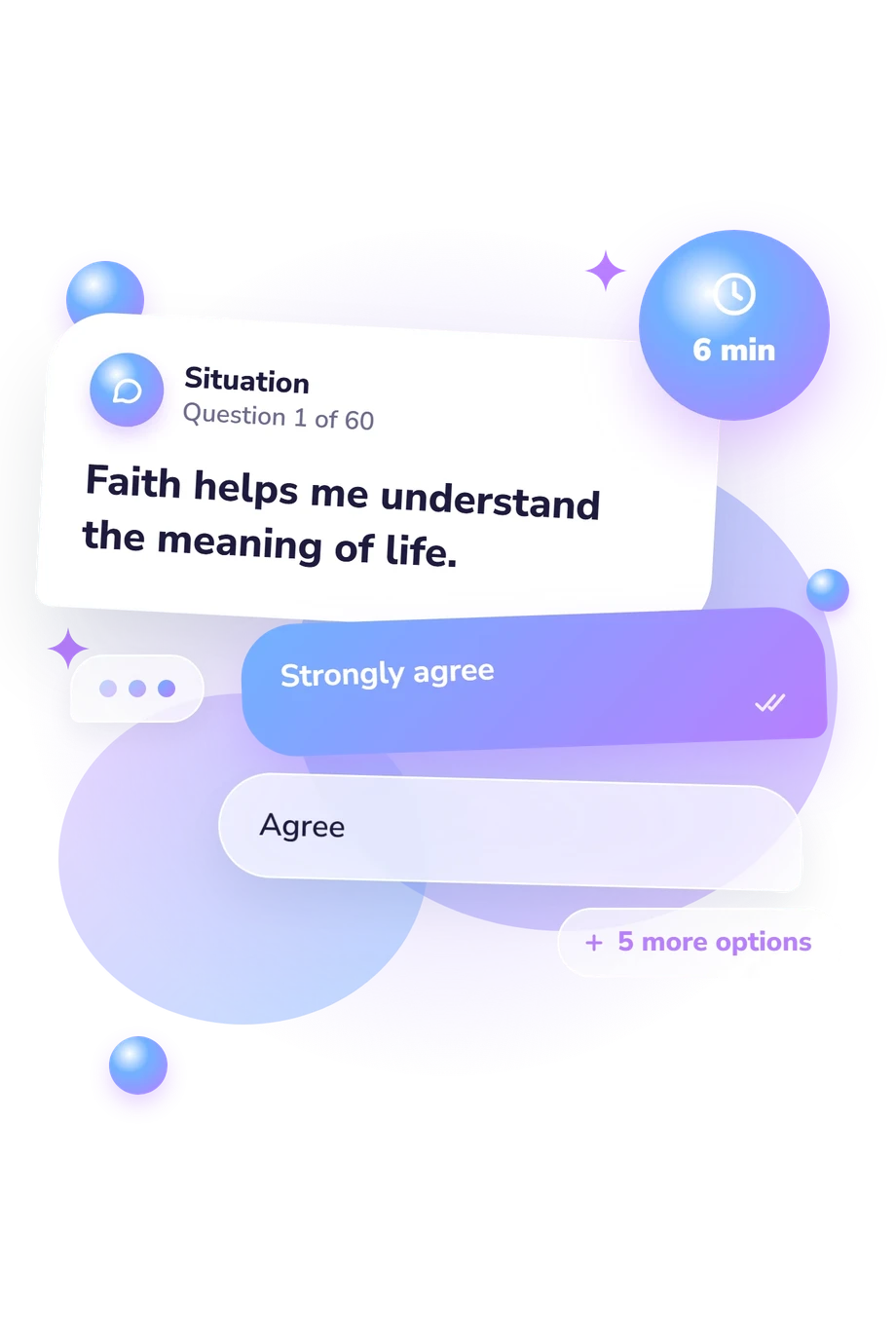
Example Questions From the Test
- Completely agree
- Agree
- Somewhat agree
- Neither agree nor disagree
- Somewhat disagree
- Disagree
- Completely disagree
- Strongly agree
- Agree
- Somewhat agree
- Neither agree nor disagree
- Somewhat disagree
- Disagree
- Strongly disagree
- Strongly agree
- Agree
- Somewhat agree
- Neither agree nor disagree
- Somewhat disagree
- Disagree
- Strongly disagree
Personal Religiosity Scale (SPR) Test - Description and methodology of the test
People who want to examine how belief shapes identity, choices, and daily life may use the Personal Religiosity Scale (SPR) Test as a structured self-reflection exercise. It is intended for respondents seeking a personal profile rather than a theological judgment. As a religiosity test, it brings together conviction, practice, moral orientation, and felt connection with God.
What This Assessment Explores
The personal religiosity scale reflects religious belief and belonging; higher scores indicate stronger orientation, not superiority. References to God, prayer, church, and Christian identity suit respondents in this framework; definitions remain broader.
The displayed dimensions are:
- Religious Self-Concept (6-42) measures religious identification: Low religious identity 6-17; Moderate religious identity 18-29; High religious identity 30-42.
- Religious Practices (9-63) measures participation: Low participation 9-26; Moderate participation 27-44; High participation 45-63.
- Morality (7-49) measures integration of religious ethics: Low integration 7-21; Moderate integration 22-35; High integration 36-49.
- Faith (8-56) measures conscious religious conviction: Lower faith conviction 8-24; Moderate faith conviction 25-40; Strong faith conviction 41-56.
- Personal Religiosity (30-210) combines beliefs, morality, practices, and identity: Low religiosity 30-89; Moderate religiosity 90-149; High religiosity 150-210.
Methodology and Scientific Basis
Each statement uses a seven-point agreement scale from strong agreement through a neutral midpoint to strong disagreement. Items address belief, prayer, contemplation, church involvement, moral choices, views of God, and felt connection with the divine. Responses form dimension totals and an overall score; the displayed bands classify the resulting ranges, not the contribution of each answer.
Jaworski’s Scale of Personal Religiousness (SPR) is the source instrument. This questionnaire is an online English translation of Jaworski’s original instrument; research by Noworol and Głaz examines links among religiosity, personality, and maturity.
Results are best read as a pattern: stronger overall orientation can coexist with less regular practice, while active practice can exceed felt conviction. This questionnaire also functions as a religious identity test, while capturing self-reported tendencies at the time of answering, so current context matters. The bands organize this questionnaire’s scores and are not population norms or universal cutoffs.
Honesty, memory, current circumstances, and interpretation of religious language can affect responses. The result does not establish clinical status or diagnosis and should be considered alongside broader personal or psychological context.
- Jaworski, Romuald. (2012). Personal and Impersonal Religiousness: A Psychological Model and Its Empirical Verification. Christian Psychology Around the World EMCAPP Journal, 1, 46-55.
- Jaworski, Romuald. (1989). Psychological Correlates of Personal Religiousness. Doctoral dissertation. Lublin: Catholic University of Lublin Press. ISBN 83-228-0167-X.
- Noworol, Anna M., and Stanisław Głaz. (2021). Religiosity, Personality and Maturity. Journal for Perspectives of Economic, Political and Social Integration, 27(2), 114-141. DOI 10.18290/pepsi-2021-0010
Updated: