
Freudly+971 508685814hello@freudly.ai
Freudly
religiosity

Centrality of Religiosity Scale (CRS) Test
Take the online Centrality of Religiosity Scale (CRS) Test - AI psychologist FreudlyYou can take Centrality of Religiosity Scale (CRS) Testhere. Online version of a simple and accurate psychological test with interpretation.en
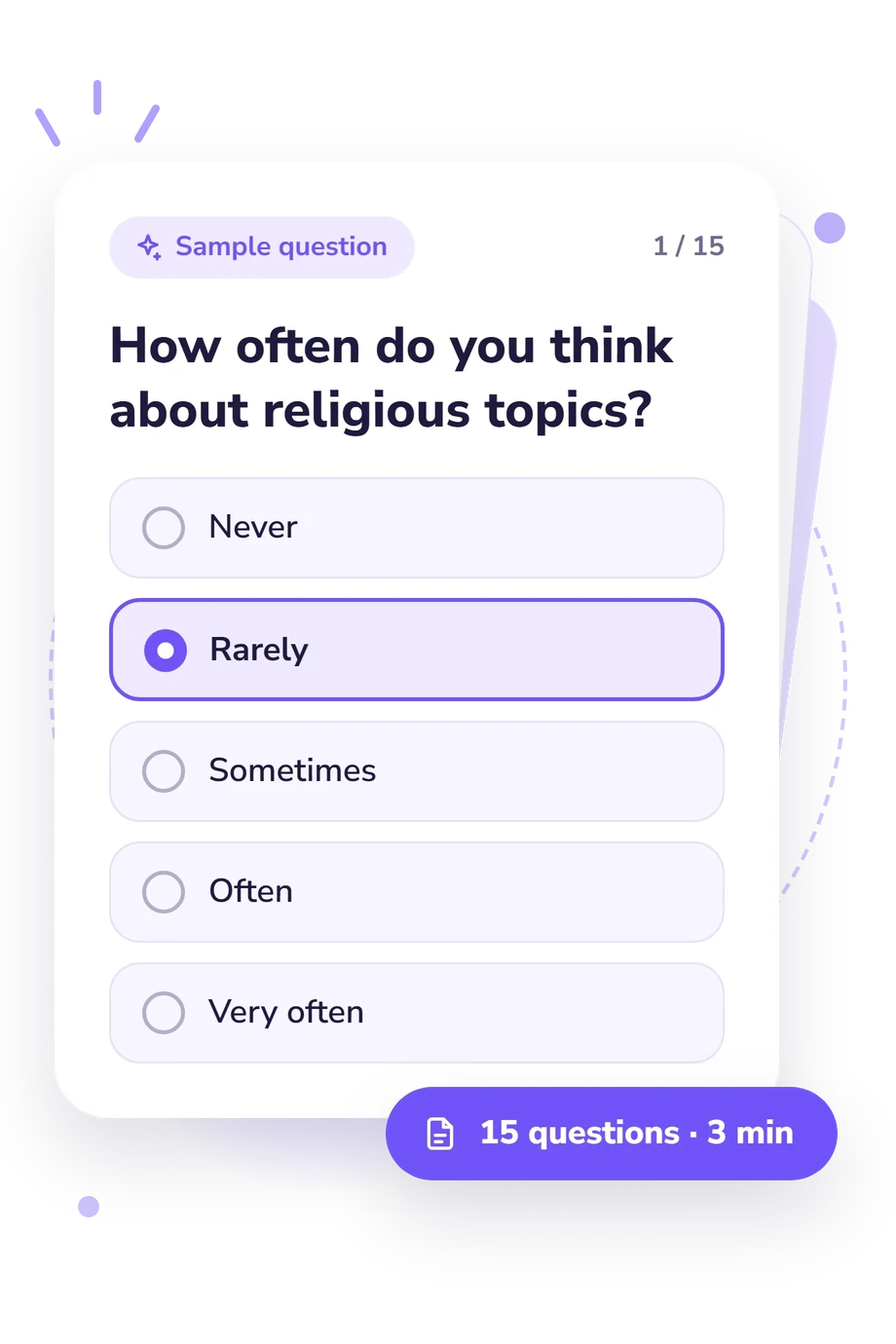
Understand how central religion is in your life and how it shapes your values in about 3 minutes. This 15 question measure is brief, research trusted worldwide, and useful for counseling and studies.
Start Online Test
Questions: 153 minutes
08:30
October 2, 2025
October 2, 2025
Material has been updated
October 2, 2025
Material has been published
23,761 view
2,607 completions
2,083 likes
Verified by Daniel Hall
Psychologist with 25 years of experience
Share
Scale Explorer

How the Scales are Structured

example score
3/5
Experience (E)
Measures how often and how intensely a person reports experiences of contact with a higher reality in personal or collective contexts.
Low
Moderate
High
12.1: Low | 2.23.9: Moderate | 45: High
A score of 3 falls in the Moderate range, suggesting occasional or moderately intense religious experiences of contact with a higher reality.
example score
4/5
Personal Practice (PP)
Personal Practice measures how often and how strongly a person engages in private religious activities such as prayer or meditation outside public rituals.
Low
Moderate
High
12.1: Low | 2.23.9: Moderate | 45: High
A score of 4 indicates high personal religious practice, suggesting private activities like prayer or meditation are a regular part of everyday life.
example score
3/5
Public Practice (PP)
Public practice measures how often a person participates in shared religious rituals and community events.
Low
Moderate
High
12.1: Low | 2.23.9: Moderate | 45: High
A score of 3 indicates a moderate level of involvement in collective religious practices, suggesting occasional participation in community rituals or events.
example score
3/5
Ideological (I)
Measures how strongly a person affirms and relies on beliefs about transcendent reality as part of their worldview.
Low
Moderate
High
12.1: Low | 2.23.9: Moderate | 45: High
A score of 3 indicates a moderate level of ideological religiosity, with religious beliefs playing a meaningful but not dominant role in the person’s worldview.
example score
3/5
Intellectual (I)
Measures how often and how deeply a person reflects on religious topics and seeks or holds knowledge about religion, independent of affiliation.
Low
Moderate
High
12: Low | 2.13.8: Moderate | 3.95: High
A score of 3 indicates a moderate level of intellectual engagement with religious content, with occasional interest and reflection but not a consistently central focus.
example score
2/5
Centrality of Religiosity Scale (CoRS)
Measures how central religion is in a person’s life across beliefs, practices, and everyday experiences.
Low centrality
Moderate centrality
High centrality
12: Low centrality | 2.13.9: Moderate centrality | 45: High centrality
A score of 2 indicates low centrality, suggesting religion tends to play a more peripheral role in your daily thinking and behavior.
Start Online Test
just completed the test
DATA-BASED USER COHORTS

Who Usually Takes This Test?

Religion-oriented seekers
41%OF USERS
People who want to understand how central faith is in their daily choices, values, and sense of meaning.
Psychology and counseling clients
34%OF USERS
Clients and practitioners who need a quick snapshot of how strongly religious beliefs and practices shape coping and identity.
Students and researchers
25%OF USERS
Students and academics using a short, standardized measure of religiosity for surveys, theses, or cross-cultural comparisons.
BASED ON AGGREGATED, ANONYMIZED DATA FROM TENS OF THOUSANDS OF FREUDLY USERS.
Benchmarking

See How You Compare

Once you complete the test, your results are compared with real-world data from people in your country.
Below is a preview of how scores are typically distributed across each scale.
Experience (E)
Experience (E)
Average
3
Normal range
2.53.5
min.
1
max.
5
This curve shows how scores are typically distributed.
Once you complete the test, your result will appear on the scale so you can see how you compare.
Personal Practice (PP)
Average
2.7
Normal range
23.4
min.
1
max.
5
This curve shows how scores are typically distributed.
Once you complete the test, your result will appear on the scale so you can see how you compare.
Public practice (Pp)
Average
2.7
Normal range
2.13.4
min.
1
max.
5
This curve shows how scores are typically distributed.
Once you complete the test, your result will appear on the scale so you can see how you compare.
Ideological (I)
Ideological (I)
Average
3.1
Normal range
2.63.7
min.
1
max.
5
This curve shows how scores are typically distributed.
Once you complete the test, your result will appear on the scale so you can see how you compare.
Intellectual (I)
Intellectual (I)
Average
3.3
Normal range
2.73.8
min.
1
max.
5
This curve shows how scores are typically distributed.
Once you complete the test, your result will appear on the scale so you can see how you compare.
Centrality of Religiosity Scale (CoRS)
Average
4
Normal range
3.24.7
min.
1
max.
5
This curve shows how scores are typically distributed.
Once you complete the test, your result will appear on the scale so you can see how you compare.
Featured On
SAMPLE QUESTIONS

Example Questions From the Test

    • Never
    • Rarely
    • Sometimes
    • Often
    • Very often
    • Not at all
    • Slightly
    • Moderately
    • Quite strongly
    • Very strongly
    • More often than once a week
    • Once a week
    • One to three times a month
    • Several times a year
    • Less often
    • Never
WHAT THE TEST MEASURES
About This Assessment
Religious Centrality Scale, CRS Test

Centrality of Religiosity Scale (CRS) Test - Symptoms and Signs

religiosity

This brief self-report measure evaluates the extent to which religious meanings are central within an individual’s personality and everyday life. The Centrality of Religiosity Scale (CRS) is intended for use in research and clinical assessment when understanding the salience of religiosity may inform case formulation.

The measure includes 15 items and typically takes about 3 minutes to complete. Items assess multiple facets of religiosity (e.g., engagement with religious practices, frequency of religious thoughts, and the perceived importance of religion in personal values and decision-making), allowing for a concise profile of how strongly religious content influences cognition and behavior. The Centrality of Religiosity Scale (CRS) was developed by Stefan Huber and Odilo W. Huber and has been used in cross-cultural contexts; interpretation should consider cultural and denominational background as well as the respondent’s self-identified religious affiliation.

Author: Odilo W. Huber, Stefan Huber
Literature: Hill, P. C., & Hood, R. W., Jr. Measures of religiosity. Religious Education Press. 1999.; Huber, S., & Huber, O. W. The centrality of religiosity scale (CRS). Religions. 2012.
Popular tests
Comments
Leave a Comment