
Freudly+971 508685814hello@freudly.ai
Freudly
family roles

Partner Role Expectations Questionnaire Test
Take the online Partner Role Expectations Questionnaire Test - AI psychologist FreudlyYou can take Partner Role Expectations Questionnaire Testhere. Online version of a simple and accurate psychological test with interpretation.en
In 7 minutes, see how each partner expects roles in intimacy, parenting, chores, and support. Compare answers to spot mismatches and reduce day to day friction fast.
Start Online Test
Questions: 367 minutes
08:30
October 2, 2025
October 2, 2025
Material has been updated
October 2, 2025
Material has been published
32,661 view
3,687 completions
2,935 likes
Verified by Daniel Hall
Psychologist with 25 years of experience
Share
Scale Explorer

How the Scales are Structured

example score
5/9
Parental Responsibilities (PR)
Assesses how strongly parental responsibilities and the father's role are valued within the family role expectations.
Lower emphasis
Moderate emphasis
High emphasis
04: Lower emphasis | 56: Moderate emphasis | 79: High emphasis
A score of 5 indicates a moderate emphasis on parental responsibilities, suggesting a balanced view of the importance of the father's role and parenthood in the family.
example score
5/9
Expectations (Household and Domestic Functions) (EaDF)
Measures the degree to which a partner expects to be actively involved in household chores and daily living responsibilities.
Low claims
Moderate claims
High claims
03: Low claims | 46: Moderate claims | 79: High claims
A score of 5 indicates moderate expectations of personal involvement in managing household chores, suggesting a willingness to share these responsibilities without insisting on taking primary control.
example score
5/9
Expectations (Household and Domestic Functions) (EaDF)
Measures how strongly a person expects their partner to take an active role in household tasks and management.
Low expectations
Moderate expectations
High expectations
03: Low expectations | 46: Moderate expectations | 79: High expectations
A score of 5 indicates moderate expectations for the partner’s involvement in household functions, suggesting a balanced but noticeable demand for shared responsibility.
example score
4/9
Household and Domestic Functions (HaDF)
Assesses how important a partner’s involvement and personal competence are considered in organizing and maintaining household and domestic tasks.
Low importance
Moderate importance
High importance
03: Low importance | 46: Moderate importance | 79: High importance
A score of 4 indicates a moderate emphasis on household and domestic functions, suggesting a balanced expectation for partner involvement and home-management skills.
example score
3/9
Role Aspirations (Importance of Physical Appearance) (RAoPA)
Measures how important physical appearance and fashionable self-presentation are in one’s role expectations within the relationship.
Low emphasis
Moderate emphasis
High emphasis
03: Low emphasis | 46: Moderate emphasis | 79: High emphasis
A score of 3 indicates a low emphasis on one’s own attractiveness and a relatively limited desire to dress fashionably as a role expectation.
example score
6/9
Expectations (Importance of Physical Appearance) (EoPA)
Measures how important having an externally attractive partner is within the respondent’s expectations of family roles.
Low importance
Moderate importance
High importance
03: Low importance | 46: Moderate importance | 79: High importance
A score of 6 indicates a moderate emphasis on a partner’s physical appearance as part of role expectations in the relationship.
example score
4/9
Importance of Physical Appearance (IoPA)
Measures how strongly a person values physical appearance and alignment with current fashion standards within partner role expectations.
Low importance
Moderate importance
High importance
03: Low importance | 46: Moderate importance | 79: High importance
A score of 4 indicates a moderate emphasis on physical appearance and some interest in meeting contemporary style norms, without this being a dominant priority.
example score
7/9
Role Expectations (Emotional and Psychotherapeutic Function) (REaPF)
Measures the extent to which a partner expects to take on the role of providing emotional and moral support within the family.
Low role demands
Moderate role demands
High role demands
03: Low role demands | 46: Moderate role demands | 79: High role demands
A score of 7 indicates high role demands, suggesting a strong expectation to be the primary source of emotional support and “family psychotherapist” in the relationship.
example score
5/9
Expectations (Emotional and Psychotherapeutic Function) (EaPF)
Measures how strongly a person expects their spouse to take the lead in providing emotional support and psychotherapeutic care within the family.
Low expectation
Moderate expectation
High expectation
03: Low expectation | 46: Moderate expectation | 79: High expectation
A score of 5 indicates a moderate expectation that the partner will act as an emotional leader, with shared responsibility likely seen as appropriate.
example score
4/9
Emotional and Psychotherapeutic Function (EaPF)
Measures how important mutual emotional support and a psychotherapeutic (comforting, stabilizing) function are expected to be in marriage.
Low importance
Moderate importance
High importance
03: Low importance | 46: Moderate importance | 79: High importance
A score of 4 indicates a moderate emphasis on emotional support in the relationship, suggesting it is valued but not seen as a primary marital function.
example score
5/9
Role Expectations (External Social Activity) (RESA)
Measures the strength of expectations for an active professional and social role within the family system.
Low claims
Moderate claims
High claims
03: Low claims | 46: Moderate claims | 79: High claims
A score of 5 indicates moderate role claims, suggesting a balanced need for professional realization and social activity alongside family roles.
example score
2/9
Expectations (External Social Activity) (ESA)
Measures how strongly a person expects their partner to pursue serious professional interests and maintain an active social role.
Low expectation
Moderate expectation
High expectation
03: Low expectation | 46: Moderate expectation | 79: High expectation
A score of 2 indicates a low expectation that the partner will be highly engaged in professional ambitions or external social activity.
example score
6/9
External Social Activity (ESA)
Measures how important external social activity (professional or public involvement) is considered for the stability of marital and family relationships.
Low importance
Moderate importance
High importance
03: Low importance | 46: Moderate importance | 79: High importance
A score of 6 indicates a moderate view that external social activity contributes to family stability, but it is not seen as the primary factor.
example score
6/9
Role Expectations (Parental Responsibilities) (RER)
Measures how strongly a partner expects to take personal responsibility for child-rearing within the family role structure.
Low claims
Moderate claims
High claims
04: Low claims | 56: Moderate claims | 79: High claims
A score of 6 indicates a moderate expectation to be personally involved in parenting responsibilities, with a willingness to share duties rather than assume them entirely.
example score
6/9
Expectations (Parental Responsibilities) (ER)
Measures how strongly a person expects their spouse to take an active role in parenting responsibilities within the family.
Low expectation
Moderate expectation
High expectation
03: Low expectation | 46: Moderate expectation | 79: High expectation
A score of 6 indicates a moderate expectation that the partner will be actively involved in parenting duties, with room for differing views on how responsibilities should be shared.
example score
3/9
Personal Identification (PI)
Measures the tendency to personally identify with a marital partner by expecting shared interests, needs, and values versus maintaining autonomy.
Autonomy-oriented
Balanced identification
Strong identification
03: Autonomy-oriented | 46: Balanced identification | 79: Strong identification
A score of 3 falls in the autonomy-oriented range, suggesting a preference for personal independence rather than expecting extensive overlap in interests, needs, and values with the partner.
example score
3/9
Sexual Relations (SR)
Measures how important sexual harmony is considered for marital satisfaction and well-being.
Low importance
Moderate importance
High importance
03: Low importance | 46: Moderate importance | 79: High importance
A score of 3 indicates that sexual relations are currently viewed as a lower-priority condition for marital happiness compared with other family functions.
Start Online Test
just completed the test
DATA-BASED USER COHORTS

Who Usually Takes This Test?

Couples in ongoing conflict
41%OF USERS
Partners who keep arguing about chores, parenting, intimacy, or support take it to pinpoint mismatched expectations and hidden tensions.
Pre-marriage or newlyweds
33%OF USERS
People starting a life together use it to compare role views early and prevent future misunderstandings about responsibilities and closeness.
Therapy or counseling clients
26%OF USERS
Couples already working with a specialist take it as a structured way to discuss and adjust family roles based on both partners’ answers.
BASED ON AGGREGATED, ANONYMIZED DATA FROM TENS OF THOUSANDS OF FREUDLY USERS.
Benchmarking

See How You Compare

Once you complete the test, your results are compared with real-world data from people in your country.
Below is a preview of how scores are typically distributed across each scale.
Parental Responsibilities (PR)
Average
5.1
Normal range
3.76.5
min.
0
max.
9
This curve shows how scores are typically distributed.
Once you complete the test, your result will appear on the scale so you can see how you compare.
Claims (Household and Daily Living Functions) (C(aDLF)
Average
4.1
Normal range
2.55.8
min.
0
max.
9
This curve shows how scores are typically distributed.
Once you complete the test, your result will appear on the scale so you can see how you compare.
Expectations (Household Functions) (E(F)
Average
6.1
Normal range
4.77.5
min.
0
max.
9
This curve shows how scores are typically distributed.
Once you complete the test, your result will appear on the scale so you can see how you compare.
Household and domestic functions (Hadf)
Average
5.2
Normal range
3.96.4
min.
0
max.
9
This curve shows how scores are typically distributed.
Once you complete the test, your result will appear on the scale so you can see how you compare.
Demands (Importance of Physical Appearance) (D(oPA)
Average
3.5
Normal range
2.34.8
min.
0
max.
9
This curve shows how scores are typically distributed.
Once you complete the test, your result will appear on the scale so you can see how you compare.
Expectations (Importance of Physical Appearance) (E(oPA)
Average
4.8
Normal range
3.26.4
min.
0
max.
9
This curve shows how scores are typically distributed.
Once you complete the test, your result will appear on the scale so you can see how you compare.
The Importance of Physical Appearance (TIoPA)
Average
4.5
Normal range
3.45.6
min.
0
max.
9
This curve shows how scores are typically distributed.
Once you complete the test, your result will appear on the scale so you can see how you compare.
Claims (Emotional-Psychotherapeutic Function) (C(F)
Average
5.7
Normal range
47.4
min.
0
max.
9
This curve shows how scores are typically distributed.
Once you complete the test, your result will appear on the scale so you can see how you compare.
Expectations (Emotional-Psychotherapeutic Function) (E(F)
Average
4
Normal range
2.65.4
min.
0
max.
9
This curve shows how scores are typically distributed.
Once you complete the test, your result will appear on the scale so you can see how you compare.
Emotional-Psychotherapeutic Function (EF)
Average
3.2
Normal range
2.14.4
min.
0
max.
9
This curve shows how scores are typically distributed.
Once you complete the test, your result will appear on the scale so you can see how you compare.
Claims (External Social Activity) (C(SA)
Average
3.2
Normal range
24.5
min.
0
max.
9
This curve shows how scores are typically distributed.
Once you complete the test, your result will appear on the scale so you can see how you compare.
Expectations (External Social Activity) (E(SA)
Average
4
Normal range
2.85.2
min.
0
max.
9
This curve shows how scores are typically distributed.
Once you complete the test, your result will appear on the scale so you can see how you compare.
External social activity (Esa)
Average
2.9
Normal range
1.34.6
min.
0
max.
9
This curve shows how scores are typically distributed.
Once you complete the test, your result will appear on the scale so you can see how you compare.
Claims (Parental Responsibilities) (C(R)
Average
3.3
Normal range
24.7
min.
0
max.
9
This curve shows how scores are typically distributed.
Once you complete the test, your result will appear on the scale so you can see how you compare.
Expectations (Parental Responsibilities) (E(R)
Average
6.7
Normal range
5.28.2
min.
0
max.
9
This curve shows how scores are typically distributed.
Once you complete the test, your result will appear on the scale so you can see how you compare.
Personal Identification (PI)
Average
5.9
Normal range
4.67.2
min.
0
max.
9
This curve shows how scores are typically distributed.
Once you complete the test, your result will appear on the scale so you can see how you compare.
Sexual Relationships (SR)
Average
3.7
Normal range
2.35.1
min.
0
max.
9
This curve shows how scores are typically distributed.
Once you complete the test, your result will appear on the scale so you can see how you compare.
Featured On
SAMPLE QUESTIONS

Example Questions From the Test

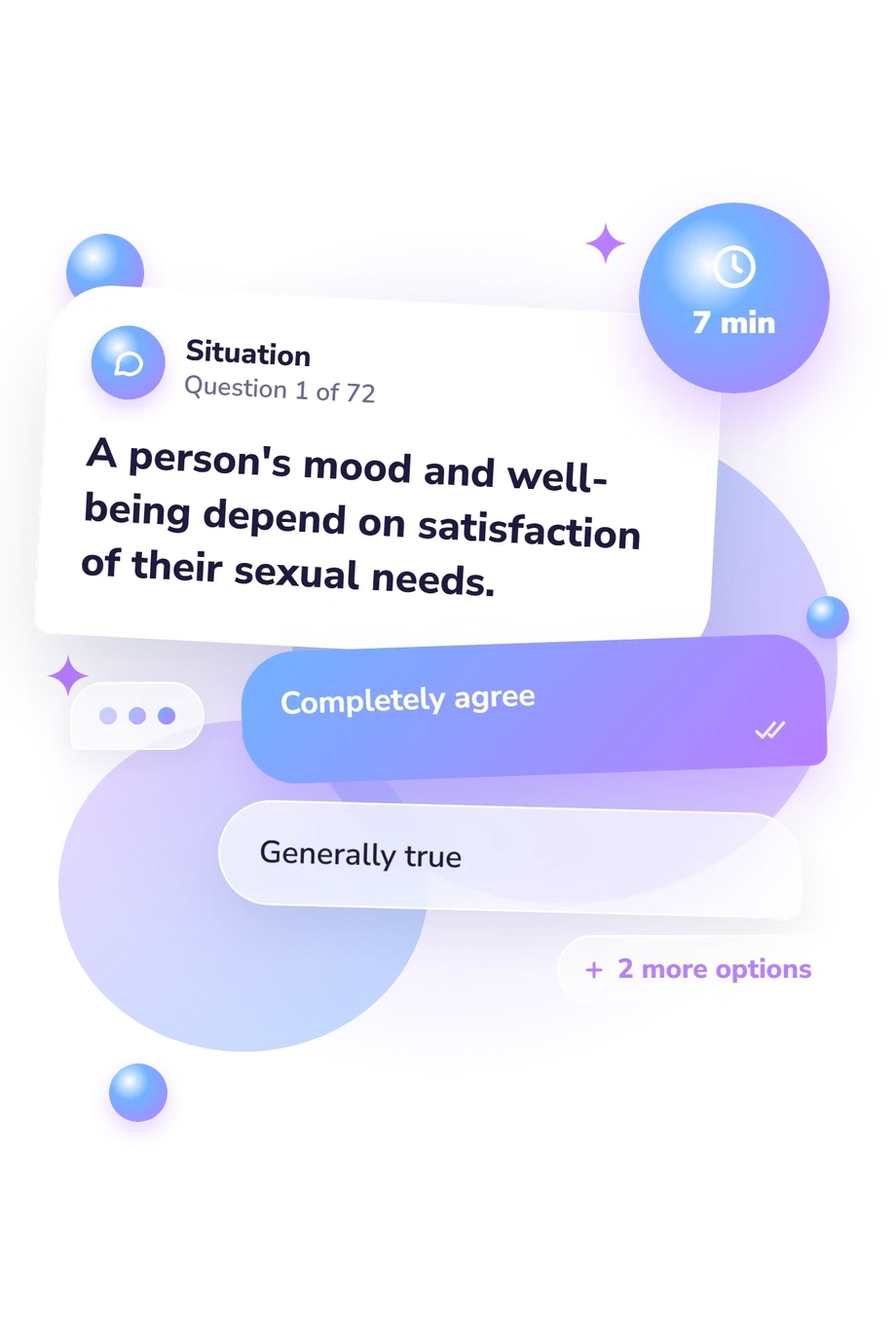
You will be presented with various statements about marriage, family, and the relationship between husband and wife. Please indicate the extent to which you agree or disagree with each statement. When selecting your response, please reflect your own personal views rather than what is commonly accepted among your relatives and friends.
    • Completely agree
    • Generally true
    • Not quite true
    • Not true
    • Completely agree
    • Generally true
    • This is not entirely true
    • This is not true
    • Completely agree
    • Generally true
    • Not really true
    • Not true
WHAT THE TEST MEASURES
About This Assessment
Partner Role Expectations, PRE Test

Partner Role Expectations Questionnaire Test - Symptoms and Signs

family roles
family

In couple or marital assessment, the Partner Role Expectations Questionnaire is used to elicit each partner’s expectations regarding roles and responsibilities within the relationship. It provides a structured way to compare partners’ views and identify areas of alignment or discrepancy that may be relevant to clinical formulation and treatment planning.

The measure includes 36 items and typically takes about 7 minutes to complete. Items query expectations across common domains of couple functioning (e.g., household responsibilities, parenting roles, emotional support, intimacy, and personal or professional interests), allowing the clinician to review patterns that may indicate potential sources of tension or unmet needs. Authorship is attributed to E. E. Filsinger and R. N. Wilson.

The Partner Role Expectations Questionnaire is most informative when both partners complete it, as results are interpreted by examining similarities and differences in reported expectations. Findings are generally used to guide collaborative discussion, clarify implicit assumptions, and support goal setting in couple-focused interventions.

Author: E. E. Filsinger, R. N. Wilson
Literature: Spanier, G. B. Measuring dyadic adjustment: New scales for assessing the quality of marriage and similar dyads. Journal of Marriage and the Family. 1976.; Bradbury, T. N., Fincham, F. D., & Beach, S. R. H. Research on the nature and determinants of marital satisfaction: A decade in review. Journal of Marriage and the Family. 2000.
Popular tests
Comments
Leave a Comment