
Kessler Psychological Distress Scale (K10) Test
How the Scales are Structured
Who Usually Takes This Test?
See How You Compare
Below is a preview of how scores are typically distributed across each scale.
Example Questions From the Test
- Never
- Rarely
- Sometimes
- Often
- All of the time
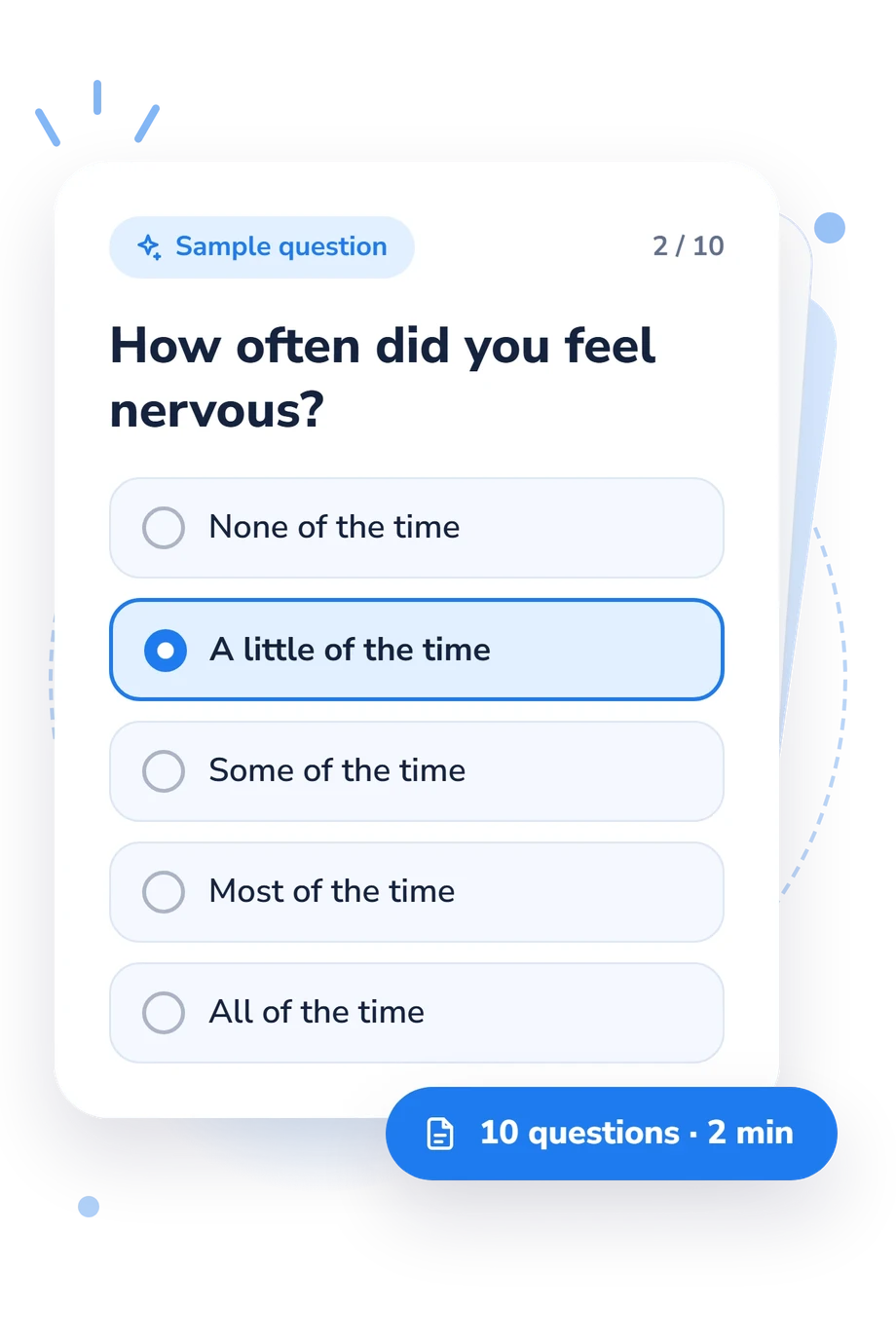
- None of the time
- A little of the time
- Some of the time
- Most of the time
- All of the time
- Never
- Rarely
- Sometimes
- Often
- Always
Kessler Psychological Distress Scale (K10) Test - Description and methodology of the test
People seeking a structured snapshot of recent emotional strain can use the Kessler Psychological Distress Scale (K10) Test to consider how often distress-related feelings have affected them. The result is intended to show the reported severity of psychological distress, not to explain its cause. As a K10 psychological distress test, it can help someone decide whether their current experience merits closer reflection.
What This Assessment Measures
Recent emotional and physical experiences are the focus of this questionnaire. Items ask about nervousness, feeling unable to calm down, hopelessness, restlessness, low mood, effortfulness, sadness, and worthlessness during the past four weeks. It is suited to people who want a concise summary of psychological strain, rather than a profile of conditions.
The Kessler distress scale summarizes the intensity of this strain. The score is reported on one Psychological Distress scale, scored from 10-50, with Low distress (10-19), Moderate distress (20-29), and High distress (30-50). Higher results indicate more severe distress across the situations described, while lower results indicate minimal or no distress. The themes represented are:
- Nervous activation reflects tension and difficulty settling.
- Restlessness reflects agitation or an urge to move.
- Depressive affect reflects hopelessness, sadness, and low mood.
- Burden and self-worth reflect effortful functioning and feeling worthless.
Methodology and Evidence Base
Each item asks about the previous four weeks and uses five ordered frequency choices, moving from least to most frequent. Wording varies slightly-Never to Always or None of the time to All of the time-but the direction is consistent. Responses receive values from 1 to 5 and are combined into a total, so higher totals represent more reported distress.
The online questionnaire presents the published Kessler Psychological Distress Scale (K10) item set in an online format; it is an administration of those items, not a separately validated online version. Kessler et al. (2002) established its population-monitoring purpose; Andrews and Slade (2001) described interpretation of total scores; and Furukawa et al. (2003) examined K10 performance in a national mental-health survey. These studies support reading the result as an indicator of nonspecific psychological distress.
As a psychological distress screening scale, it is most useful when answers reflect the stated period. The cited survey evidence does not establish that this online result has the same norms or survey conditions as the original studies. Memory, current circumstances, and willingness to disclose can affect self-report, and the total cannot identify the cause of distress or replace an assessment when concerns persist.
- Kessler RC, Andrews G, Colpe LJ, Hiripi E, Mroczek DK, Normand SLT, Walters EE, Zaslavsky AM. (2002). Short screening scales to monitor population prevalences and trends in non-specific psychological distress. Psychological Medicine, 32(6), 959-976. 10.1017/S0033291702006074
- Andrews G, Slade T. (2001). Interpreting scores on the Kessler Psychological Distress Scale (K10). Australian and New Zealand Journal of Public Health, 25(6), 494-497. 10.1111/j.1467-842X.2001.tb00310.x
- Furukawa TA, Kessler RC, Slade T, Andrews G. (2003). The performance of the K6 and K10 screening scales for psychological distress in the Australian National Survey of Mental Health and Well-Being. Psychological Medicine, 33(2), 357-362. 10.1017/S0033291702006700
Updated: