
Psychological Stress Measure (PSM-25) Test
How the Scales are Structured
Who Usually Takes This Test?
See How You Compare
Below is a preview of how scores are typically distributed across each scale.
Example Questions From the Test
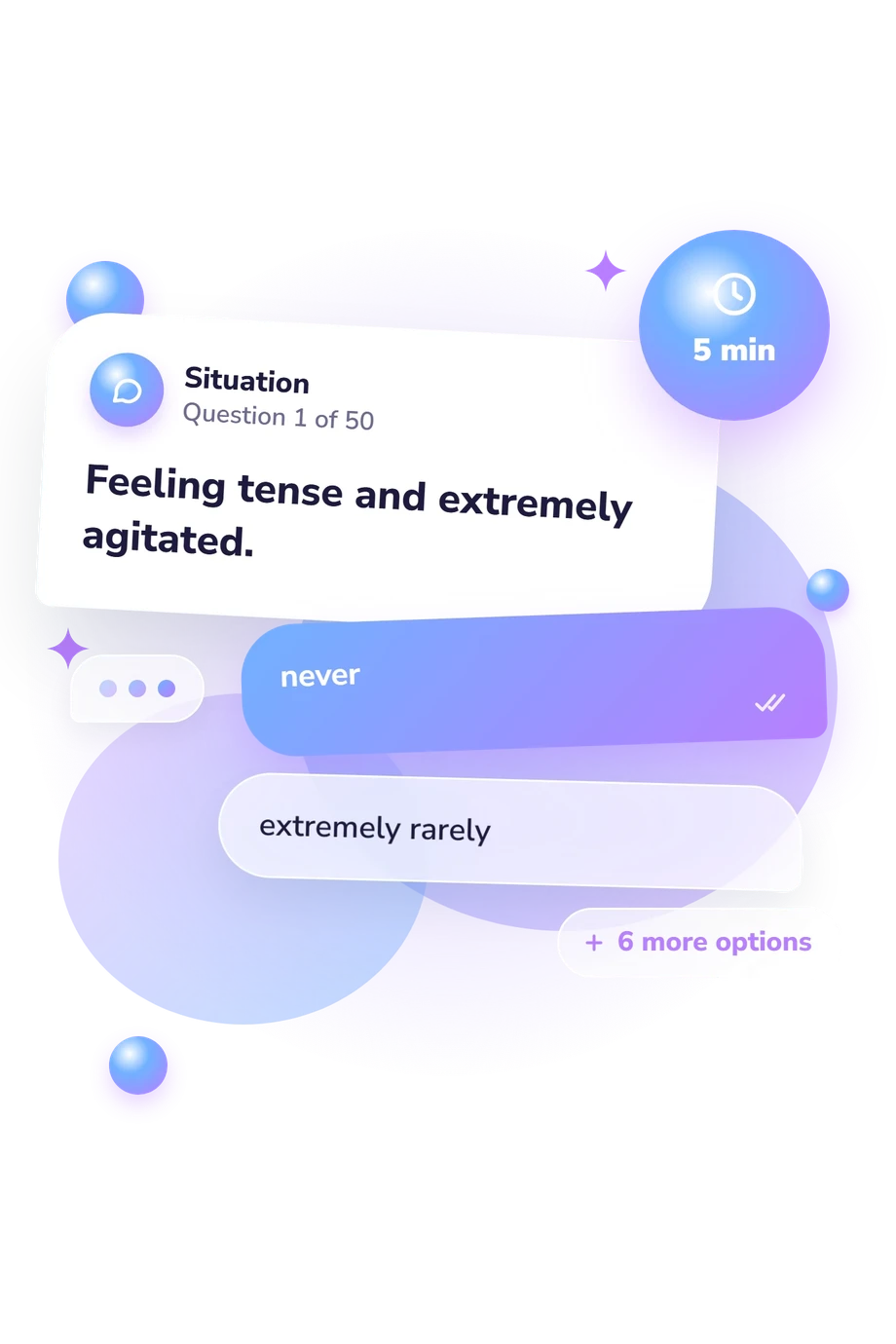
- never
- extremely rarely
- very rarely
- rarely
- sometimes
- often
- very often
- constantly (daily)
- never
- extremely rarely
- very rarely
- rarely
- sometimes
- often
- very often
- constantly (daily)
- never
- extremely rarely
- very rarely
- rarely
- sometimes
- often
- very often
- constantly (every day)
Psychological Stress Measure (PSM-25) Test - Description and methodology of the test
For people who want a structured snapshot of how strain is showing up, the Psychological Stress Measure (PSM-25) Test links emotional tension with bodily, cognitive, behavioral, and work-related experiences. It can help a respondent notice patterns that are easy to dismiss, especially when stress feels diffuse rather than tied to one defined event. This psychological stress test is most useful when answers reflect recent, typical experience.
What This Assessment Explores
Stress is treated here as a broad psychological state rather than a single symptom. The items ask about tension, worry, work overload, rumination, fatigue, concentration, sleep, bodily discomfort, mood, appetite, restlessness, and difficulty disengaging from tasks. This makes the assessment useful for exploring how pressure affects everyday functioning.
The Psychological Stress Index ranges from 25-200 and reflects psychological stress and adaptation to work demands. The result provides a stress level assessment represented by three bands: Good adaptation (25-100), Moderate stress (101-154), and High stress (155-200). The thematic areas represented by the questions are:
- Emotional activation describes worry, agitation, irritability, and reactions that feel hard to regulate.
- Cognitive load reflects rumination, forgetfulness, confusion, and reduced focus.
- Physical strain captures tension, pain, digestive symptoms, breathing changes, and tiredness.
- Functional pressure indicates overload, disrupted routines, sleep problems, and difficulty switching off.
Methodology and Evidence Base
Each item asks how often an experience occurs, using an eight-point frequency scale from never through constantly (daily). The questions group naturally around emotional activation, cognitive load, physical strain, and functional pressure, while scoring produces one composite index rather than separate scores for each symptom area. The displayed range does not by itself show how many points any response contributes.
The published Psychological Stress Measure (PSM), described in the 1990 manual, is the evidence source; this online form is conceptually consistent with it, without implying a direct adaptation or identical validation status. A 1989 validity study by Lise Fillion and colleagues examined the measure in relation to stress and immunity, while a 1988 study by Lemyre and Tessier examined feeling stressed. Viewed as a psychological stress questionnaire, population norms are not stated for this online form; its displayed bands provide the interpretation.
Interpret the single composite result as a reflection on current strain, not a diagnosis. Self-report results shift with mood, recall, disclosure, and context, so read it alongside current circumstances, stressors, and recovery.
- Lemyre, Louise, Rejean Tessier, and Lise Fillion. Psychological Stress Measure (M.S.P.): User Manual. Editions Behaviora, Brossard, Quebec, 1990. ISBN 978-2762900217.
- Fillion, Lise, Rejean Tessier, Emile Tawadros, and Claudie Mouton. Stress and Immunity: Study on the Validity of a Psychological Stress Measure (MSP). Canadian Psychology/Psychologie canadienne, 1989, 30(1), 30-38. 10.1037/h0079852.
- Lemyre, Louise, and Rejean Tessier. Psychological Stress Measure (MSP): Feeling Stressed. Canadian Journal of Behavioural Science/Revue canadienne des sciences du comportement, 1988, 20(3), 302-321. 10.1037/h0079945.
Updated: