
Hers Quiz
How the Scales are Structured
Who Usually Takes This Test?
See How You Compare
Below is a preview of how scores are typically distributed across each scale.
Example Questions From the Test
- Tracking consistent measures such as waist change, strength, mobility, energy, habits, and clinician-relevant health markers
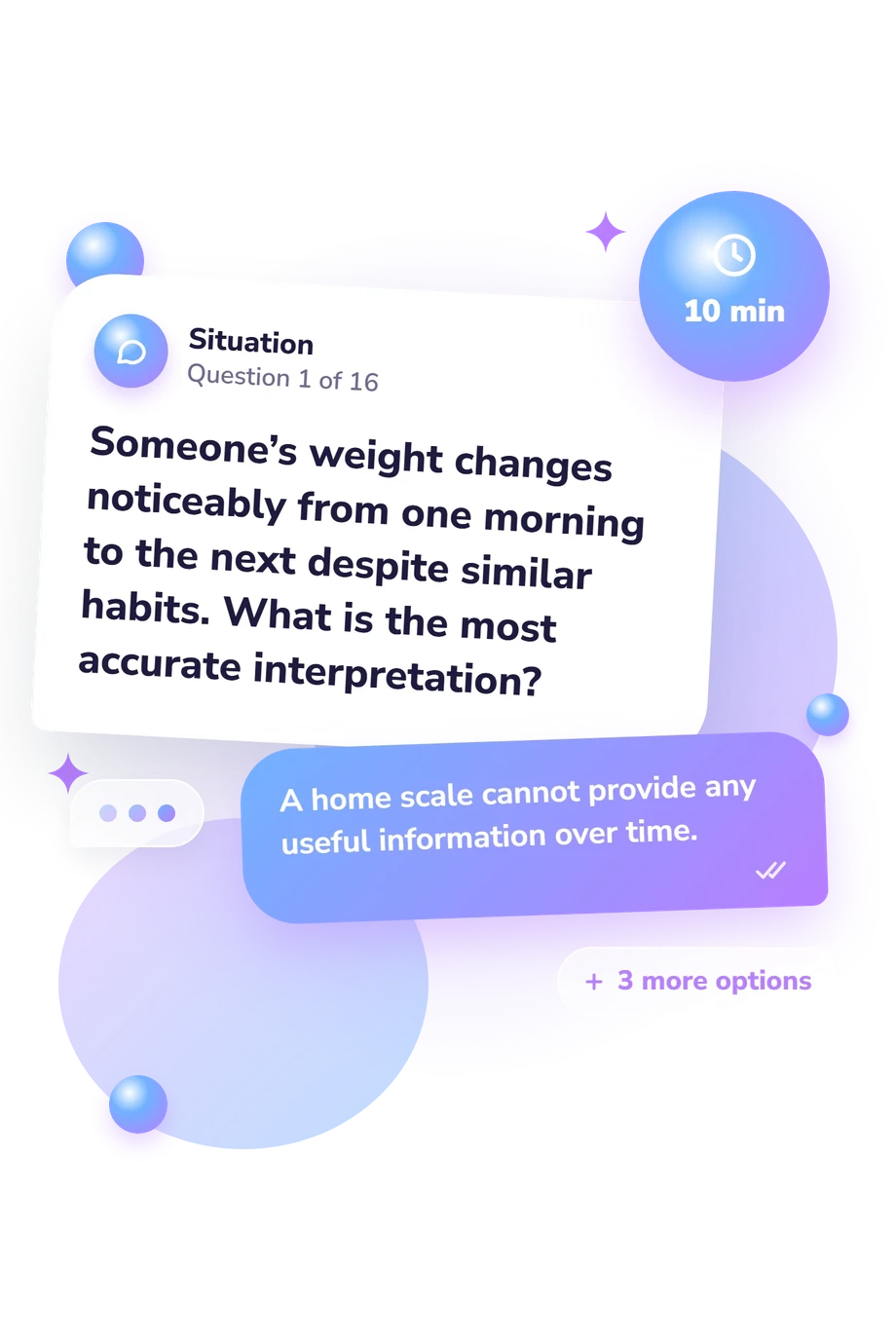
- Comparing weight at different times of day under changing conditions
- Judging success only by how quickly other people notice a difference
- Using the lowest weight recorded during the week as the official result
- Review the longer-term trend, routines, sleep, medications, and health factors with the clinician before changing treatment.
- Assume the treatment has permanently failed and stop it immediately.
- Take more medication than prescribed until the scale moves again.
- Eliminate an entire food group without checking nutritional or medical implications.
- Follow the medication-specific instructions or ask the prescriber or pharmacist rather than improvising.
- Double the next dose unless symptoms are already present.
- Restart the entire treatment from the beginning without consulting anyone.
- Replace the missed dose with a different weight-management product.
Hers Quiz - Description and methodology of the test
People considering medication-based treatment can use the Hers Quiz to check whether their practical knowledge matches the decisions these treatments involve. It is intended for readers who want a clearer starting point before discussing options with a clinician. It tests informed weight care knowledge and treatment safeguards, highlighting topics to review across treatment, monitoring, and follow-up.
What This Assessment Explores
Questions cover progress beyond scale weight, energy balance, BMI limits, resistance training, maintenance, and daily fluctuations. They also test missed-dose decisions, GLP-1 medicines, pregnancy, compounded products, warning symptoms, and safeguards in telehealth prescribing. Together, these topics test weight management knowledge in thematic groups about informed care rather than appearance alone; the displayed result is one overall measure of quiz knowledge.
The Hers Weight Care Knowledge scale runs from 0-16: Foundations to build (0-6), Developing knowledge (7-12), and Strong knowledge (13-16). The questions fall into the following thematic groups, not separate scored dimensions:
- Progress interpretation concerns distinguishing useful trends from short-term noise.
- Medication safety concerns appropriate responses to dosing issues and symptoms.
- Clinical review concerns why history and interactions matter.
- Long-term planning connects habits, monitoring, movement, and maintenance.
Methodology and Scientific Basis
Each of the 16 items uses four answer choices and one best response, combining scenario-based judgment with direct questions about weight-care topics, weight medication safety, monitoring, and treatment decisions. The quiz moves between factual knowledge and judgment about safer next steps. In practice, the questionnaire emphasizes safeguards, clinical review, and follow-up. The result is an overall measure of quiz knowledge, interpreted through the displayed bands.
The content is conceptually consistent with the Weight Literacy Scale (Wang et al., 2018), especially its focus on understanding weight-related information. Nutrition and behavior topics also align with Mikhail et al. (2020), while prescribing and safety issues correspond with Chetty et al. (2026) and recommendations from Grunvald et al. (2022). These are evidence links, not claims that the online questionnaire adapts or validates those instruments.
Because the score is explicitly unvalidated, it measures quiz knowledge only, not health status, medication eligibility, expected results, or diagnosis. Performance may vary with prior exposure, attention, wording interpretation, and current concerns, so read the result as a prompt to review knowledge areas.
- Wang ML, Little TV, Frisard C, Borg A, Lemon SC, Rosal MC. Development and validation of a Weight Literacy Scale in English and Spanish. PLOS ONE. 2018;13(10):e0204678. 10.1371/journal.pone.0204678
- Chetty AK, Chen AS, Ross JS, Ramachandran R. Online Prescribing of GLP-1 Receptor Agonists. JAMA. 2026;336(5):428-431. 10.1001/jama.2026.9131
- Mikhail D, Rolls B, Yost K, Balls-Berry J, Gall M, Blixt K, Novotny P, Albertie M, Jensen M. Development and validation testing of a weight management nutrition knowledge questionnaire for adults. International Journal of Obesity. 2020;44(3):579-589. 10.1038/s41366-019-0510-1
- Grunvald E, Shah R, Hernaez R, Chandar AK, Pickett-Blakely O, Teigen LM, Harindhanavudhi T, Sultan S, Singh S, Davitkov P; AGA Clinical Guidelines Committee. AGA Clinical Practice Guideline on Pharmacological Interventions for Adults With Obesity. Gastroenterology. 2022;163(5):1198-1225. 10.1053/j.gastro.2022.08.045
Updated: