
Mentality Type Assessment Test
How the Scales are Structured
Who Usually Takes This Test?
See How You Compare
Below is a preview of how scores are typically distributed across each scale.
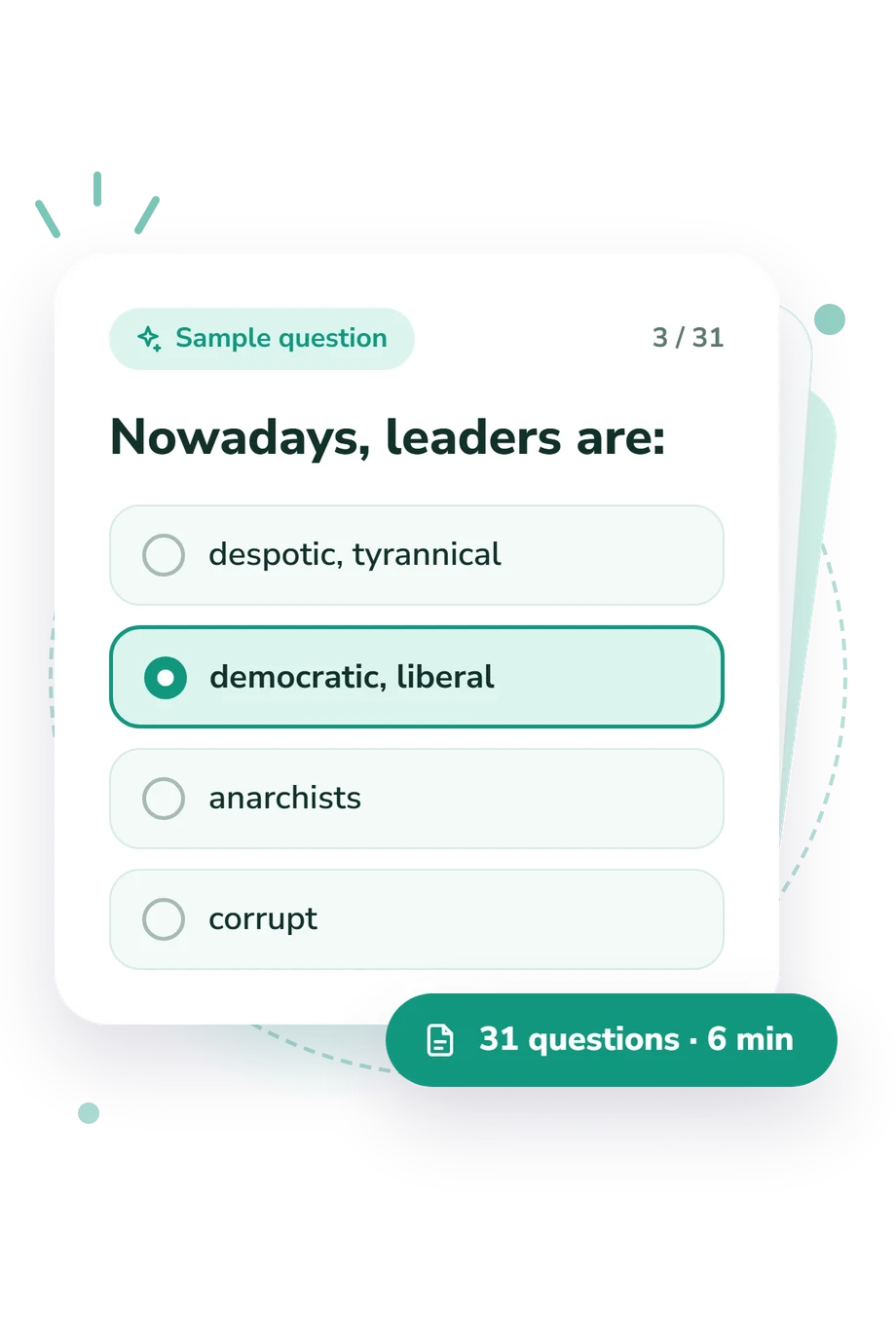
Example Questions From the Test
- altruistic, romantic
- businesspeople, "go-getters"
- priests or people engaged in spiritual practices
- strong, gangster-type men
- aim to start a family
- aim to pursue a career
- have no specific occupation
- break the law
- despotic, tyrannical
- democratic, liberal
- anarchists
- corrupt
Mentality Type Assessment Test - Description and methodology of the test
People seeking a structured way to pause, compare their impressions, and consider personal patterns may use the Mentality Type Assessment Test for guided self-reflection. This mentality assessment questionnaire is intended for readers who want a clearer profile of their perspective rather than a fixed label. Its result can support reflection on how a person understands their own tendencies and priorities.
What This Assessment Explores
The questions explore generational ideals and orientations through situations involving leadership, work, family, relationships, decision-making, time, change, spirituality, and the meaning of life. The result displays levels across the listed dimensions rather than assigning a permanent identity. Readers can use the resulting mentality type profile to reflect on social values and life direction.
The displayed scales describe these result dimensions:
- Innovative: 0-31 measures an active, rational, achievement-oriented outlook linked to vertical individualism and less closed interpersonal relationships; Low innovative 0-10, Moderate innovative 11-21, High innovative 22-31.
- Traditional: 0-31 assesses horizontal collectivism through respect for traditions and honest, friendly relationships; Low 0-10, Moderate 11-20, High 21-31.
- Post-Innovative: 0-31 describes stability and horizontal individualism; Low 0-10, Moderate 11-20, High 21-31.
- Transitional: 0-31 assesses vertical collectivism; Low 0-10, Moderate 11-21, High 22-31.
Methodology and Scientific Basis
Methodologically, this is a self-report questionnaire built from fixed-choice prompts with several alternatives. Prompts ask respondents to choose the statement that best fits their generation or experience across social ideals, worldview, lifestyle, relationships, and life direction. The themes examine cultural expectations alongside personal orientation.
The result displays separate dimension scores with their corresponding bands; the point allocation for individual answers is not stated. As a mentality type test, it reports separate dimension scores rather than treating one pattern as a complete description of the person.
No standardization data, norms, reliability, or validation evidence are stated for this online questionnaire. The closest source, Pishchik (2020), describes features associated with generations X, Y, and Z. Sivrikova and colleagues (2021) studied how mentality patterns relate to generational identification. The questionnaire's themes are conceptually consistent with these works, but it is not a verbatim reproduction or validated version of them.
Self-report results may shift with current circumstances, cultural context, self-awareness, and response style, so the profile is a structured reflection of this response set rather than a clinical diagnosis or fixed category.
- Pishchik, V. I. (2010). Mentality of Generations: Psychological Research. Rostov-on-Don: RO IPK and PRO.
- Sivrikova, N. V., Perebejnos, A. E., Reznikova, E. V., Nemudraya, E. U., & Vorozheykina, A. V. (2021). Relationship between mentality type and generational identification type. The European Proceedings of Social and Behavioural Sciences, 924-930. 10.15405/epsbs.2021.02.02.115
- Pishchik, V. I. (2020). Features of the mentality of generations X, Y, Z. E3S Web of Conferences, 210, 20007. 10.1051/e3sconf/202021020007
Updated: