
Find Your Inner Self Quiz
How the Scales are Structured
Who Usually Takes This Test?
See How You Compare
Below is a preview of how scores are typically distributed across each scale.
Example Questions From the Test
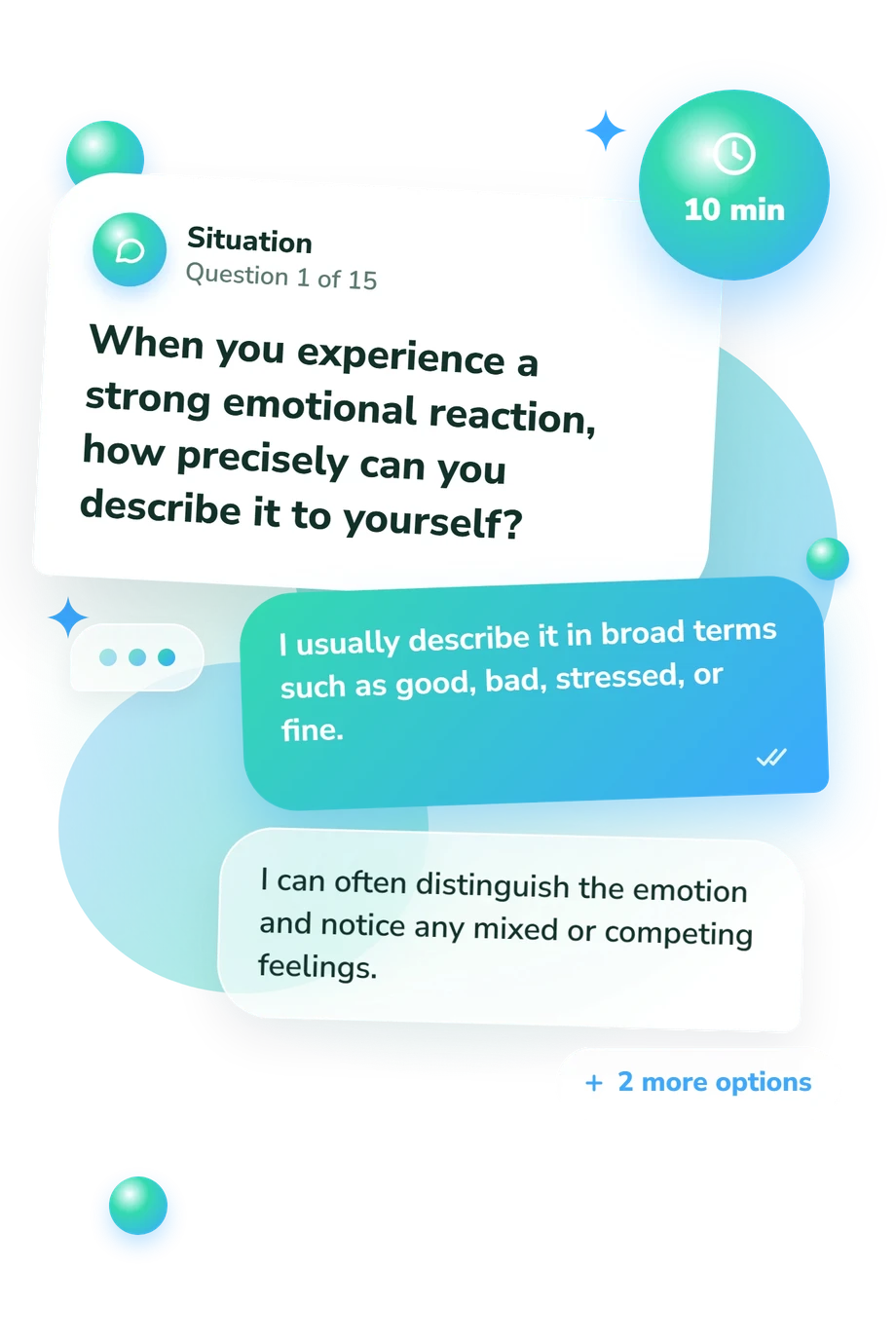
- I usually describe it in broad terms such as good, bad, stressed, or fine.
- I can often distinguish the emotion and notice any mixed or competing feelings.
- I tend to focus on what happened rather than name my internal reaction.
- I can name the main emotion, though its source or nuance may take longer.
- I usually know whether I need rest, connection, movement, focus, or simple enjoyment.
- I choose whatever is easiest and discover afterward whether it helped.
- I can narrow it to a couple of needs but may not know which is strongest.
- I sense whether I want activity or downtime, though not much beyond that.
- I adjust my tone, but my central opinions, boundaries, and interests remain recognizable.
- Different people see different genuine parts of me, with some important parts kept separate.
- I often shape myself around what each group seems to expect.
- I feel most like myself in one or two settings and more carefully edited elsewhere.
Find Your Inner Self Quiz - Description and methodology of the test
People who want a more deliberate way to understand their reactions, preferences, and priorities may find the Find Your Inner Self Quiz useful. Readers wondering how reflection can clarify their inner self can use everyday situations for inner self reflection, examining reactions and choices. The intended reader is anyone seeking a structured snapshot of personal awareness, self-expression, and guiding priorities, with themes to revisit after receiving the result.
What This Assessment Explores
The questionnaire focuses on how inner signals become choices, words, boundaries, and direction. Used as an inner self assessment, the result helps a respondent see which areas appear more developed and which may invite further reflection. Authenticity here does not mean total disclosure, and values are described rather than judged.
The three result dimensions are:
- Authentic Expression (0-15) shows how preferences, fitting boundaries, and genuine interests are expressed, from Mostly Guarded (0-5) through Selectively Expressive (6-10) to Openly Aligned (11-15).
- Inner Awareness (0-15) shows how readily emotions, needs, bodily cues, and recurring reactions are interpreted, from Signals in the Background (0-5) through Growing Awareness (6-10) to Attuned Observer (11-15).
- Values Clarity (0-15) shows how clearly meaningful priorities guide choices, from Still Exploring (0-5) through Taking Shape (6-10) to Clearly Grounded (11-15).
Methodology and Scientific Basis
Each prompt presents an emotional, social, or decision-making situation with four response choices. Options differ in how directly a person notices, interprets, expresses, or acts on an inner experience; the respondent chooses the closest statement.
The result reports one score for each dimension and places each within the displayed band for that scale. The displayed result does not explain how individual responses are converted into points or provide population norms, so its bands function as descriptive summaries rather than norm-referenced comparisons.
Conceptually, the questionnaire is consistent with the Value Clarity Questionnaire (McLoughlin et al., 2025), Wood et al.'s Authenticity Scale, Lane and Schwartz's cognitive-developmental account of emotional awareness, and Campbell et al.'s work on self-concept clarity. It is a self-awareness quiz with related constructs, not a reproduction or validation of those published instruments.
Interpretation should stay close to the situations described: current context and recent experiences may affect answers. Self-report is also influenced by mood, self-awareness, and the wish to present oneself favorably, so the result is best treated as a starting point for reflection rather than a diagnosis.
- McLoughlin, S., Stapleton, A., Pendrous, R., Oldham, P., & Hochard, K. D. (2025). A multi-study paper on the development and validation of the Value Clarity Questionnaire in adults and adolescents. Counselling Psychology Quarterly. Advance online publication. 10.1080/09515070.2025.2451317
- Wood, A. M., Linley, P. A., Maltby, J., Baliousis, M., & Joseph, S. (2008). The authentic personality: A theoretical and empirical conceptualization and the development of the Authenticity Scale. Journal of Counseling Psychology, 55(3), 385-399. 10.1037/0022-0167.55.3.385
- Lane, R. D., & Schwartz, G. E. (1987). Levels of emotional awareness: A cognitive-developmental theory and its application to psychopathology. American Journal of Psychiatry, 144(2), 133-143. 10.1176/ajp.144.2.133
- Campbell, J. D., Trapnell, P. D., Heine, S. J., Katz, I. M., Lavallee, L. F., & Lehman, D. R. (1996). Self-concept clarity: Measurement, personality correlates, and cultural boundaries. Journal of Personality and Social Psychology, 70(1), 141-156. 10.1037/0022-3514.70.1.141
Updated: