
Teacher Communication Effectiveness Scale Test
How the Scales are Structured
Who Usually Takes This Test?
See How You Compare
Below is a preview of how scores are typically distributed across each scale.
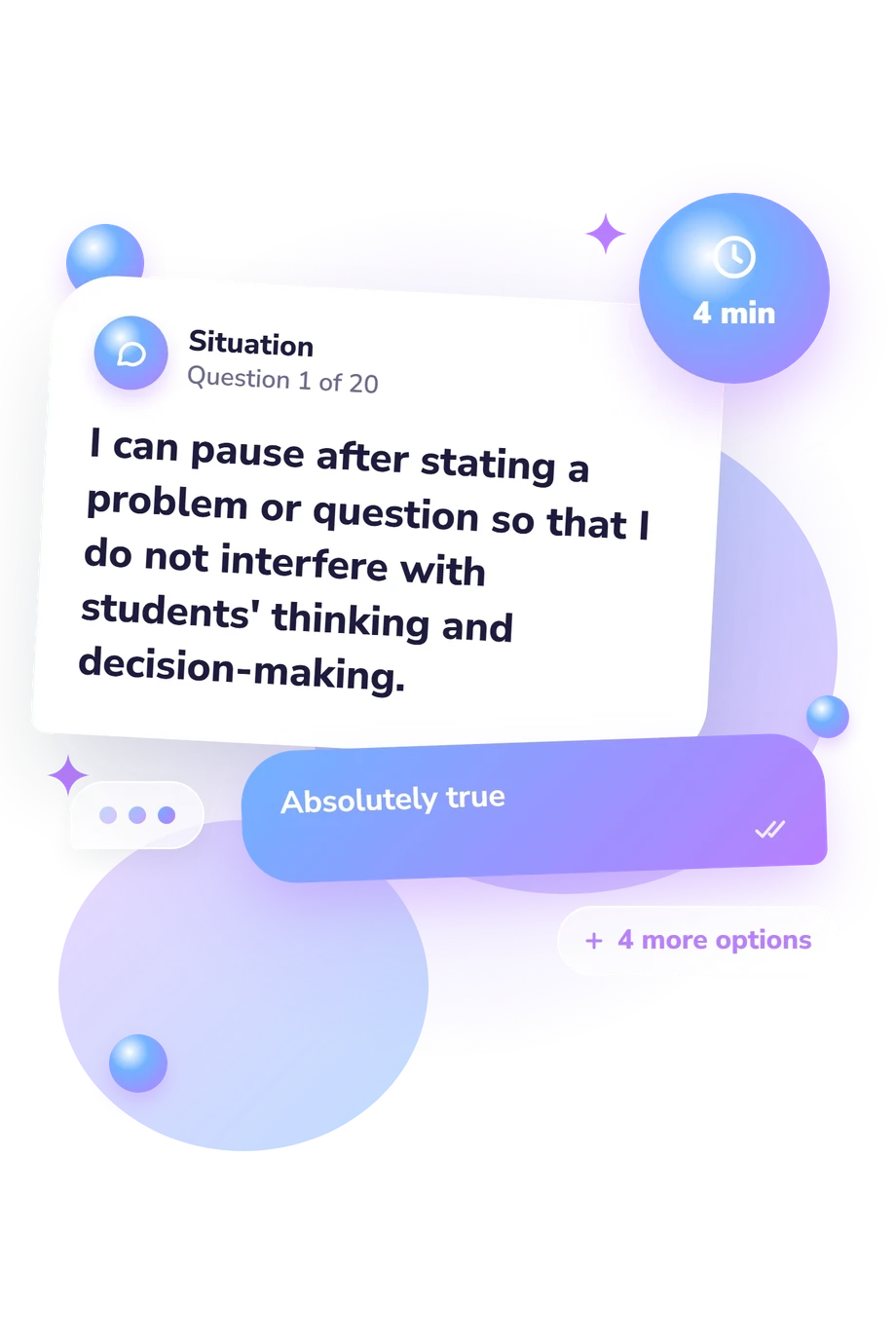
Example Questions From the Test
- Absolutely true
- Yes, true
- Neither yes nor no
- Generally no
- No, not true
- Absolutely true
- Yes, true
- Neither yes nor no
- Generally no
- No, not true
- Absolutely true
- Yes, true
- Neither yes nor no
- Generally no
- No, not true
Teacher Communication Effectiveness Scale Test - Description and methodology of the test
Educators who want to review communication between teachers and students and classroom interaction patterns can use the Teacher Communication Effectiveness Scale Test to identify patterns that may support student autonomy and participation. It is suited to teachers and other education professionals who want to examine how they invite student thinking, respond to individuality, and create conditions for participation. This teacher communication assessment offers a focused way to consider everyday practice.
What This Assessment Explores
The questionnaire examines whether a teacher leaves room for student thinking, choice, expression, cooperation, and independent problem-solving. It also considers responses to mistakes, emotions, creativity, peer relationships, individual strengths, and classroom well-being. Here, effective teacher communication means a democratic interaction style that considers individual differences and encourages autonomy.
These themes show what the result invites the respondent to consider:
- Autonomy is reflected in whether support lets students think, choose, and solve problems independently.
- Emotional climate is reflected in calm expression, emotional support, and constructive use of mistakes.
- Social participation is reflected in respect for individuality, peer connection, dialogue, and group learning.
One overall result, Teacher Communication Effectiveness: -2-2, is reported as Low -2--0.9, Moderate -0.9-1, or High 1.1-2. Higher results indicate more effective teacher-student communication and attention to individuality; average results suggest room to encourage initiative, while lower results point to reconsidering interaction style.
Methodology and Evidence Base
First-person statements are answered on five ordered choices, from strong agreement or truth to strong disagreement, with a neutral middle option. The format captures perceived classroom habits rather than direct observation.
Responses form one overall result, but no independently reconstructable answer-to-point conversion is stated; labels should not imply another scoring rule. As a teacher communication skills test, it suits personal reflection or exploratory professional development.
The questionnaire is conceptually consistent with Vyunkova’s 2004 work and related 1998 work, but it is not presented as a direct adaptation or validation of either study.
Pianta, Hamre, and Allen’s 2012 work offers a compatible framework for teacher-student relationships and engagement; Hamre and colleagues’ 2013 work links classroom interactions with teacher effectiveness. Those studies address broader relational or observed behavior than this self-report format.
Self-report may reflect memory, current classroom pressures, and socially desirable answers. This questionnaire has no stated standardization or population norms; its displayed bands are descriptive catalogue labels, not independently validated cutoffs. The result does not establish a diagnosis, and fuller judgment needs observation or discussion.
- Vyunkova, Yulia N. (2004). How educationally effective is your pedagogical communication style? Elementary School, No. 48, p. 24.
- Vyunkova, Yulia N. (1998). Educational effectiveness of pedagogical communication: Work in compensatory education classes. Elementary School, No. 5, pp. 92-94.
- Pianta, Robert C., Hamre, Bridget K., & Allen, Joseph P. (2012). Teacher-student relationships and engagement: Conceptualizing, measuring, and improving the capacity of classroom interactions. In S. L. Christenson, A. L. Reschly, & C. Wylie (Eds.), Handbook of Research on Student Engagement (pp. 365-386). Springer. 10.1007/978-1-4614-2018-7_17
- Hamre, Bridget K., Pianta, Robert C., Downer, Jason T., DeCoster, Jamie, Mashburn, Andrew J., Jones, Stephanie M., Brown, Joshua L., Cappella, Elise, Atkins, Marc, Rivers, Susan E., Brackett, Marc A., & Hamagami, Aki. (2013). Teaching through interactions: Testing a developmental framework of teacher effectiveness in over 4,000 classrooms. The Elementary School Journal, 113(4), 461-487. 10.1086/669616
Updated: