
Dunning Kruger Effect Test
How the Scales are Structured
Who Usually Takes This Test?
See How You Compare
Below is a preview of how scores are typically distributed across each scale.
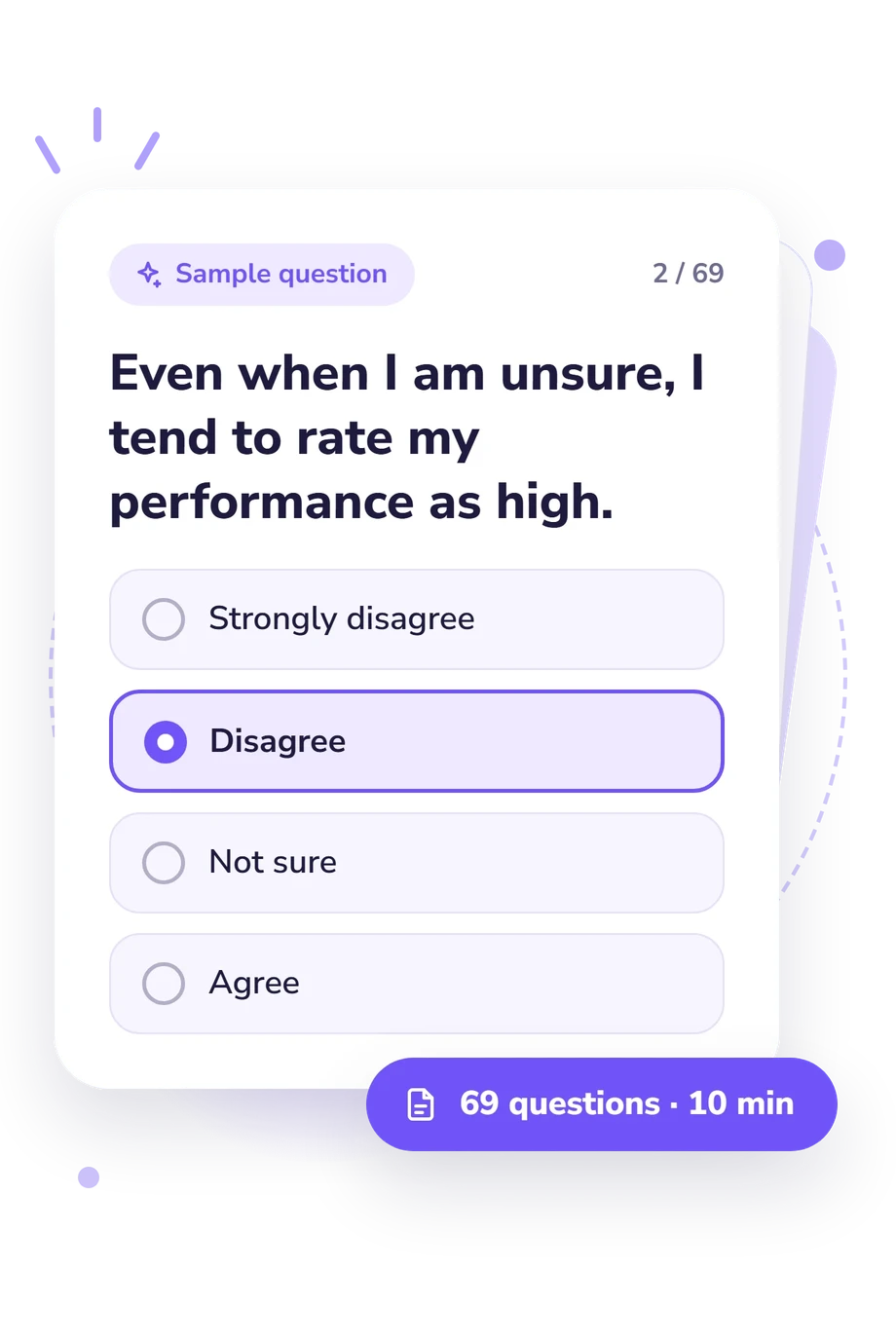
Example Questions From the Test
- Strongly disagree
- Disagree
- Not sure
- Agree
- Strongly disagree
- Disagree
- Not sure
- Agree
- Strongly disagree
- Disagree
- Not sure
- Agree
Dunning Kruger Effect Test - Description and methodology of the test
People who want to check whether their confidence matches their performance can use this assessment to examine self-evaluation during reasoning tasks. The Dunning Kruger Effect Test is intended for curious respondents who notice missed mistakes, inflated expectations, or overly cautious judgments. This assessment functions as a dunning kruger test for focused self-reflection, separating what you think you achieved from what you demonstrated.
What This Test Measures
Confidence is treated as calibration: how closely estimated performance tracks actual performance. Logic, language, and everyday reasoning items test performance, while self-report statements examine expectations, mistakes, and confidence. In this dunning kruger quiz, task questions and self-ratings produce separate results rather than one blended ability score.
Three result dimensions are shown:
- Calibration Gap (-20-20) measures perceived-versus-actual performance: positive values show overconfidence, negative values underconfidence, and values near 0 accurate calibration. Bands: Underconfident -20 to -1; Well-calibrated 0 to 0; Overconfident 1 to 20.
- Performance Score (0-20) measures correct answers across logic, language, and everyday reasoning. Higher scores show stronger demonstrated performance. Bands: Lower performance 0-8; Moderate performance 9-14; Higher performance 15-20.
- Self-Rated Performance (0-20) measures the estimated score before results; higher scores show greater perceived performance. Bands: Low self-rating 0-6; Moderate self-rating 7-13; High self-rating 14-20.
Methodology and Evidence Base
The format combines self-evaluation statements with objective reasoning items. In the represented format, agreement prompts use four choices-Strongly disagree, Disagree, Not sure, and Agree-while task items present four possible answers. The represented items span logic, language, everyday reasoning, patterns, probability, vocabulary, arithmetic, and practical judgment.
Scoring defines Calibration Gap as Self-Rated Performance minus Performance Score, showing whether the estimate is above or below demonstrated performance. The displayed ranges describe outcome categories, not a separate points-per-answer rule.
The framework is conceptually consistent with Kruger and Dunning (1999), who examined self-assessment alongside task performance. Ehrlinger and colleagues (2008) explored self-insight, while Jansen and colleagues (2021) modelled confidence across performance levels. Here, estimated and demonstrated performance sit side by side; this confidence calibration test does not reproduce those studies.
Interpret the result as a task-specific snapshot. Concentration, familiarity, response bias, self-awareness, and item difficulty can influence it, so these results may not represent broader ability. Read the displayed bands alongside the separate performance and self-rating results.
- Kruger, Justin, and David Dunning. "Unskilled and unaware of it: How difficulties in recognizing one’s own incompetence lead to inflated self-assessments." Journal of Personality and Social Psychology 77, no. 6 (1999): 1121-1134. 10.1037/0022-3514.77.6.1121
- Ehrlinger, Joyce, Kerri Johnson, Matthew Banner, David Dunning, and Justin Kruger. "Why the Unskilled Are Unaware: Further Explorations of (Absent) Self-Insight Among the Incompetent." Organizational Behavior and Human Decision Processes 105, no. 1 (2008): 98-121. 10.1016/j.obhdp.2007.05.002
- Jansen, Rachel A., Anna N. Rafferty, and Thomas L. Griffiths. "A rational model of the Dunning-Kruger effect supports insensitivity to evidence in low performers." Nature Human Behaviour 5, no. 6 (2021): 756-763. 10.1038/s41562-021-01057-0
Updated: