
Responsibility Questionnaire Test
How the Scales are Structured
Who Usually Takes This Test?
See How You Compare
Below is a preview of how scores are typically distributed across each scale.
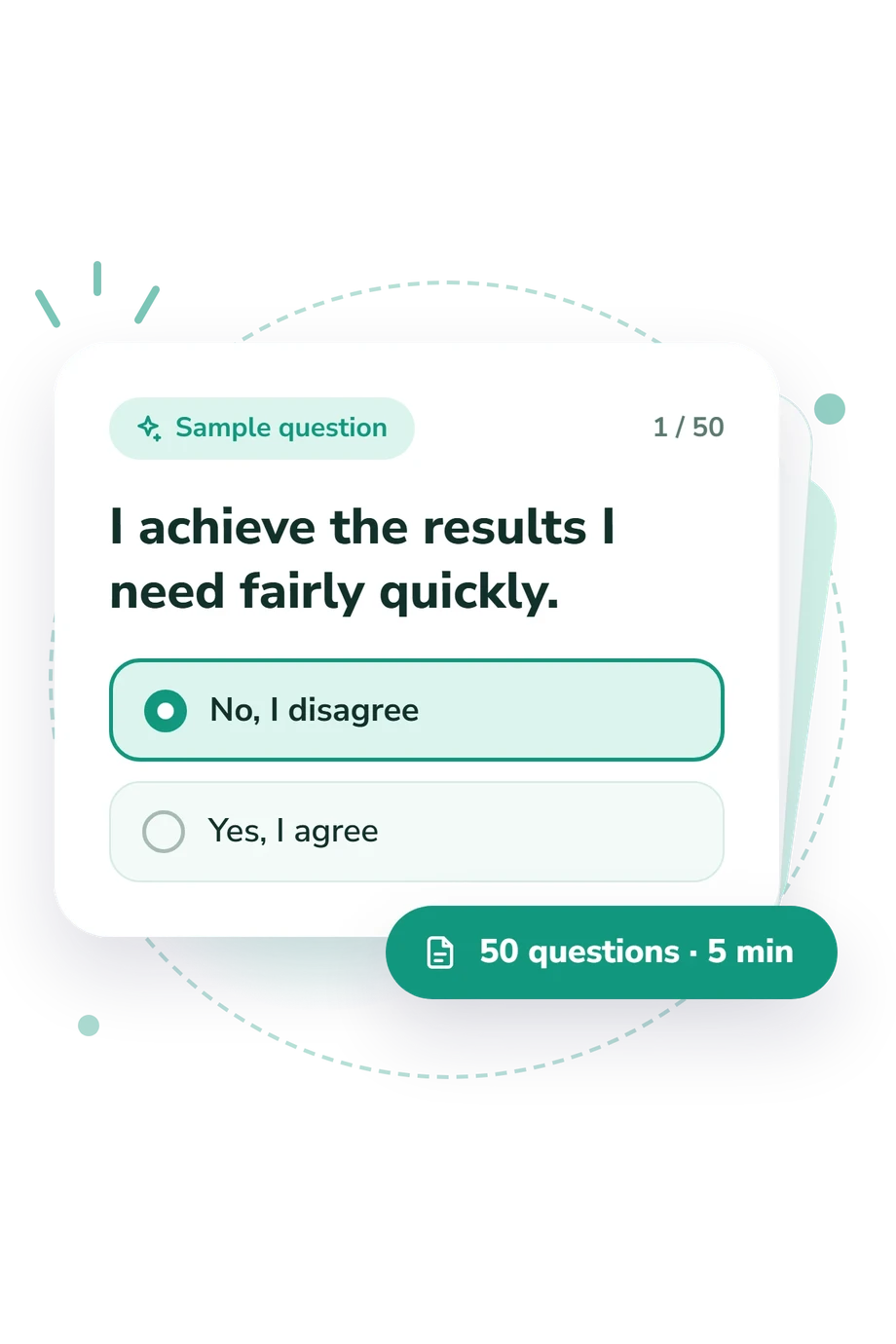
Example Questions From the Test
- No, I do not agree
- Yes, I agree
- No, I disagree
- Yes, I agree
- No, disagree
- Yes, agree
Responsibility Questionnaire Test - Description and methodology of the test
People reviewing their habits around duties, commitments, and work decisions may find this questionnaire useful when they want a clearer picture of reliability and autonomy. The Responsibility Questionnaire Test focuses on everyday responsibility rather than a pass-fail judgment. The responsibility assessment can help readers notice how they approach unfinished tasks, mistakes, consequences, and obligations to other people.
What This Assessment Explores
The questionnaire examines duty and willingness to assume obligations in work and social situations. Its items address finishing tasks, reviewing performance, correcting errors, setting priorities, weighing consequences, and owning shared outcomes.
This personal responsibility test describes tendencies toward autonomy, reliability, and keeping commitments, including a balanced approach that avoids both passivity and overcontrol.
The main themes can be read through these dimensions:
- Follow-through shows how consistently a person completes plans and unfinished tasks.
- Self-correction indicates whether performance is reviewed and mistakes are addressed.
- Accountability reflects willingness to own decisions, admit errors, and accept consequences.
- Work and social orientation shows how usefulness, growth, and other people's needs influence action.
The result uses one scale: Responsibility Level (0-25). Low is 0-14, Moderate is 15-19, and High is 20-25; the bands indicate duty, dependability, and readiness to take ownership.
Methodology and Evidence Base
In practice, the online responsibility questionnaire uses brief self-report statements with two choices, such as disagree and agree. Items sample work discipline, planning, self-evaluation, decision ownership, concern for others, and reactions to mistakes or unfinished duties. Responses are combined into one overall result, expressing the profile’s general direction.
These themes are conceptually consistent with work on duty, accountability, and dependable functioning, including Vera A. Rozanova’s management-psychology discussion. Rozanova’s discussion does not establish this online questionnaire as an adaptation of a published instrument. Polyakov’s 2024 study linked responsibility with psychological well-being, but it does not validate this online form.
Rotter’s 1966 framework on internal and external control provides a related lens for connecting outcomes with personal actions or outside forces. This questionnaire is not Rotter’s locus-of-control scale or an adaptation of it.
Because the form relies on self-report, workload, role expectations, self-awareness, and impression management may affect results; the displayed bands are the questionnaire’s supplied categories rather than established population norms, so read the outcome as a structured reflection profile.
- Rozanova, Vera A. (1999). Psychology of Management: A Textbook. Moscow: Business School Intel-Sintez. 352 pp.
- Polyakov, Alexander S. (2024). The Relationship Between the Level of Psychological Well-Being and Responsibility in Young People. World of Science. Pedagogy and Psychology, 12(3), 96PSMN324.
- Rotter, Julian B. (1966). Generalized Expectancies for Internal Versus External Control of Reinforcement. Psychological Monographs: General and Applied, 80(1), 1-28. 10.1037/h0092976
Updated: