
Freudly+971 508685814hello@freudly.ai
Freudly
self-determination

Academic Motivation Scales for School Students Test
Take the online Academic Motivation Scales for School Students Test - AI psychologist FreudlyYou can take Academic Motivation Scales for School Students Testhere. Online version of a simple and accurate psychological test with interpretation.en
In 6 minutes, learn what truly drives a high school or college student to study. Get clear, actionable insights to guide supportive conversations and tailor motivation strategies fast.
Start Online Test
Questions: 326 minutes
08:30
October 2, 2025
October 2, 2025
Material has been updated
October 2, 2025
Material has been published
25,349 views
2,759 completions
2,141 likes
Verified by Daniel Hall
Psychologist with 25 years of experience
Share
Scale Explorer

How the Scales are Structured

example score
9/20
Amotivation (A)
Amotivation measures the extent to which a student feels uninterested in studying and sees little meaning in academic activities.
Low
Moderate
High
49: Low | 1014: Moderate | 1520: High
A score of 9 falls in the Low range, suggesting relatively little lack of interest or meaninglessness toward schoolwork compared with higher scores.
example score
12/20
Negative External Motives (NEM)
Measures the extent to which studying is driven by pressure to meet expectations and avoid negative consequences rather than personal interest.
Low pressure-driven
Moderate pressure-driven
High pressure-driven
49: Low pressure-driven | 1014: Moderate pressure-driven | 1520: High pressure-driven
A score of 12 falls in the Moderate pressure-driven range, suggesting external expectations and avoidance of problems play a noticeable role in motivation alongside other factors.
example score
17/20
Positive External Motives (PEM)
Measures how strongly a student’s learning effort is driven by seeking parents’ approval and respect through achievement.
Low
Moderate
High
49: Low | 1015: Moderate | 1620: High
A score of 17 falls in the High range, suggesting the student is strongly motivated by positive external support and parental approval tied to academic success.
example score
12/20
Introjected Motivation (IM)
Measures the extent to which studying is driven by internal pressure such as duty, guilt, or fear of disappointing others.
Low internal pressure
Moderate internal pressure
High internal pressure
49: Low internal pressure | 1014: Moderate internal pressure | 1520: High internal pressure
A score of 12 indicates a moderate level of introjected motivation, suggesting studying is partly fueled by self-imposed expectations or guilt rather than purely interest or external rewards.
example score
18/20
Self-Esteem Motivation (SEM)
Measures the extent to which a student is motivated to study in order to bolster self-esteem and personal significance through academic achievement.
Low
Moderate
High
49: Low | 1015: Moderate | 1620: High
A score of 18 indicates high self-esteem-driven motivation, meaning academic success is a prominent source of self-affirmation for the student.
example score
11/20
Self-Development Motivation (SDM)
Measures how strongly a student is driven to improve skills, achieve mastery, and grow academically.
Low
Moderate
High
49: Low | 1014: Moderate | 1520: High
A score of 11 falls in the Moderate range, suggesting a balanced interest in building competence and improving through learning, though it may not be a dominant driver in all situations.
example score
16/20
Achievement Motivation (AM)
Achievement Motivation measures the student’s drive to excel academically by investing effort and striving for strong results.
Low
Moderate
High
49: Low | 1015: Moderate | 1620: High
A score of 16 falls in the High range, suggesting a strong focus on achieving excellent academic outcomes and willingness to apply sustained effort.
example score
10/20
Cognitive Motivation (CM)
Cognitive Motivation measures how much a student enjoys learning and seeks new knowledge for its own sake.
Low
Moderate
High
49: Low | 1014: Moderate | 1520: High
A score of 10 falls in the Moderate range, suggesting a noticeable but not strongly pronounced interest in learning and gaining new knowledge.
Start Online Test
just completed the test
DATA-BASED USER COHORTS

Who Usually Takes This Test?

Students feeling unmotivated
41%OF USERS
High school or college students take it to understand why studying feels hard and what could help them re-engage.
Students aiming higher
34%OF USERS
Motivated learners use it to pinpoint what drives their effort and how to sustain it through exams, grades, and long-term goals.
Students in counseling support
25%OF USERS
Students referred by a teacher, counselor, or school psychologist take it to guide a practical plan for improving study habits and motivation.
BASED ON AGGREGATED, ANONYMIZED DATA FROM TENS OF THOUSANDS OF FREUDLY USERS.
Benchmarking

See How You Compare

Once you complete the test, your results are compared with real-world data from people in your country.
Below is a preview of how scores are typically distributed across each scale.
Amotivation (A)
Amotivation (A)
Average
15.8
Normal range
12.818.8
min.
4
max.
20
This curve shows how scores are typically distributed.
Once you complete the test, your result will appear on the scale so you can see how you compare.
Negative external motives (Nem)
Average
9.6
Normal range
6.712.5
min.
4
max.
20
This curve shows how scores are typically distributed.
Once you complete the test, your result will appear on the scale so you can see how you compare.
Positive external motives (Pem)
Average
14.2
Normal range
1216.5
min.
4
max.
20
This curve shows how scores are typically distributed.
Once you complete the test, your result will appear on the scale so you can see how you compare.
Introjected Motivation (IM)
Average
10.4
Normal range
8.112.6
min.
4
max.
20
This curve shows how scores are typically distributed.
Once you complete the test, your result will appear on the scale so you can see how you compare.
Motivation of self-esteem (Mos)
Average
10.2
Normal range
7.412.9
min.
4
max.
20
This curve shows how scores are typically distributed.
Once you complete the test, your result will appear on the scale so you can see how you compare.
Motivation for self-development (Mfs)
Average
9.8
Normal range
712.5
min.
4
max.
20
This curve shows how scores are typically distributed.
Once you complete the test, your result will appear on the scale so you can see how you compare.
Achievement Motivation (AM)
Average
13.1
Normal range
11.115.2
min.
4
max.
20
This curve shows how scores are typically distributed.
Once you complete the test, your result will appear on the scale so you can see how you compare.
Cognitive Motivation (CM)
Average
9.2
Normal range
6.611.7
min.
4
max.
20
This curve shows how scores are typically distributed.
Once you complete the test, your result will appear on the scale so you can see how you compare.
Featured On
SAMPLE QUESTIONS

Example Questions From the Test

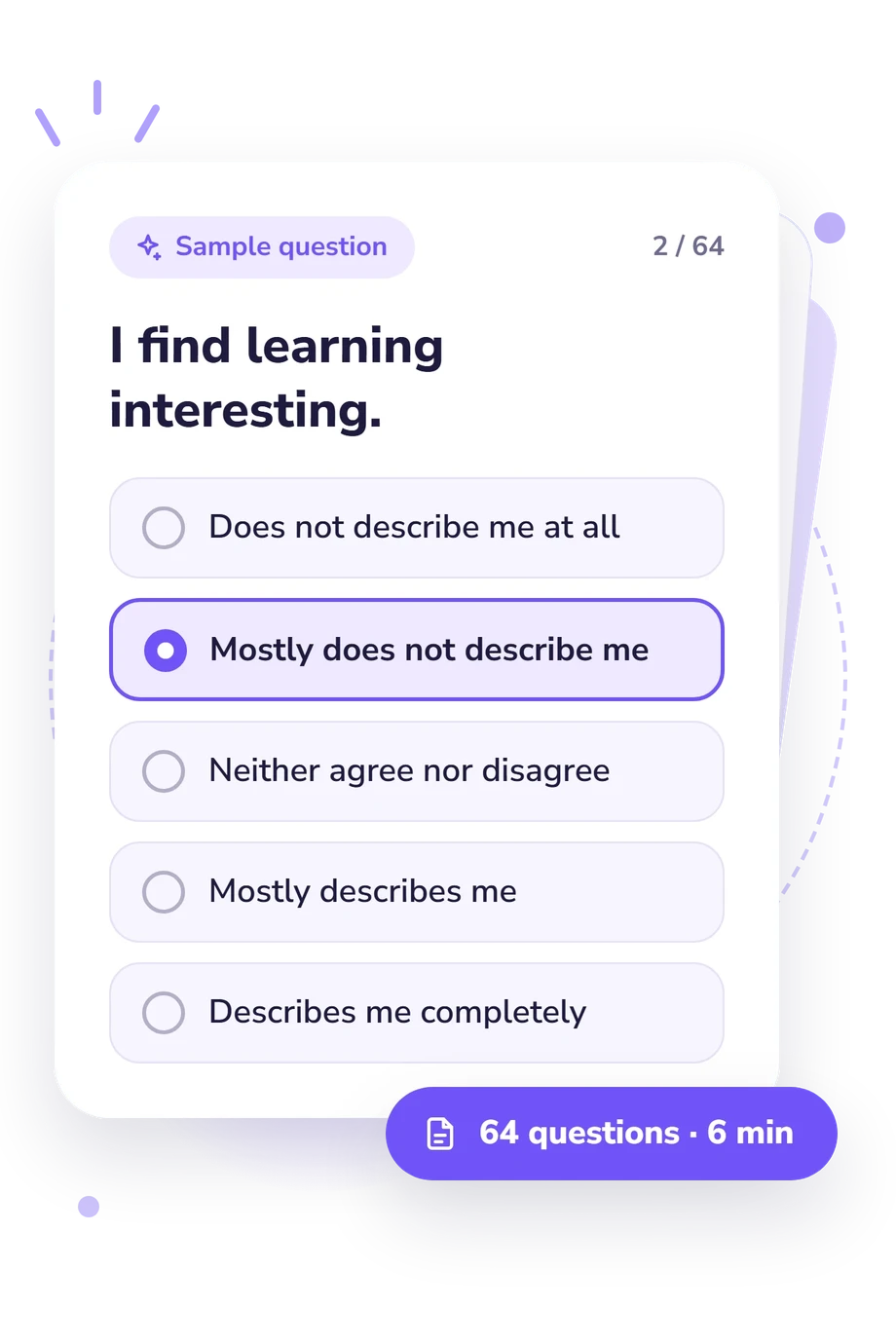
Please read each statement carefully. Using the response scale provided, select the answer that best reflects what you think about the reasons for your engagement in the activity. Why are you currently attending classes at school (college)?
    • Does not describe me at all
    • Mostly does not describe me
    • Neither agree nor disagree
    • Mostly describes me
    • Describes me completely
    • Does not describe me at all
    • Mostly does not describe me
    • Neither describes me nor does not describe me
    • Mostly describes me
    • Describes me completely
    • Not at all true
    • Mostly not true
    • Somewhere in between
    • Mostly true
    • Completely true
WHAT THE TEST MEASURES
About This Assessment
Academic Motivation Scales for School Students, AMS-S Test

Academic Motivation Scales for School Students Test - Symptoms and Signs

self-determination
academic motivation

This self-report measure is designed to clarify the motivational factors that influence students’ engagement in academic work. Academic Motivation Scales for School Students provides a structured way to examine patterns of academic motivation in secondary school populations.

Grounded in contemporary motivational theory (Deci, Ryan, and Eccles), the instrument assesses multiple forms of motivation relevant to learning in school contexts, including internally and externally regulated reasons for studying. It includes 32 items and typically requires about 6 minutes to complete.

Scores from Academic Motivation Scales for School Students can help clinicians and school-based professionals identify predominant motivational drivers, support case conceptualization, and guide collaborative goal-setting with students and caregivers. Results are generally interpreted in conjunction with academic history, behavioral observations, and other assessment data rather than used as a standalone indicator.

Author: Edward L. Deci, Jacquelynne S. Eccles, Richard M. Ryan
Literature: Ryan, R. M., & Deci, E. L. Self-determination theory and the facilitation of intrinsic motivation, social development, and well-being. American Psychologist. 2000.; Eccles, J. S., & Wigfield, A. Motivational beliefs, values, and goals. Annual Review of Psychology. 2002.
Popular tests
Comments
Leave a Comment