
Wolf Quiz
How the Scales are Structured
Who Usually Takes This Test?
See How You Compare
Below is a preview of how scores are typically distributed across each scale.
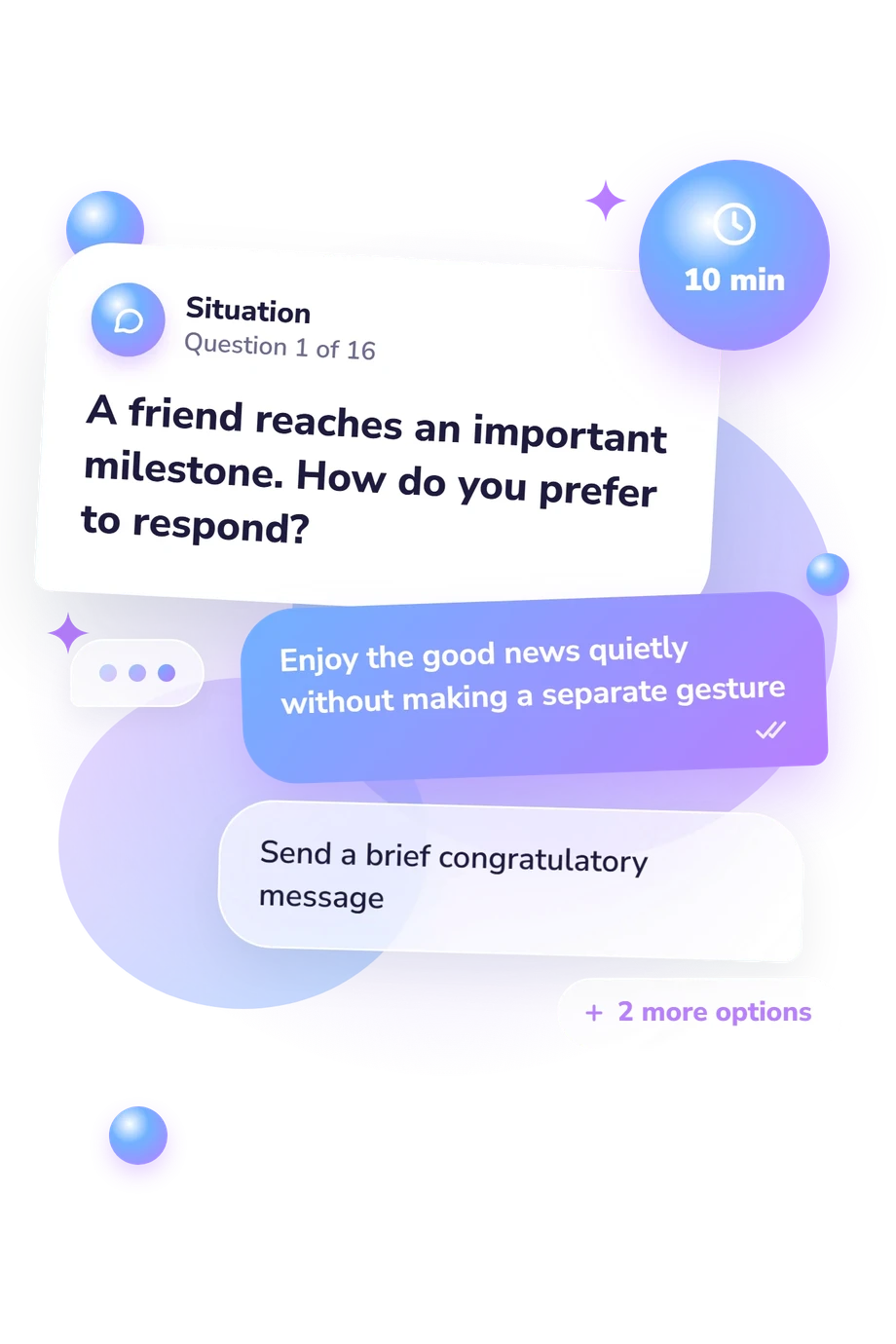
Example Questions From the Test
- Focus on the activity and let relationships develop over time
- Start a conversation with the person nearest to me
- Introduce people who seem to have interests in common
- Invite several people into an easy, shared conversation
- Follow my interests and meet everyone again at the agreed time
- Keep a casual eye on where the group is
- Make sure everyone knows the meeting place and basic plan
- Track changing logistics and help the group handle disruptions
- Set it aside unless the disagreement has practical importance
- Ask what led them to that conclusion
- Compare sources and investigate the issue after the conversation
- Listen to their reasoning while keeping my current view for now
Wolf Quiz - Description and methodology of the test
People drawn to symbolic personality frameworks can use this wolf quiz to examine how they respond when plans change, groups need coordination, or unfamiliar possibilities appear. For visitors approaching it as a what wolf are you quiz, the result offers a practical profile of preferences rather than a claim about literal animal identity. It is suited to anyone seeking a concise way to reflect on flexibility, responsibility, connection, and curiosity.
What This Assessment Explores
The questionnaire turns everyday scenarios-changed plans, incomplete tasks, group coordination, and practical shortages-into choices about preferred action. The result answers the personal question behind a what wolf am I quiz by showing how four orientations appear in ordinary decisions, rather than judging character or predicting conduct.
These dimensions are interpreted as affinities:
- Adapter (0-12) reflects continuity versus flexible reorganization: Steady-Course Adapter (0-4), Practical Adapter (5-8), Strong Adapter (9-12).
- Guardian (0-12) reflects independent, responsive, or stabilizing support: Independent Guardian (0-4), Responsive Guardian (5-8), Strong Guardian (9-12).
- Pack Connector (0-12) reflects natural, selective, or active belonging: Self-Directed Connector (0-4), Personal Connector (5-8), Strong Pack Connector (9-12).
- Scout (0-12) reflects familiar, selective, or discovery-led exploration: Familiar-Ground Scout (0-4), Selective Scout (5-8), Strong Scout (9-12).
Together, they describe preferred roles, not intelligence, virtue, popularity, relationship quality, courage, competence, resilience, or actual wolf behavior.
Methodology and Scientific Basis
Each item presents a social or practical situation with four response options. Choices contrast routine, experimentation, support, coordination, and exploration; none is objectively correct. The what type of wolf am I quiz framing therefore uses wolf imagery as an archetypal metaphor for preferred action, not species classification.
Selected options produce separate totals for the four dimensions, and each total is read through its displayed range and band. The profile is best understood as a combination of tendencies, not a single identity or universal ranking.
Conceptually, the structure is consistent with Moretti et al. (2015), linking relationships with exploration and neophobia in wolves and dogs. Benson et al. (2025) adds context on cohesion in wild Canis groups, while Marshall-Pescini et al. (2017) examines exploratory and neophobic behavior in young wolves and dogs. These studies support the analogy, not this questionnaire’s authorship or validation.
As a what kind of wolf am I quiz, it is an online self-report tool rather than a standardized clinical instrument with published norms. Current context, self-awareness, and response style can affect results, which are best used for reflection rather than diagnosis.
- Moretti, Lucia, Hentrup, Marleen, Kotrschal, Kurt, and Range, Friederike. (2015). The influence of relationships on neophobia and exploration in wolves and dogs. Animal Behaviour, 107, 159-173. 10.1016/j.anbehav.2015.06.008
- Benson, John F., Keiter, David A., Mahoney, Peter J., Allen, Benjamin L., Allen, Lee, et al. (2025). Intrinsic and environmental drivers of pairwise cohesion in wild Canis social groups. Ecology, 106(1), e4492. 10.1002/ecy.4492
- Marshall-Pescini, Sarah, Virányi, Zsófia, Kubinyi, Enikő, and Range, Friederike. (2017). Motivational Factors Underlying Problem Solving: Comparing Wolf and Dog Puppies' Explorative and Neophobic Behaviors at 5, 6, and 8 Weeks of Age. Frontiers in Psychology, 8, 180. 10.3389/fpsyg.2017.00180
Updated: