
Will I Be Single Forever Quiz
How the Scales are Structured
Who Usually Takes This Test?
See How You Compare
Below is a preview of how scores are typically distributed across each scale.
Example Questions From the Test
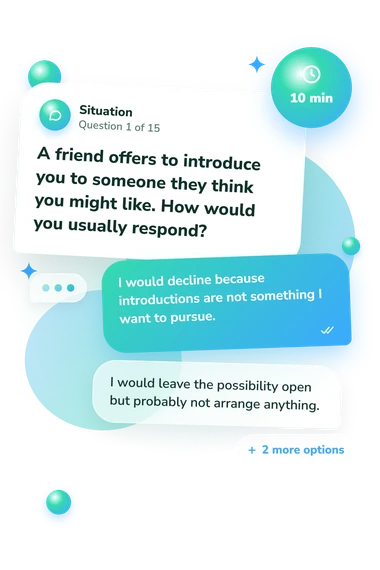
- I would decline because introductions are not something I want to pursue.
- I would leave the possibility open but probably not arrange anything.
- I would ask for some details and consider a low-pressure meeting.
- I would be interested in arranging a casual introduction if the basic fit sounded plausible.
- I usually set the boundary aside to preserve the connection.
- I hint at my discomfort and hope they adjust without a direct request.
- I state the boundary, although I may overexplain or apologize for having it.
- I communicate it clearly and respectfully while accepting that their response provides useful information.
- Almost never; my routines mostly involve familiar people or solitary time.
- Once or twice, usually by coincidence rather than intention.
- Several times through social, community, hobby, work, or dating settings.
- Regularly, because my routine includes multiple ways to encounter new people.
Will I Be Single Forever Quiz - Description and methodology of the test
People questioning whether a relationship fits their life can use the Will I Be Single Forever Quiz to examine present patterns in openness, opportunities, and interaction. It is designed for readers who want to understand how willingness, daily opportunities, and interaction habits may shape their dating experience. It turns that concern into a focused relationship readiness assessment.
What This Assessment Explores
Questions cover partnership priorities, routine openings, and habits supporting mutual relationships. Situations involve introductions, follow-up, boundaries, disclosure, repair, planning, and disappointment. The three dimensions give structure to a fear of being alone, helping you compare willingness with opportunity and skill. They are:
- Openness to Partnership (0-15) shows current room for commitment: Comfortable Independence (0-5) means limited priority, Conditional Openness (6-10) means cautious receptiveness, and Active Openness (11-15) means willingness to integrate a partner.
- Opportunities for Connection (0-15) shows routine openings, not guaranteed chemistry: Limited Exposure (0-5) means few chances, Occasional Openings (6-10) means irregular pathways, and Consistent Openings (11-15) means regular varied opportunities.
- Relationship-Building Skills (0-15) shows communication, pacing, boundaries, and repair: Less Practiced (0-5) means inconsistent use, Emerging Capacity (6-10) means helpful skills are developing, and Established Capacity (11-15) means direct, constructive responses.
Methodology and Evidence Base
Each item presents a situation with four response choices covering different styles or degrees of engagement. Examples address willingness, exposure, initiative, boundaries, communication, pacing, disclosure, and repair. The format is a structured self-report producing three profile scores.
The questionnaire does not document how many points any choice contributes. Read the bands as current tendencies, then compare dimensions: partnership may matter while routines offer few openings, or opportunities may exist while communication and boundary habits need attention. This makes the profile useful for reflecting on partnership priorities.
Conceptually, the partnership-readiness dimension is consistent with Commitment readiness (Hadden et al., 2018), which links willingness to form relationships with relationship formation. The opportunity dimension is consistent with Walldén et al.’s Mate Access Scale, while the skills dimension is consistent with Faber et al.’s Inventory of Romantic Relationship Competence. These are conceptual parallels, not standardized adaptations or validations of those instruments.
Because answers depend on mood, recent experiences, self-awareness, and socially favorable responding, interpret the result as a current self-report snapshot rather than a definitive account of your future.
- Hadden, Benjamin W., Christopher R. Agnew, and Kenneth Tan. (2018). Commitment Readiness and Relationship Formation. Personality and Social Psychology Bulletin, 44(8), 1242-1257. 10.1177/0146167218764668
- Walldén, C., Westerlund, M., Gunst, A., Santtila, P., and Antfolk, J. (2020). Finding the Mating Gear: The Development and Validation of a Mate Access Scale. Evolutionary Psychology, 18(3), 1-9. 10.1177/1474704920935583
- Faber, Anthony J., Chin, Eu Gene, Wilburn, Victor R., and Shafaie, Shahrokh M. (2019). Measuring romantic competence in young adults: The Inventory of Romantic Relationship Competence. Interpersona: An International Journal on Personal Relationships, 13(1), 72-95. 10.5964/ijpr.v13i1.341