
Wife Quiz
How the Scales are Structured
Who Usually Takes This Test?
See How You Compare
Below is a preview of how scores are typically distributed across each scale.
Example Questions From the Test
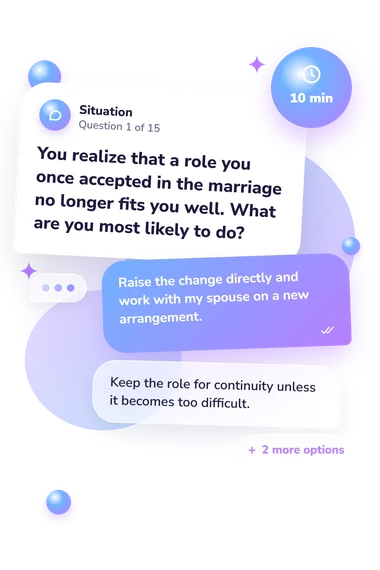
- Raise the change directly and work with my spouse on a new arrangement.
- Keep the role for continuity unless it becomes too difficult.
- Make small adjustments on my own before proposing a larger change.
- Explain what has shifted for me and suggest trying a revised arrangement.
- Somewhat important, though shared plans usually take priority.
- Very important; separate interests help me bring energy and perspective to the marriage.
- Moderately important; I enjoy some independence within a mostly shared life.
- Not especially important; I prefer most of my free time to center on us.
- I usually adapt to what is already happening rather than introduce another preference.
- I state my preference clearly and invite us to shape the plan together.
- I share what matters most to me but stay flexible about the details.
- I hint at what I would enjoy and see whether my spouse picks up on it.
Wife Quiz - Description and methodology of the test
People reflecting on marriage roles, communication, and mutual support can use this wife quiz to organize self-reflection rather than seek a single ideal of being a spouse. It gives structure to asking whether I am a good wife without reducing marriage to a pass-or-fail label. The profile offers a focused starting point for noticing strengths, preferences, and possible areas for conversation.
What This Assessment Explores
Rather than measuring an ideal role, the assessment examines responses to emotional bids, shared decisions, changing responsibilities, and separate interests. It helps readers consider what makes a good wife through everyday patterns, not judgment.
The dimensions are:
- Affection & Emotional Presence (0-15) reflects expressive warmth. Quietly Caring (0-5) suggests understated care; Selectively Expressive (6-10) shows context-sensitive warmth; Emotionally Engaged (11-15) indicates open connection.
- Communication & Teamwork (0-15) reflects explicit communication and collaboration. Independent Processor (0-5) favors private processing; Flexible Collaborator (6-10) combines discussion with judgment; Active Teammate (11-15) favors shared decisions and repair.
- Individuality & Shared Growth (0-15) reflects support for autonomy and adaptable roles. Togetherness-Oriented (0-5) emphasizes shared routines; Balanced Explorer (6-10) balances independence and stability; Growth-Supporting Partner (11-15) supports mutual growth.
These bands show emphasis and style, not love's depth or a superior model of marriage.
Methodology and Scientific Basis
Each item presents a marriage situation with four response options; you choose the reaction that best matches your usual tendency. Scenarios cover affection, support, disagreement, household decisions, role change, and separate interests, inviting pattern recognition rather than ideal-answer checking.
The method is conceptually consistent with the Dyadic Adjustment Scale (Spanier, 1976), especially its focus on relationship functioning. It also aligns with the Relationship Flourishing Scale (Fowers et al., 2016), which views positive partnership functioning as broader than satisfaction, and with responsiveness theory described by Reis and Gable (2015). This questionnaire is not an adaptation of those instruments.
Responses are summarized into the three displayed dimensions, supporting reflection on communication, emotional availability, and support for change. The question of whether you would be a good wife is better treated as a conversation about patterns and values than a universal standard.
The profile presents tendencies, not pass-or-fail judgments. Because answers depend on self-perception, current mood, and context, the result is a structured snapshot rather than a standardized clinical measure and cannot settle whether you are a good wife.
- Spanier, Graham B. (1976). Measuring Dyadic Adjustment: New Scales for Assessing the Quality of Marriage and Similar Dyads. Journal of Marriage and Family, 38(1), 15-28. 10.2307/350547
- Fowers, Blaine J., Laurenceau, Jean-Philippe, Penfield, Randall D., Cohen, Laura M., Lang, Samantha F., Owenz, Meghan B., and Pasipandoya, Elizabeth (2016). Enhancing relationship quality measurement: The development of the Relationship Flourishing Scale. Journal of Family Psychology, 30(8), 997-1007. 10.1037/fam0000263
- Reis, Harry T., and Gable, Shelly L. (2015). Responsiveness. Current Opinion in Psychology, 1, 67-71. 10.1016/j.copsyc.2015.01.001