
Which Health Insurance Is Best for Me Quiz
How the Scales are Structured
Who Usually Takes This Test?
See How You Compare
Below is a preview of how scores are typically distributed across each scale.
Example Questions From the Test
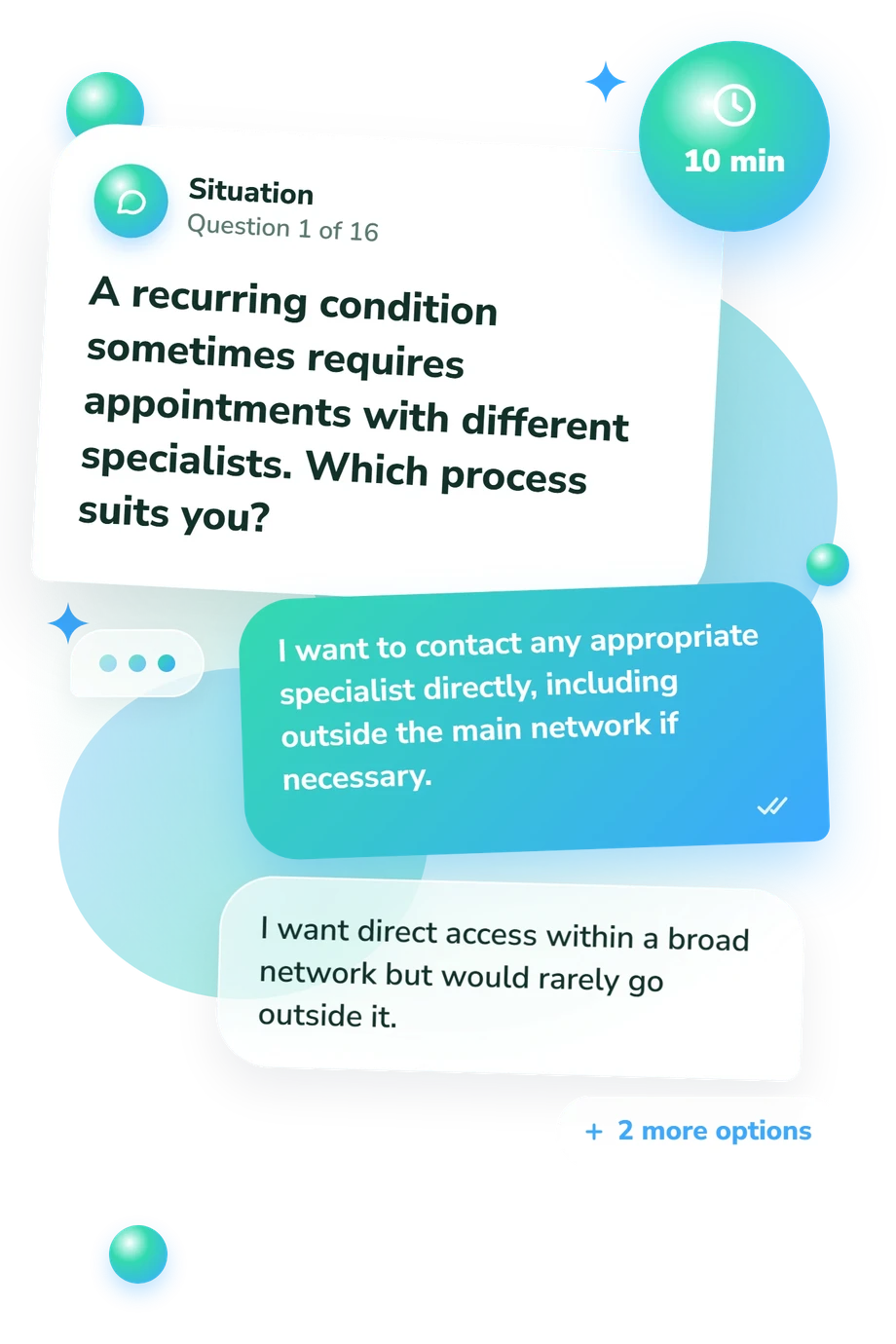
- I want to contact any appropriate specialist directly, including outside the main network if necessary.
- I want direct access within a broad network but would rarely go outside it.
- I can use referrals when needed if there is some flexibility in specialist selection.
- I prefer my primary care clinician to select and coordinate network specialists.
- Primary care should coordinate most treatment, with an option to use non-network care when necessary.
- I want coordination for routine care but would use non-network benefits only in unusual cases.
- I prefer coordinated care entirely within one network.
- I want direct access and broad provider choice without relying on primary care referrals.
- Comfortable, provided the network covers the essential services available in my area.
- Reasonable after I confirm my current clinicians and likely services are included.
- Restrictive enough that I would prefer a broader network, even at some added cost.
- Unsuitable because I expect to use non-network clinicians for routine care.
Which Health Insurance Is Best for Me Quiz - Description and methodology of the test
Choosing coverage becomes easier when you clarify your priorities around coordinated care, specialist access, provider choice, and non-network flexibility. For anyone comparing plan structures, the Which Health Insurance Is Best for Me Quiz turns those priorities into a profile across four arrangements. Readers who approach it as a what health insurance should i get quiz can use the result to organize the next review of networks, costs, and benefits.
What This Assessment Explores
Questions cover coordination, direct specialist access, provider choice, network boundaries, referrals, travel, and non-network administration. Intended readers are clarifying trade-offs before comparing plans.
The result separates four preference patterns. It describes priorities, not insurer performance, quality, or affordability, and can focus a health insurance plan comparison.
The four profiles are:
- EPO Plan (0-12) reflects direct specialist access within one network: Limited EPO fit (0-4), Conditional EPO fit (5-8), or Strong EPO fit (9-12).
- HMO Plan (0-12) reflects primary-care coordination, referrals, and network-focused care: Limited HMO fit (0-4), Conditional HMO fit (5-8), or Strong HMO fit (9-12).
- POS Plan (0-12) reflects coordinated care with out-of-network flexibility: Limited fit (0-4), Conditional fit (5-8), or Strong fit (9-12).
- PPO Plan (0-12) reflects direct access, broad choice, and out-of-network options: Limited PPO fit (0-4), Conditional PPO fit (5-8), or Strong PPO fit (9-12).
Methodology and Interpretation
Each item presents a situation with four responses varying coordination, specialist access, network limits, and out-of-network flexibility. Selecting the closest response makes the task a preference-ranking exercise rather than a knowledge test.
Answers are combined into separate totals for the four profiles and displayed in the catalogue’s bands. The questionnaire has no validated norms, clinical cutoffs, or documented point key, so a higher total means stronger alignment with that profile, not a universal recommendation.
Methodologically, the questionnaire is conceptually consistent with the Health Insurance Navigation Tool (HINT; Zheng and Caban-Martinez, 2021), which examined online insurance-navigation feasibility and acceptability; it is not an adaptation of HINT. Harris’s 2002 choice experiment supports attention to provider access and restricted networks, while Faugno and colleagues’ 2023 qualitative study helps explain why consumers may find non-group plan selection difficult.
When comparing health insurance coverage options, verify networks, referral rules, emergency provisions, prescription coverage, premiums, deductibles, reimbursement, and balance-billing exposure. Preferences can shift with health needs, location, budget, and familiarity with plan rules, so use the profile to focus the next comparison rather than settle it.
- Zheng, Caiwei, and Alberto J. Caban-Martinez. "Acceptability, feasibility and implementation of a web-based U.S. Health Insurance Navigation Tool (HINT)." BMC Research Notes 14, article 165 (2021). 10.1186/s13104-021-05577-w
- Harris, Katherine M. "Can High Quality Overcome Consumer Resistance to Restricted Provider Access? Evidence from a Health Plan Choice Experiment." Health Services Research 37, no. 3 (2002): 551-571. 10.1111/1475-6773.00037
- Faugno, Elena, Melissa B. Gilkey, Lauren A. Cripps, Anna Sinaiko, Alon Peltz, Jon Kingsdale, and Alison A. Galbraith. "Pick a Plan and Roll the Dice": A Qualitative Study of Consumer Experiences Selecting a Health Plan in the Non-Group Market. Health Policy Open 5 (2023): 100112. 10.1016/j.hpopen.2023.100112
Updated: