
Which Haikyuu Character Are You Quiz
How the Scales are Structured
Who Usually Takes This Test?
See How You Compare
Below is a preview of how scores are typically distributed across each scale.
Example Questions From the Test
- Celebrate so loudly and fully that everyone feels the moment
- Offer a quiet acknowledgment that shows I noticed their progress
- Praise the specific improvement that made the success possible
- Point out how their success changes the team’s possibilities
- Model the system quietly before making a significant move
- Repeat the core technique until I can execute it consistently
- Get the group excited and discover the solution through action
- Collect information about how other people have approached it
- Give everyone the same clear technical reminder
- Read each person and tailor my confidence to what motivates them
- Deliver one large, emotional boost to the whole group
- Allow people quiet space to prepare in their own way
Which Haikyuu Character Are You Quiz - Description and methodology of the test
Fans who want to connect their habits with Haikyu!! personalities can use the Which Haikyuu Character Are You Quiz as a playful character-affinity assessment. For readers who enjoy team dynamics and reflective questions, it helps answer what Haikyuu character I am by showing which fictional style most closely echoes how I handle pressure, cooperation, ambition, attention, and energy. It offers comparison rather than a fixed identity.
What This Assessment Explores
The questions cover mistakes, rivalry, technical demands, social situations, group pressure, and limited energy. They give a structured answer to which Haikyuu character I am by showing a leading style and whether a near-leading affinity creates a blended result.
These scales describe the dimensions:
- Kenma Kozume (0-12) reflects quiet analysis and selective energy: Different Rhythm 0-4, Kenma Insight 5-8, Strong Kenma Affinity 9-12.
- Kotaro Bokuto (0-12) reflects expressive confidence and emotional drive: Different Rhythm 0-4, Bokuto Energy 5-8, Strong Bokuto Affinity 9-12.
- Shoyo Hinata (0-12) reflects persistence and growth-focused enthusiasm: Different Rhythm 0-4, Hinata Spark 5-8, Strong Hinata Affinity 9-12.
- Tobio Kageyama (0-12) reflects precision and demanding teamwork: Different Rhythm 0-4, Kageyama Focus 5-8, Strong Kageyama Affinity 9-12.
- Toru Oikawa (0-12) reflects ambition and socially strategic leadership: Different Rhythm 0-4, Oikawa Edge 5-8, Strong Oikawa Affinity 9-12.
Methodology and Scientific Basis
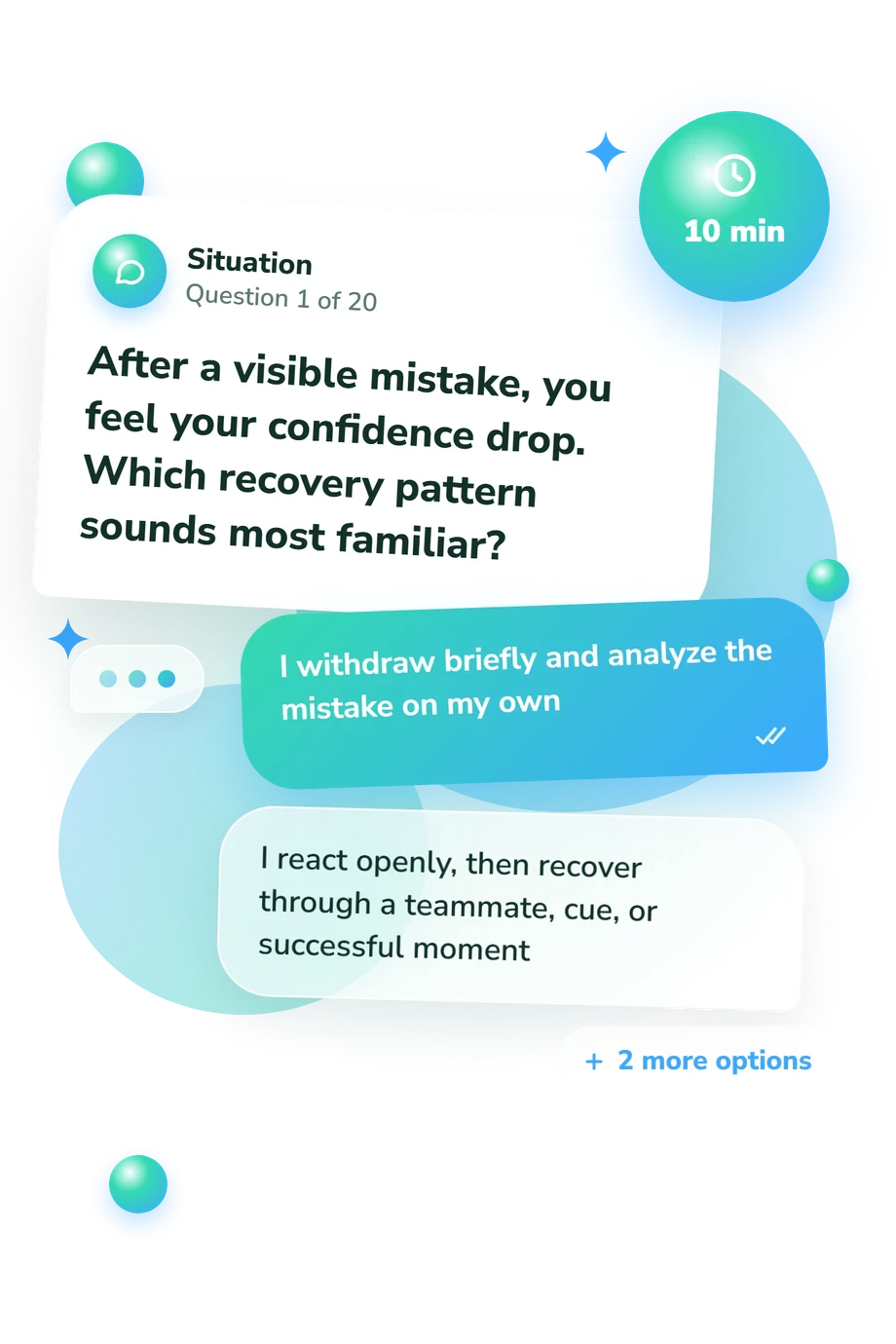
Each item describes a team-related situation and offers four response options. The choices contrast emotional, technical, social, strategic, and energy-management approaches, then map selections onto five character-affinity totals. The result therefore compares relative resemblance rather than producing one overall personality score.
The highest total is the strongest affinity. Any other total within one point of that leader joins the blended result. Its categories are descriptive rather than norm-referenced and do not define a complete personality type.
Rarity et al. (2022) reported that character identification in parasocial relationships can predict sharing personality traits. Huang and Fung (2024) developed and validated a measure of identification with narrative characters. Together, they frame comparison with fictional figures; they do not validate this online questionnaire. The character anchors come from Haruichi Furudate’s Haikyu!!.
As a Haikyuu character quiz, it is an online self-report tool for reflection. Honest answers, self-awareness, current mood, familiarity with the series, and attachment to a favorite character can influence the outcome, so the profile is best treated as a conversation starter rather than a fixed psychological classification.
- Rarity, Erica C., Matthew R. Leitao, and Abraham M. Rutchick. “Identification With Characters in Parasocial Relationships Predicts Sharing Their Personality Traits.” Psychology of Popular Media 11, no. 2 (2022): 111-116. 10.1037/ppm0000389
- Huang, Kate Y., and Helene H. Fung. “Measuring identification with narrative characters: the development and validation of a new scale.” Current Psychology 43 (2024): 24835-24849. 10.1007/s12144-024-06191-2
- Furudate, Haruichi. Haikyu!!, Vol. 1. VIZ Media, 2016. ISBN 978-1-4215-8766-0.
Updated: