
Which DC Villain Are You Quiz
How the Scales are Structured
Who Usually Takes This Test?
See How You Compare
Below is a preview of how scores are typically distributed across each scale.
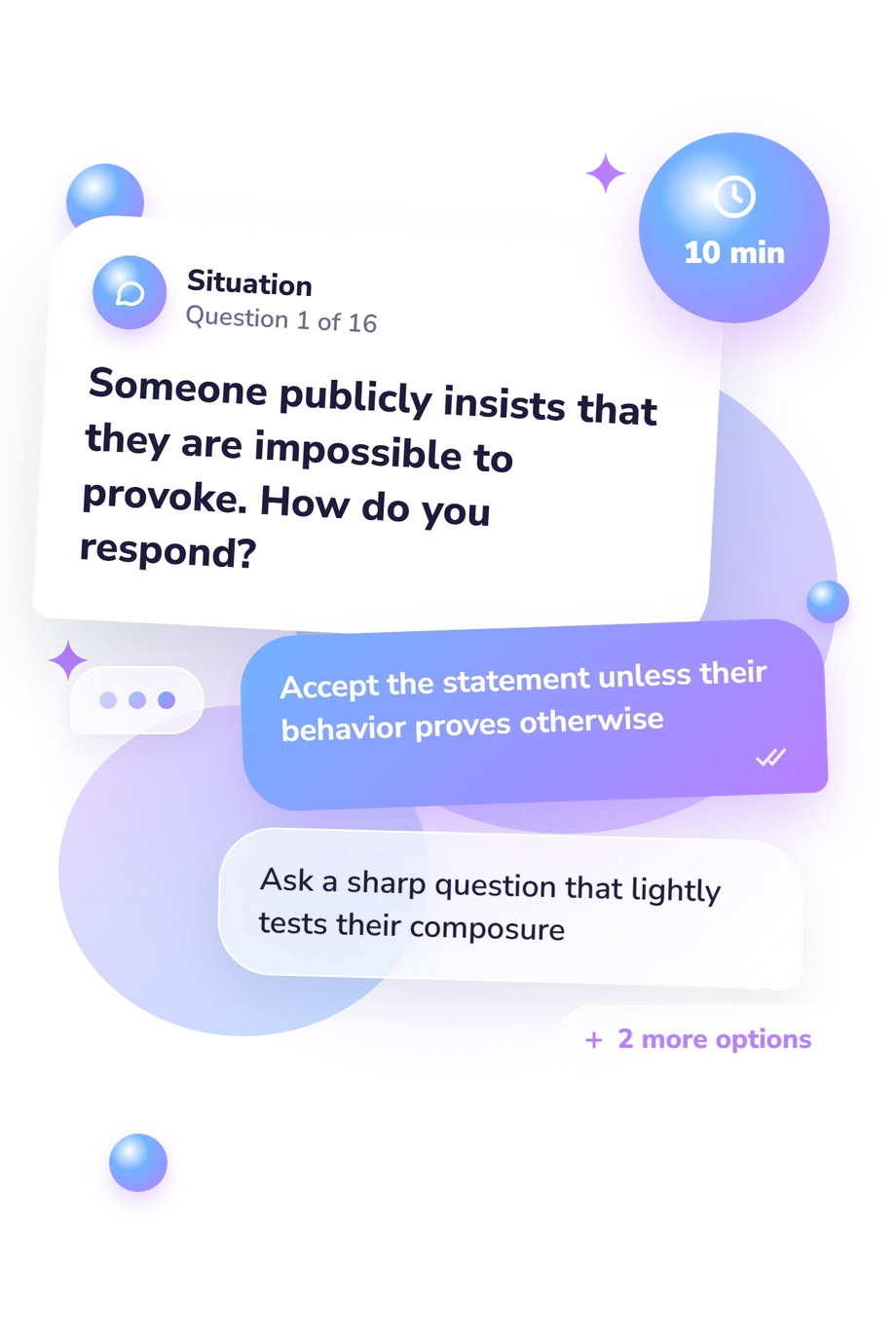
Example Questions From the Test
- Find one interesting person and quietly ignore the ceremony
- Follow the program and focus on why everyone gathered
- Make a pointed joke that exposes how artificial the event feels
- Stage an unforgettable interruption just to transform the mood
- Finding a legitimate invitation through my network
- Entering through the shortcut and blending in as though I belong
- Waiting outside to see whether a spontaneous opportunity appears
- Persuading an attendee to bring me along at the last moment
- In a lively place where other people create energy
- At home with familiar comforts and no demands
- In a quiet garden shared with someone I trust
- Deep among plants, far from crowds and concrete
Which DC Villain Are You Quiz - Description and methodology of the test
Readers who enjoy DC stories and want to reflect on their own motives can use this character-matching assessment as a playful starting point. The Which DC Villain Are You Quiz turns everyday choices about loyalty, freedom, influence, and disruption into a fictional affinity profile. A DC villain personality test format makes the result approachable without treating a character match as a verdict on moral character.
What This Assessment Explores
Instead of criminality, it examines authority, loyalty, risk, ecology, influence, freedom, and disruption. Visitors compare preferences with villain profiles. A DC villain quiz result describes resemblance, not approval of harmful conduct.
The scales and bands are:
- Catwoman (0-12) shows independence, adaptable risk-taking, and flexible rule use: Grounded Loyalist (0-4), Independent Adventurer (5-8), or Elusive Free Spirit (9-12).
- Lex Luthor (0-12) shows strategic intellect, ambition, and self-command: Collaborative Operator (0-4), Calculated Achiever (5-8), or Master Strategist (9-12).
- Poison Ivy (0-12) shows ecological conviction, guarded empathy, and selective loyalty: Human-Centered Pragmatist (0-4), Protective Idealist (5-8), or Nature’s Guardian (9-12).
- The Joker (0-12) shows theatrical unpredictability, provocation, and disruptive humor: Order-Oriented (0-4), Playful Disruptor (5-8), or Agent of Chaos (9-12).
Methodology and Scientific Basis
Each item presents a social or practical situation with four response options. Choices feed four affinity scores, and the highest score indicates the strongest affinity. Any score within one point of the highest score contributes to a blended result. The output is comparative, not a right-or-wrong tally.
Conceptually, Kjeldgaard-Christiansen et al. (2021) examine personality and engagement with fictional villainy. Black et al. (2019) discuss morality, Machiavellian tendencies, and enjoyment of morally dark fictional figures. Huang and Fung (2024) address narrative-character identification, a related but distinct construct from fictional-trait affinity. These studies provide conceptual context only: they do not establish the validity or standardization of this questionnaire, its four character scales, or its displayed bands, and this questionnaire is not an adaptation of their instruments.
This is an online fictional-affinity questionnaire with non-standardized scoring; its displayed bands are descriptive categories rather than norm-based thresholds. Response bias, familiarity with the characters, current mood, and self-awareness can shift answers. As a DC villain personality quiz, it offers a snapshot of fictional affinity, not a fixed personality diagnosis.
- Kjeldgaard-Christiansen, Jens, Anne Fiskaali, Henrik Høgh-Olesen, John A. Johnson, Murray Smith, and Mathias Clasen. "Do Dark Personalities Prefer Dark Characters? A Personality Psychological Approach to Positive Engagement with Fictional Villainy." Poetics 85 (2021): 101511. 10.1016/j.poetic.2020.101511
- Black, Jessica E., Yomna Helmy, Olivia Robson, and Jennifer L. Barnes. "Who Can Resist a Villain? Morality, Machiavellianism, Imaginative Resistance and Liking for Dark Fictional Characters." Poetics 74 (2019): 101344. 10.1016/j.poetic.2018.12.005
- Huang, Kate Y., and Helene H. Fung. "Measuring Identification with Narrative Characters: The Development and Validation of a New Scale." Current Psychology 43 (2024): 24835-24849. 10.1007/s12144-024-06191-2
Updated: