
Which Contact Lenses Are Best for Me Quiz
How the Scales are Structured
Who Usually Takes This Test?
See How You Compare
Below is a preview of how scores are typically distributed across each scale.
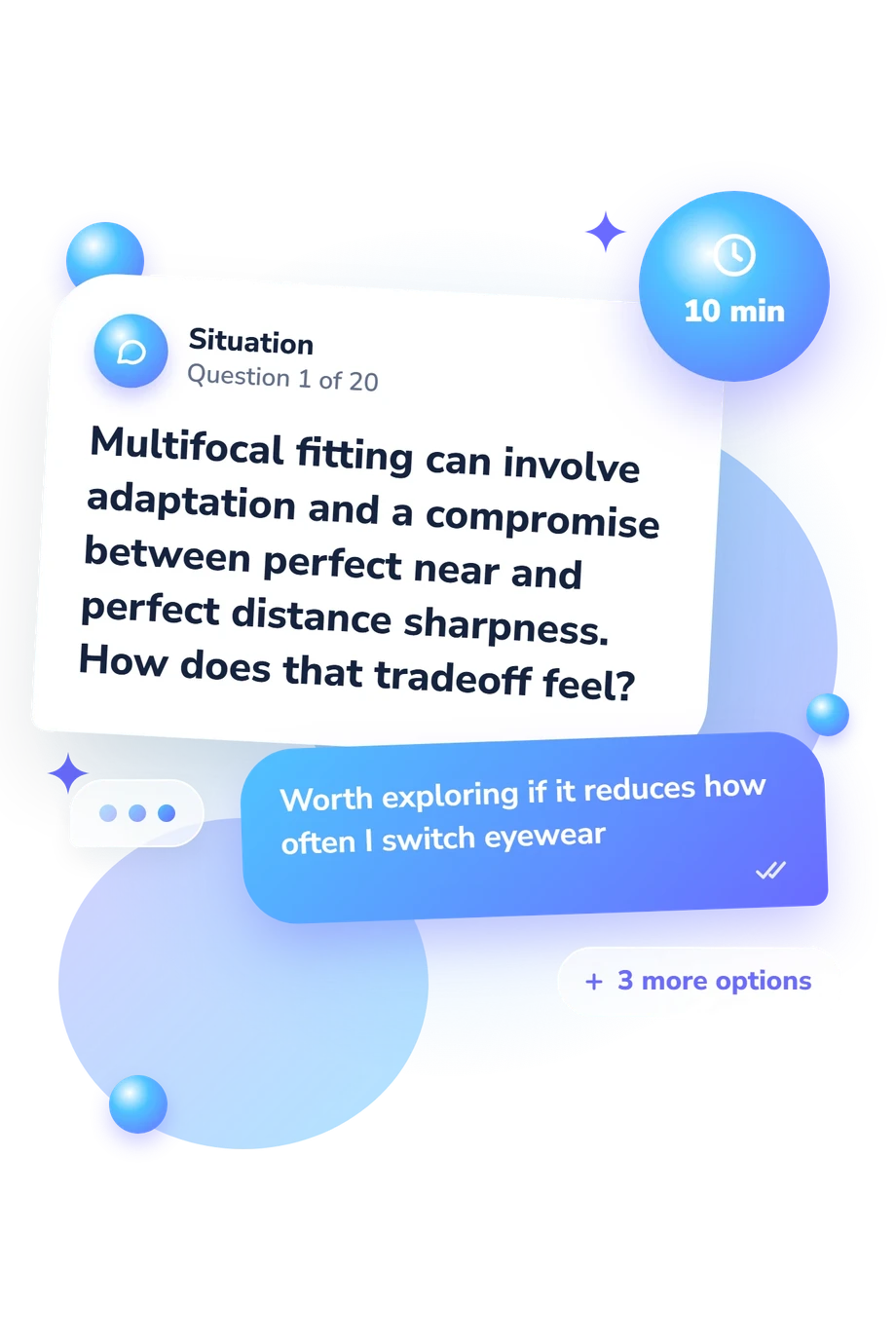
Example Questions From the Test
- Reducing cost per wear is a major priority for me
- Cost matters, but avoiding care matters more
- I want reasonable value and can accept some maintenance
- My choice would depend more on occasional-use convenience
- Comfortable; precision handling would not bother me
- Willing to learn if there were a meaningful visual benefit
- Unsure, but I could try it before choosing
- I strongly prefer the handling and feel of soft lenses
- Stable distance detail that accounts for my known astigmatism
- Basic convenience even if fine detail varies slightly
- A balance between stable detail and easy availability
- I am still determining whether variable detail is an issue for me
Which Contact Lenses Are Best for Me Quiz - Description and methodology of the test
People comparing lens formats can use the Which Contact Lenses Are Best for Me Quiz to organize preferences before an appointment. Rather than deciding whether someone should wear contacts, it organizes discussion points for a contact lens fitting, connecting daily habits with visual demands, care routines, and willingness to adapt. The result is most useful to a reader considering which formats and trade-offs to discuss with an eye-care professional.
What This Assessment Explores
These contact lens options cover routines, prescriptions, visual priorities, and adaptation. Scores show affinity, not physical fit or fitting advice. The dimensions are:
- Daily Disposable Soft Lenses (0-12) reflect fresh-pair affinity amid routine, frequency, budget, and waste priorities; Limited affinity 0-4; Possible affinity 5-8; Strong affinity 9-12.
- Multifocal Contact Lenses (0-12) reflect affinity for documented near-vision needs and distance switching; Limited affinity 0-4; Possible affinity 5-8; Strong affinity 9-12.
- Reusable Soft Lenses (0-12) reflect affinity where care, frequent wear, and value per wear align; Limited affinity 0-4; Possible affinity 5-8; Strong affinity 9-12.
- Rigid Gas-Permeable (RGP) Lenses (0-12) reflect affinity for specialist advice, demanding vision, or adaptation; Limited affinity 0-4; Possible affinity 5-8; Strong affinity 9-12.
- Toric Contact Lenses (0-12) reflect affinity when prescription or stability information points to astigmatism correction; Limited affinity 0-4; Possible affinity 5-8; Strong affinity 9-12.
Methodology and Scientific Basis
Each item offers four choices about wear frequency, care, cost, near-and-distance demands, experience, and professional advice. Self-report produces five separate scores rather than one ranking. Results show ranges, but the questionnaire does not explain response scoring.
Morgan and Efron (2022) provide context. CLEAR optics addresses design and performance; CLEAR evidence-based practice covers history, assessment, fitting, adaptation, care, and aftercare. Swingle Fogt, Satiani, and Patton (2023) compare daily disposable and reusable toric wear. The questionnaire is conceptually consistent with these sources, not an adaptation of them.
The questionnaire does not assess cosmetic colour preferences; it examines vision needs, prescription information, contact lens care, replacement preferences, and adaptation. No norms or reliability estimates are reported, so the bands are affinity categories rather than population norms. Context, memory, response bias, and self-awareness can shape results; scores cannot establish prescription, astigmatism, presbyopia, or safe wear. Use your profile to prepare questions for fitting; seek urgent eye care for significant pain, marked redness, injury, or sudden vision changes.
- Morgan PB, Efron N. Global contact lens prescribing 2000-2020. Clinical and Experimental Optometry. 2022;105(3):298-312. 10.1080/08164622.2022.2033604
- Richdale K, Cox I, Kollbaum P, Bullimore MA, Bakaraju RC, Gifford P, Plainis S, McKenney C, Newman S, Tomiyama ES, Morgan PB. CLEAR - Contact lens optics. Contact Lens and Anterior Eye. 2021;44(2):220-239. 10.1016/j.clae.2021.02.005
- Wolffsohn JS, Dumbleton K, Huntjens B, Kandel H, Koh S, Kunnen CME, Nagra M, Pult H, Sulley AL, Vianya-Estopa M, Walsh K, Wong S, Stapleton F. CLEAR - Evidence-based contact lens practice. Contact Lens and Anterior Eye. 2021;44(2):368-397. 10.1016/j.clae.2021.02.008
- Swingle Fogt J, Satiani N, Patton K. Wear Experience with a daily disposable soft contact lens for astigmatism in current wearers of a reusable soft toric contact lens. Journal of Contact Lens Research and Science. 2023;7(1):e1-e6. 10.22374/jclrs.v7i1.54
Updated: