
Which Bible Character Are You Quiz
How the Scales are Structured
Who Usually Takes This Test?
See How You Compare
Below is a preview of how scores are typically distributed across each scale.
Example Questions From the Test
- Learn how the community works, contribute through practical effort, and stay close to the people I chose to join.
- Use the change as a chance to reinvent myself and pursue an independent opportunity.
- Find a clear structure or experienced mentor before deciding where I belong.
- Keep my options open and avoid firm commitments until I know the place better.
- Study the relationships in the room, refine the framing, and choose the moment when the proposal can have the most influence.
- State the central demand directly at the beginning so everyone knows where I stand.
- Build support beforehand but ask a more established spokesperson to deliver the proposal.
- Submit a carefully written proposal and let its evidence speak for itself.
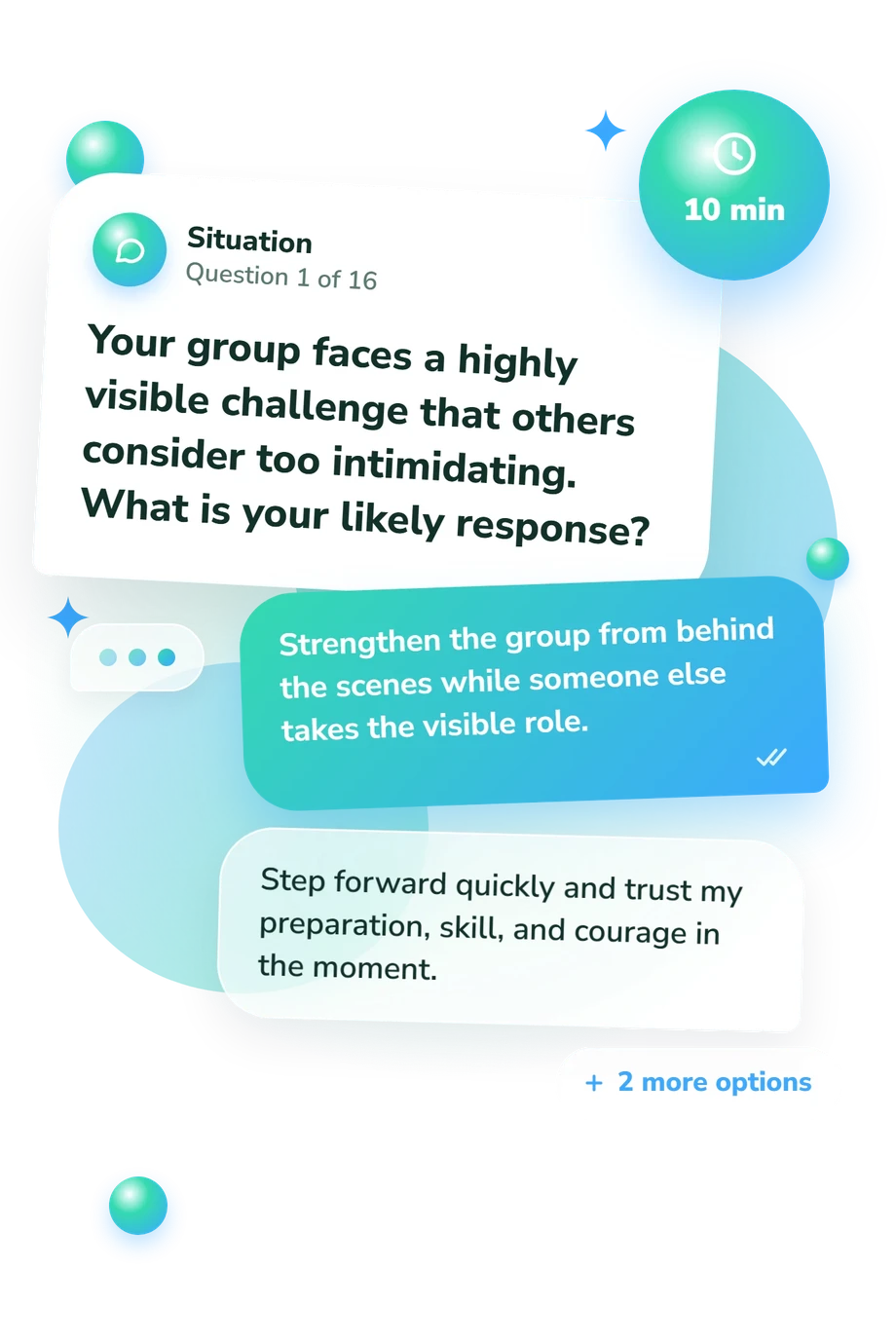
- Strengthen the group from behind the scenes while someone else takes the visible role.
- Step forward quickly and trust my preparation, skill, and courage in the moment.
- Develop an unconventional plan and recruit a few people to help carry it out.
- Wait for someone with more experience before deciding how I can contribute.
Which Bible Character Are You Quiz - Description and methodology of the test
People drawn to biblical narratives can use the Which Bible Character Are You Quiz to reflect on how they approach courage, influence, loyalty, and responsibility. It is intended for anyone who wants a symbolic character profile tied to everyday choices, rather than a literal identity match. As a bible character quiz, it gives language for patterns that may otherwise be difficult to name.
What This Assessment Explores
The questionnaire examines choices about change, influence, challenge, repair, care, emotion, and leadership. Its result identifies a style visible in responses. In the what bible character are you quiz, biblical figures mirror behavior; the profile describes tendencies.
The four dimensions are:
- David (0-12) measures expressive courage and candid growth; Measured Style (0-4) favors deliberation, Emerging Challenger (5-8) shows selective courage, and David Affinity (9-12) reflects alignment.
- Esther (0-12) measures preparation, timing, and advocacy; Direct or Independent Route (0-4) favors autonomy, Thoughtful Advocate (5-8) balances caution, and Esther Affinity (9-12) reflects influence.
- Moses (0-12) measures principled leadership and responsibility; Different Center (0-4) favors other roles, Situational Guide (5-8) leads as needed, and Moses Affinity (9-12) reflects perseverance.
- Ruth (0-12) measures loyalty, care, and adaptation; Independent Path (0-4) favors autonomy, Steady Companion (5-8) shows dependable care, and Ruth Affinity (9-12) reflects commitment.
Methodology and Scientific Basis
Each prompt offers four response options describing reactions, making the task comparative self-report rather than a factual knowledge test. Choosing the closest response turns what bible character am i quiz into reflection on preferences, not biblical expertise.
Results are read across separate character dimensions, not as one total score. The who am i in the bible quiz framing is symbolic: it links response patterns with narrative qualities rather than declaring a literal match.
Friedman and Friedman (2026) is the closest conceptual reference for consequential choices in biblical heroes, while Rabin (2020) pairs heroism with fallibility. Peterson and Seligman (2004) adds a character-strength vocabulary, and Huang and Fung (2024) supports research on narrative-character identification. Together, these sources are theoretical reference points, not evidence that this questionnaire adapts or validates any one instrument.
Individual point allocations and population norms are not stated, so the displayed bands are descriptive levels of affinity rather than clinical cutoffs; self-report may also shift with mood, memory, self-awareness, or the imagined situation, making the profile a reflection prompt rather than a diagnosis.
- Friedman, Hershey H., and Linda Weiser Friedman. 2026. "The Power of Choice: Transformative Moments in the Lives of Biblical Heroes." The Journal of Values-Based Leadership 19(1), Article 14. DOI 10.22543/1948-0733.1578
- Rabin, Elliott. 2020. The Biblical Hero: Portraits in Nobility and Fallibility. Philadelphia: Jewish Publication Society; Lincoln: University of Nebraska Press. DOI 10.2307/j.ctvw04kp4
- Peterson, Christopher, and Martin E. P. Seligman. 2004. Character Strengths and Virtues: A Handbook and Classification. Washington, DC: American Psychological Association; New York: Oxford University Press
- Huang, Kate Y., and Helene H. Fung. 2024. "Measuring identification with narrative characters: the development and validation of a new scale." Current Psychology 43:24835-24849. DOI 10.1007/s12144-024-06191-2
Updated: