
What YouTuber Am I Quiz
How the Scales are Structured
Who Usually Takes This Test?
See How You Compare
Below is a preview of how scores are typically distributed across each scale.
Example Questions From the Test
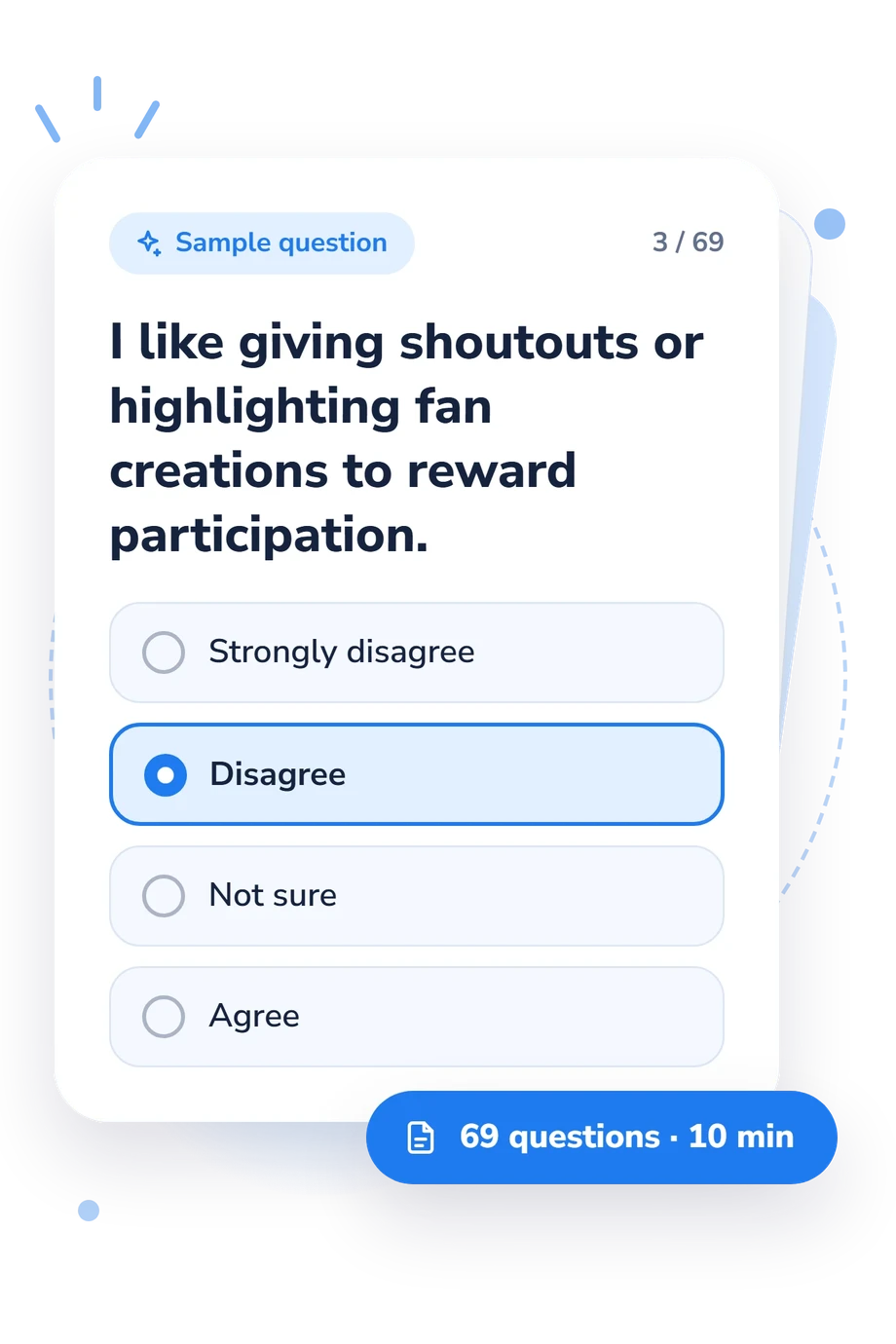
- Strongly disagree
- Disagree
- Not sure
- Agree
- Strongly disagree
- Disagree
- Not sure
- Agree
- Strongly disagree
- Disagree
- Not sure
- Agree
What YouTuber Am I Quiz - Description and methodology of the test
For people exploring a possible channel identity, the What YouTuber Am I Quiz turns creator preferences into a practical profile. It can help you choose early content experiments and shape a channel around your instincts. The result also uses the quiz to answer which YouTuber you are, highlighting the working style that may feel natural to you. It gives language to choices that might otherwise remain intuitive.
What This Assessment Explores
Three dimensions cover audience relationship, production preference, and presentation style. Together they describe a possible creator profile, not technical ability or a fixed identity. The result helps identify which creator style may fit your instincts and guide early choices about format and audience relationship, making this a useful YouTube personality quiz for self-reflection.
The displayed dimensions are:
- Community Builder (0-20) measures how strongly you prioritize viewer interaction, loyalty, and collaboration: Content-First (0-6), Balanced Engager (7-13), or Community-Driven (14-20).
- Editing & Production Style (0-20) measures your preference for casual simplicity or structured, polished, fast-paced storytelling: Raw & Minimal Edit (0-6), Balanced & Structured (7-13), or Fast-Paced & High-Polish (14-20).
- On-Camera Charisma (0-20) measures expressive confidence and comfort as the face of a channel: Reserved Presence (0-7), Comfortable Host (8-14), or Magnetic On-Camera (15-20).
Methodology and Evidence Base
The questions use first-person statements about creator choices or on-camera situations. Graded agreement options move from disagreement toward agreement, but choices vary across items: some include “Not sure” and others do not. This self-report format captures preferences and perceived comfort rather than observed performance.
Scoring combines responses into the three dimensions above; higher scores indicate more of the tendency named by the dimension. Because no item-by-item point formula is published, the ranges are best read through their displayed bands rather than reverse-engineered into exact scoring rules.
The questionnaire is separate from Ferchaud et al. (2018), who examined audience-oriented and parasocial features around YouTube personalities; Guo et al. (2014), who explored pacing and visual structure in educational videos; and Berger, Niebuhr, and Zellers (2019), who studied prosodic variation alongside YouTube attention measures. These papers are contextual parallels, not evidence validating this questionnaire, its dimensions, or its scoring model.
As a YouTube creator quiz, it supports reflection. Results can shift with goals, self-awareness, and response bias, so compare them with your comfort on camera, willingness to engage viewers, and editing workflow when planning content experiments.
- Ferchaud, Arienne, Jenna Grzeslo, Stephanie Orme, and Jared LaGroue. (2018). Parasocial attributes and YouTube personalities: Exploring content trends across the most subscribed YouTube channels. Computers in Human Behavior, 80, 88-96. 10.1016/j.chb.2017.10.041
- Guo, Philip J., Juho Kim, and Rob Rubin. (2014). How video production affects student engagement: An empirical study of MOOC videos. Proceedings of the First ACM Conference on Learning @ Scale Conference, 41-50. 10.1145/2556325.2566239
- Berger, Stephanie, Oliver Niebuhr, and Margaret Zellers. (2019). A preliminary study of charismatic speech on YouTube: Correlating prosodic variation with counts of subscribers, views and likes. Proceedings of Interspeech 2019, 1761-1765. 10.21437/Interspeech.2019-1664
Updated: