
What Will I Look Like When I'm Older Quiz
How the Scales are Structured
Who Usually Takes This Test?
See How You Compare
Below is a preview of how scores are typically distributed across each scale.
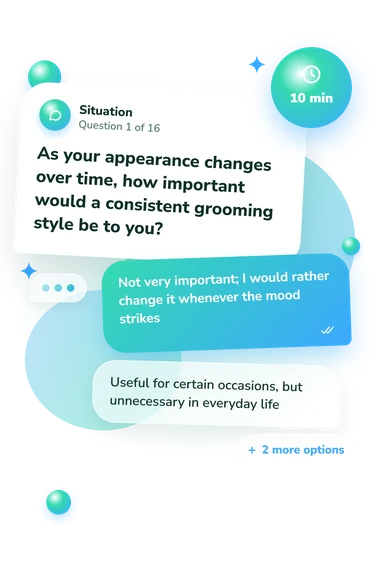
Example Questions From the Test
- Toward a stable palette of understated shades
- Mostly familiar colors with a brighter detail now and then
- Toward frequent contrasts and colors that visibly shape an outfit
- Into a flexible mix that includes several noticeable combinations
- Admire it but choose a quieter alternative for myself
- Wear it only when the setting calls for something memorable
- Build several outfits around it so it becomes part of my style
- Use it regularly, balanced with simpler clothing
- Crisp fabrics and clearly structured silhouettes
- Mostly shaped pieces softened by an occasional relaxed layer
- A balance of easy fabrics and lightly defined fits
- Breathable textures, gentle drape, and room to move
What Will I Look Like When I'm Older Quiz - Description and methodology of the test
People deciding whether to take the What Will I Look Like When I'm Older Quiz can use it to compare which aesthetic priorities feel most relevant to an imagined future wardrobe. This future appearance quiz compares grooming, color, comfort, polish, and self-expression, helping a reader decide whether the focused exercise fits their curiosity. It does not require a fixed prediction about appearance.
What This Assessment Explores
Questions cover grooming, color, coordination, fabric, fit, footwear, accessories, hair changes, and activity-inspired clothing in an imagined older wardrobe. Results reflect aesthetic preference, not physical aging. Questions turn the familiar what will i look like when i grow up quiz into a comparison of future style rather than physical appearance.
These are the four profile dimensions:
- Active & Casual (0-12) measures casual, movement-friendly style: Situational Ease (0-4), Active Influence (5-8), Active Signature (9-12).
- Bold & Expressive (0-12) measures visible experimentation: Quiet Accents (0-4), Expressive Influence (5-8), Bold Signature (9-12).
- Natural & Relaxed (0-12) measures relaxed textures and grooming: Selective Simplicity (0-4), Relaxed Influence (5-8), Natural Signature (9-12).
- Polished & Timeless (0-12) measures coordinated refinement: Occasional Polish (0-4), Timeless Influence (5-8), Polished Signature (9-12).
The highest score shows the strongest affinity; profiles within one point of it form a blended result.
Methodology and Scientific Basis
Each item presents a future-style situation with four response options. Scenarios cover routines, celebrations, wardrobe habits, hair changes, color, fabric, shoes, accessories, and activity-inspired clothing, allowing respondents to choose a close preference rather than rate a general personality trait. The what will i look like when i get older quiz framing keeps attention on self-presentation and wardrobe choices.
Scoring is profile-based, not a single total: four scores are compared; the strongest shows leading affinity, and scores within one point of it form a blended result. The bands describe style affinity, not a predicted appearance.
As conceptual points of comparison, Kwon and Parham (1994) examine clothing practices and body-image perceptions, while Stolovy (2021) connects styling with personality traits and body image. Sontag and Lee's clothing-self proximity measure is a published scale for reading dress as self-representation. Markus and Nurius's possible-selves framework describes imagined future identity. These works are not source instruments for this questionnaire.
As an online self-reflection questionnaire, it uses descriptive preference bands; results can reflect current context, self-awareness, and response bias rather than a fixed future outcome.
- Kwon, Yoon-Hee, and Ellen S. Parham. (1994). Effects of State of Fatness Perception on Weight Conscious Women's Clothing Practices. Clothing and Textiles Research Journal, 12(4), 16-21. 10.1177/0887302X9401200403
- Stolovy, Tali. (2021). Styling the Self: Clothing Practices, Personality Traits, and Body Image Among Israeli Women. Frontiers in Psychology, 12, 719318. 10.3389/fpsyg.2021.719318
- Sontag, M. Suzanne, and Jongnam Lee. (2004). Proximity of Clothing to Self Scale. Clothing and Textiles Research Journal, 22(4), 161-177. 10.1177/0887302X0402200402
- Markus, Hazel, and Paula Nurius. (1986). Possible Selves. American Psychologist, 41(9), 954-969. 10.1037/0003-066X.41.9.954