
What Type of Cough Do I Have Quiz
How the Scales are Structured
Who Usually Takes This Test?
See How You Compare
Below is a preview of how scores are typically distributed across each scale.
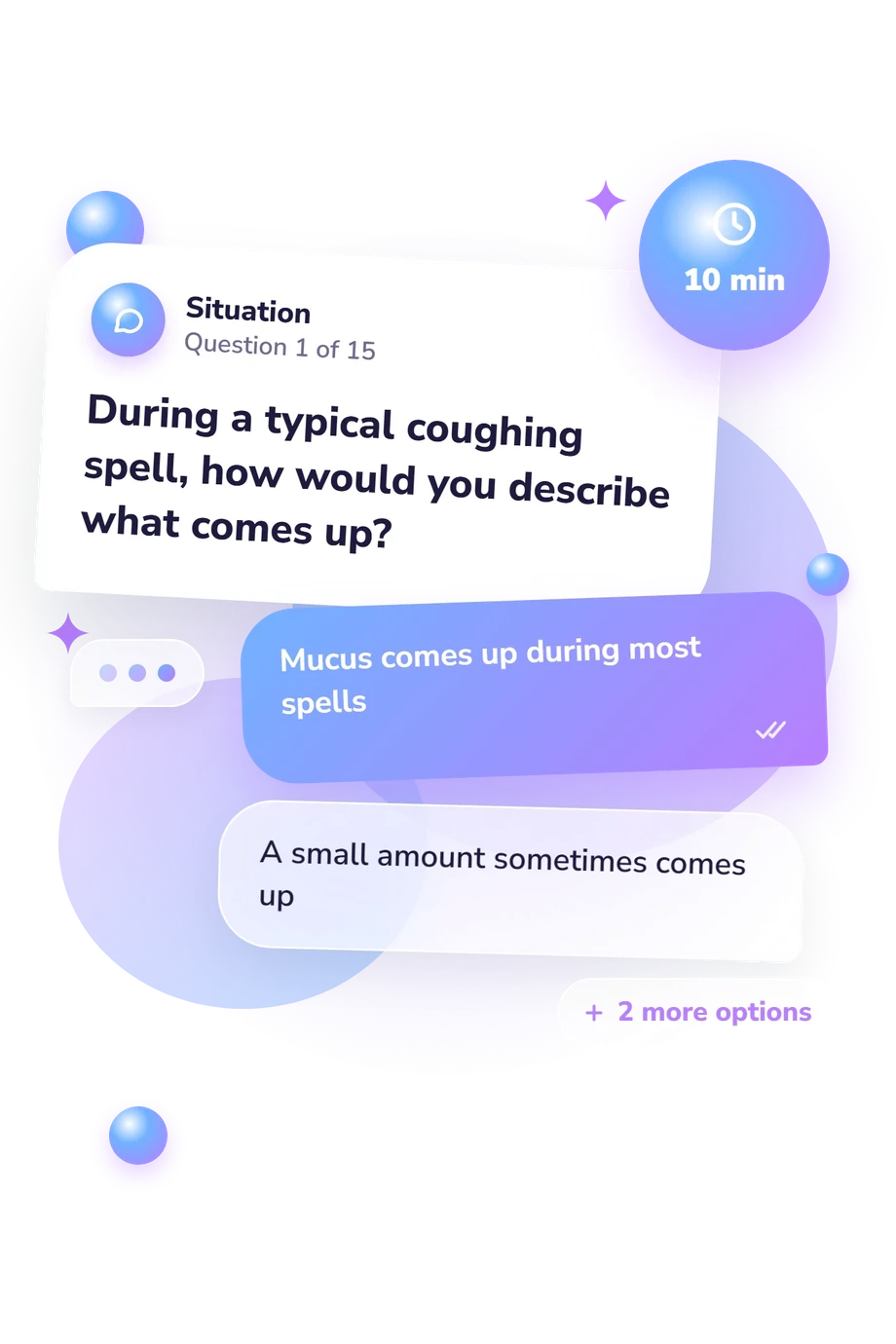
Example Questions From the Test
- Never or almost never
- Once in a while
- During several coughing spells
- During most coughing spells
- There is no visible material
- There is only a thin trace or tiny amount
- There is a noticeable but limited amount
- There is a substantial, thick, or repeatedly produced amount
- A deep feeling of chest congestion
- No consistent warning sensation
- An occasional tickle or dry patch in my throat
- A repeated scratchy, tickling, or burning irritation
What Type of Cough Do I Have Quiz - Description and methodology of the test
For readers seeking a structured way to sort unfamiliar symptoms, the What Type of Cough Do I Have Quiz organizes a cough around observable features and warning signs. It offers a what kind of cough do I have quiz format, using symptom patterns rather than a single cause. The intended user is anyone deciding whether monitoring, pharmacy advice, or clinical contact fits the situation.
What This Assessment Explores
The questionnaire separates irritation-led and mucus-associated experiences while also screening for urgent warning signs. Items ask about material brought up, throat or chest sensations, triggers, timing, breathing, fever, hydration, blood, pain, and relevant exposure or health context. As a cough symptoms quiz, it turns these observations into a profile rather than a disease label.
The displayed result types are:
- Clinical Review Signals (0-15) flags endorsed warning experiences: No listed signal 0, Check-in indicated 1-2, and Prompt action 3-15; one red flag overrides the total.
- Dry or Irritative Cough Pattern (0-15) reflects dry or tickly features, not their cause: Few dry features 0-5, Mixed dry features 6-10, Strong dry pattern 11-15.
- Mucus-Producing Cough Pattern (0-15) summarizes mucus, congestion, and clearing sensations: Few mucus features 0-5, Mixed mucus features 6-10, Strong mucus pattern 11-15.
Methodology and Evidence Base
Four response descriptions are used for each situation, allowing the respondent to distinguish absent, mild, mixed, pronounced, or urgent features without requiring a technical diagnosis. The questions group experiences around mucus, irritation, course, triggers, associated symptoms, and safety signals. Separate totals preserve the possibility that dry and mucus features coexist.
Scoring is descriptive: responses are converted into the displayed totals, but the ranges are not validated severity indices and do not identify an underlying disease. The questionnaire is conceptually consistent with the BTS chronic cough statement (Parker et al., 2023), the CHEST report by Irwin et al. (2018), and ERS guidance by Morice et al. (2020); it is not presented as an adaptation or validated implementation of those publications.
Viewed as a dry cough or mucus cough test, it can help a reader recognize which descriptions fit best while keeping warning signs in view. Because answers rely on self-report and current context, results may shift with recall or symptom changes; they do not establish a cause or diagnosis, and persistent, worsening, bloody, or concerning symptoms warrant medical advice.
- Parker SM, Smith JA, Birring SS, et al. British Thoracic Society Clinical Statement on chronic cough in adults. Thorax. 2023;78(Suppl 6):s3-s19. 10.1136/thorax-2023-220592
- Irwin RS, French CL, Chang AB, Altman KW, et al. Classification of Cough as a Symptom in Adults and Management Algorithms: CHEST Guideline and Expert Panel Report. Chest. 2018;153(1):196-209. 10.1016/j.chest.2017.10.016
- Morice AH, Millqvist E, Bieksiene K, et al. ERS guidelines on the diagnosis and treatment of chronic cough in adults and children. European Respiratory Journal. 2020;55(1):1901136. 10.1183/13993003.01136-2019
Updated: