
What NBA Player Am I Quiz
How the Scales are Structured
Who Usually Takes This Test?
See How You Compare
Below is a preview of how scores are typically distributed across each scale.
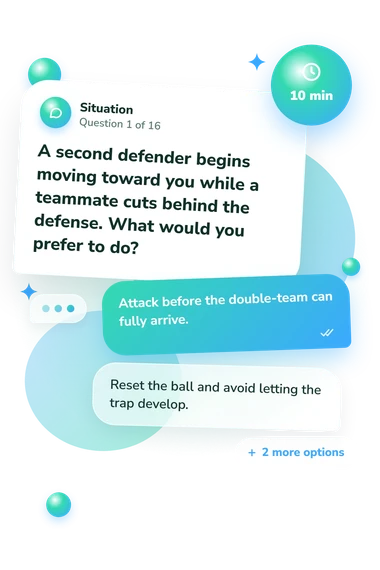
Example Questions From the Test
- Identify everyone’s strengths and help organize useful roles.
- Concentrate on performing your own specialty reliably.
- Keep the ball moving and learn the group through live play.
- Raise the pace so the lineup can play on instinct.
- Save energy and remain available for a reset pass.
- Look for rebounding position or a strong cut inside.
- Use a screen, then adjust according to the defense.
- Keep relocating so defenders must track you continuously.
- Relocate immediately to create a new shooting angle.
- Cut hard toward the rim and invite contact.
- Move into position to organize the next action.
- Hold your spacing and let the ball handler work.
What NBA Player Am I Quiz - Description and methodology of the test
Readers who want to connect basketball preferences with recognizable playing styles can use this assessment for structured self-reflection. As a basketball personality quiz, it suits fans curious about decision-making, movement, leadership, creativity, and team roles. The What NBA Player Am I Quiz offers a way to consider how someone might contribute under pressure and fit into a changing lineup.
What This Assessment Explores
The questionnaire explores pressure, transition, movement, preparation, role changes, defense, passing, and mistakes. It suits fans comparing stated basketball preferences with four player-style profiles.
The result is an affinity profile, not an athletic ranking. This quiz asks what NBA player you are by exploring which player style the choices resemble in creating advantages, sharing responsibility, and adapting.
The displayed profiles are:
- Giannis Antetokounmpo (0-12) reflects downhill force, defensive range, growth, and energy: Measured Method (0-4), Driving Energy (5-8), Giannis-Like Style (9-12).
- LeBron James (0-12) reflects versatility, court vision, leadership, and influence: Specialist Instinct (0-4), Versatile Presence (5-8), LeBron-Like Style (9-12).
- Nikola Jokić (0-12) reflects patience, unconventional vision, efficiency, and control: Direct Approach (0-4), Creative Connector (5-8), Jokić-Like Style (9-12).
- Stephen Curry (0-12) reflects movement, long-range confidence, adaptability, and team energy: Different Rhythm (0-4), Shared Spark (5-8), Curry-Like Style (9-12).
Methodology and Research Context
Each item presents a basketball situation with four responses. The scenes cover pressure, movement, role changes, and defense. This format elicits stated preferences in hypothetical situations and does not measure observed basketball performance.
Four scores compare responses with the player-style profiles. The highest shows strongest affinity; scores within one point form a blended result. The score compares choices with profiles rather than assigning identity. This keeps overlap visible. This quiz can answer which NBA player you are without forcing one choice.
A 2022 NBA network-clustering study by Muniz and Flamand treats roles as connected, not rigid. A 2017 role-analysis study by Bianchi, Facchinetti, and Zuccolotto and 2024 clustering work by Duman, Sennaroğlu, and Tuzkaya provide context on overlapping roles. These studies provide no psychometric evidence for this quiz about which NBA player I am, its scores, or result bands.
This self-report tool is not standardized. Mood, basketball knowledge, self-perception, and player interpretation may affect responses, making the result a preference snapshot, not a diagnosis or fixed ability.
- Megan Muniz and Tulay Flamand. A weighted network clustering approach in the NBA. Journal of Sports Analytics, 8, 251-275 (2022). 10.3233/JSA-220584
- Federico Bianchi, Tullio Facchinetti, and Paola Zuccolotto. Role revolution: Towards a new meaning of positions in basketball. Electronic Journal of Applied Statistical Analysis, 10(3), 712-734 (2017). 10.1285/i20705948v10n3p712
- Eyüp Anıl Duman, Bahar Sennaroğlu, and Gülfem Tuzkaya. A cluster analysis of basketball players for each of the five traditionally defined positions. Proceedings of the Institution of Mechanical Engineers, Part P: Journal of Sports Engineering and Technology, 238(1), 55-75 (2024). 10.1177/17543371211062064
Updated: