
What Is My Type Quiz
How the Scales are Structured
Who Usually Takes This Test?
See How You Compare
Below is a preview of how scores are typically distributed across each scale.
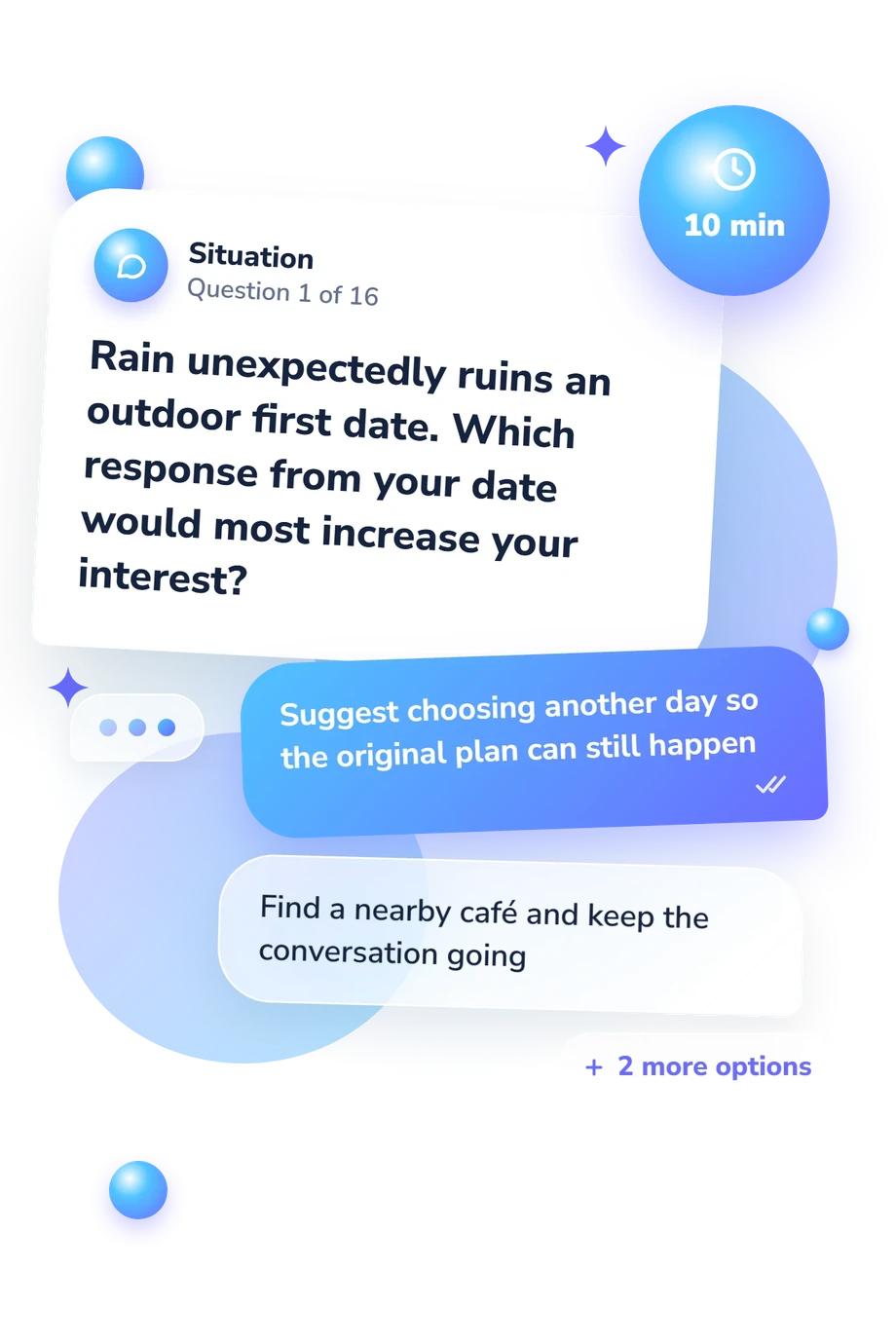
Example Questions From the Test
- They continue introducing me to unpredictable experiences
- They maintain the chemistry and make room for deeper talks
- They begin including me in realistic plans for the near future
- Their actions consistently match what they say they will do
- Measured and familiar, with very few surprises
- Mostly grounded, with room for an occasional change of pace
- Playful and open to trying unfamiliar things together
- Bold, expressive, and ready to follow an unexpected spark
- I would prefer to plan something together for a later date
- I might join if the practical details are already settled
- I would be intrigued and probably rearrange a few things
- I would feel energized by the surprise and want to go
What Is My Type Quiz - Description and methodology of the test
People curious about the qualities that draw them toward a partner can use the What Is My Type Quiz as a structured prompt for exploring romantic preferences. It suits anyone reflecting on attraction, partner qualities, or what a quiz about what's my type can clarify. For readers asking what their type is, the questions offer contrasting dating situations and help compare whether conversation, novelty, reliability, or warmth feels most compelling.
What This Assessment Explores
The items explore what raises interest, sustains attraction, creates closeness, or makes someone appealing. Type is a preference pattern, not a fixed identity. The result shows which partner qualities make up your type; the highest affinity leads, while scores within one point blend. These define a quiz about my type:
- Deep Conversationalist (0-12) reflects preference for curious partners and idea-rich conversation, with Light Mind Affinity (0-4), Engaged Mind Affinity (5-8), and Strong Mind Affinity (9-12).
- Spontaneous Spark (0-12) reflects preference for playful energy and novelty, with Selective Spark (0-4), Flexible Spark (5-8), and Strong Spark (9-12).
- Steady Teammate (0-12) reflects preference for reliability and cooperation, with Light Team Affinity (0-4), Balanced Team Affinity (5-8), and Strong Team Affinity (9-12).
- Warm Romantic (0-12) reflects preference for tenderness and emotional expression, with Light Romance Affinity (0-4), Open Romance Affinity (5-8), and Strong Romance Affinity (9-12).
Methodology and Scientific Basis
Each item presents a dating situation with four response options; the quiz asks what's your type. The alternatives emphasize conversation, novelty, dependability, or affection, and the respondent selects the reaction best matching personal attraction. Four scores frame a quiz about what your type is, but the questionnaire is not standardized: it does not show a standardized item-to-point key, so individual response contributions cannot be independently reconstructed.
Research on partner ideals and preferences supplies conceptual context. The Ideal Standards Scale (Fletcher et al., 1999) treats partner ideals as multidimensional; Sprecher and Regan (2002) examine preferred qualities as priorities, and Fletcher and Simpson (2000) discuss how ideals guide relationship evaluations. These works frame the preference themes but are not direct evidence for the four named affinities. The questionnaire is conceptually consistent with these works, which did not develop or validate this online version. It frames a reader's preferred-partner question as a comparative profile.
Displayed bands are descriptive, not norms or clinical cutoffs. Self-report can shift with mood, dating history, self-awareness, or self-presentation. It is best used for reflection, not clinical judgment.
- Fletcher, Garth J. O., Geoff Thomas, Louise Giles, and Jeffry A. Simpson. (1999). Ideals in intimate relationships. Journal of Personality and Social Psychology, 76(1), 72-89. 10.1037/0022-3514.76.1.72
- Sprecher, Susan, and Pamela C. Regan. (2002). Liking Some Things (in Some People) more than Others: Partner Preferences in Romantic Relationships and Friendships. Journal of Social and Personal Relationships, 19(4), 463-481. 10.1177/0265407502019004048
- Fletcher, Garth J. O., and Jeffry A. Simpson. (2000). Ideal Standards in Close Relationships: Their Structure and Functions. Current Directions in Psychological Science, 9(3), 102-105. 10.1111/1467-8721.00070
Updated: