
What Is My Favorite Song Quiz
How the Scales are Structured
Who Usually Takes This Test?
See How You Compare
Below is a preview of how scores are typically distributed across each scale.
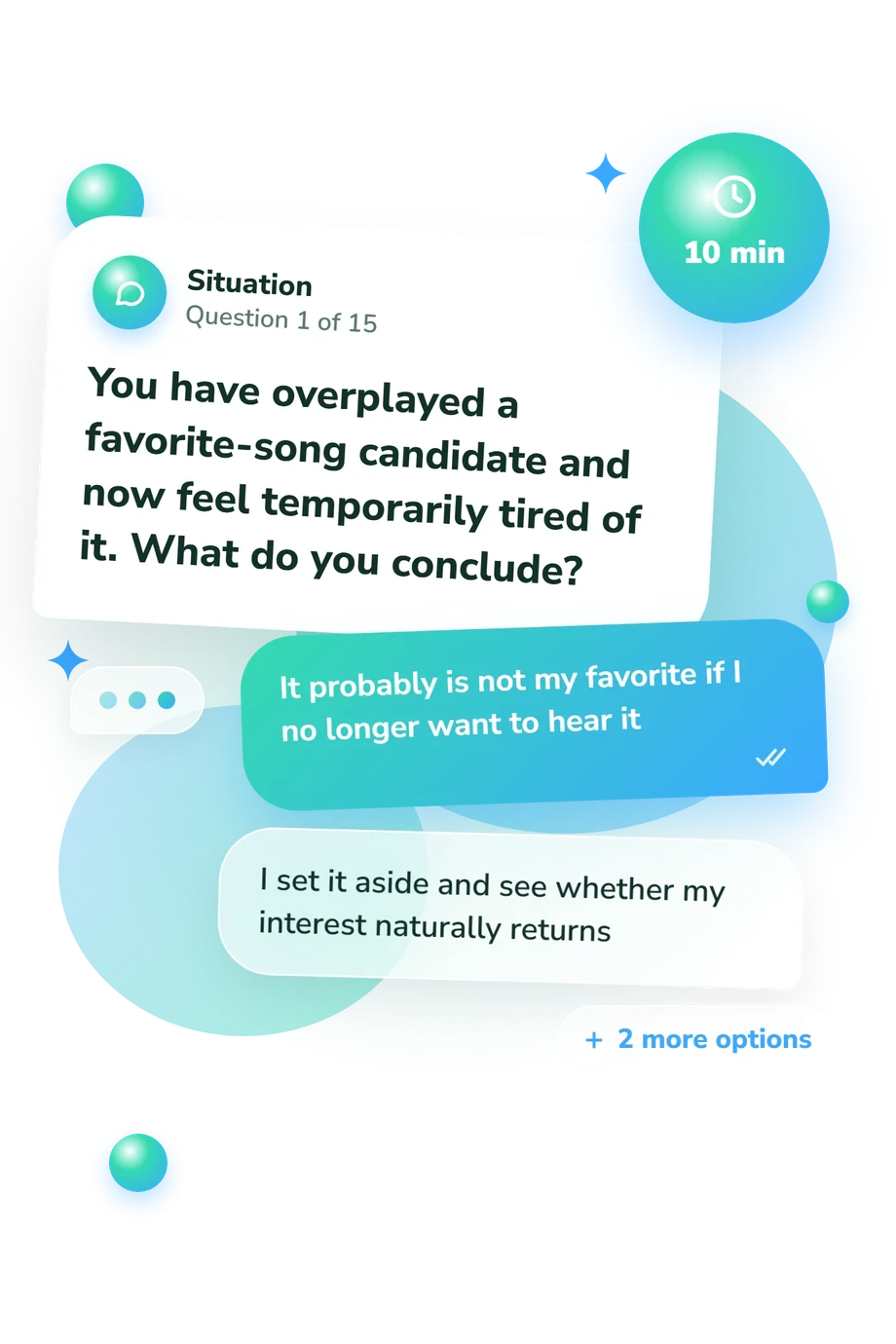
Example Questions From the Test
- It probably is not my favorite if I no longer want to hear it
- I set it aside and see whether my interest naturally returns
- I still consider it a favorite if its personal place remains unchanged
- I lower its ranking for now but remain open to rediscovering it
- It excites me intensely during my current music phase
- I choose it regularly for a particular activity or mood
- I keep returning to it across different moods and settings
- It continues to feel personally relevant across months or years
- Whether its message still feels personally true
- Whether the performance supports the emotion I associate with it
- How the voice, instruments, and production interact
- Whether the overall sound remains engaging from beginning to end
What Is My Favorite Song Quiz - Description and methodology of the test
For listeners who want to understand why one track becomes a lasting favorite, the What Is My Favorite Song Quiz offers a structured profile of musical preference. It distinguishes lyrical meaning and message, personal memories and staying power, and the immediate sensory pull of melody, rhythm, voice, instrumentation, and production. This favorite song questionnaire helps listeners examine the pattern behind that choice.
What This Assessment Explores
The assessment treats favorite-song choice as a blend of interpretation, personal history, and sensory response. It suits listeners who want to see how the profile from this favorite song quiz maps their preferences across message, memory, durability, and musical texture.
The three dimensions are:
- Meaning and Lyrics (0-15) shows how strongly lyrical meaning and emotional themes shape preference: Sound-Led (0-5), Meaning Matters (6-10), or Message-Centered (11-15).
- Personal Significance and Staying Power (0-15) shows how memories, repeated return, and life relevance sustain attachment: Present-Focused (0-5), Growing Attachment (6-10), or Life-Soundtrack Bond (11-15).
- Sound and Physical Pull (0-15) shows how melody, rhythm, voice, instrumentation, and production create attraction: Context-Led (0-5), Balanced Listener (6-10), or Sound-Led Attraction (11-15).
Methodology and Scientific Basis
Each item presents a familiar listening situation and four response options. Choices contrast message, personal history, repeated return, mood, beat, voice, arrangement, and production, allowing the respondent to select the reason closest to their own experience. The scoring groups those choices into three displayed scores; the questionnaire reports a profile rather than requiring one factor to outrank the others. This profile can show that meaning and sound-based attraction may both be strong within this favorite song test.
The closest published comparison is Lamont and Webb (2010), whose findings distinguish immediate enjoyment from personal, emotional, and autobiographical qualities that can support a lasting favorite. This questionnaire is conceptually consistent with that work, not an adaptation of it. Lamont and Loveday (2020) support the role of memory and preference, while Ali and Peynircioğlu (2006) are relevant to how lyrics and melody interact.
The bands are interpretive labels, not population norms or clinical cutoffs. Because answers depend on current mood, listening habits, and self-awareness, the result is best read as a structured snapshot of musical preference.
- Lamont, Alexandra, and Rebecca Webb. (2010). Short- and long-term musical preferences: What makes a favourite piece of music? Psychology of Music, 38(2), 222-241. 10.1177/0305735609339471
- Lamont, Alexandra, and Catherine Loveday. (2020). A New Framework for Understanding Memories and Preference for Music. Music & Science, 3, 2059204320948315. 10.1177/2059204320948315
- Ali, S. Omar, and Zehra F. Peynircioğlu. (2006). Songs and emotions: Are lyrics and melodies equal partners? Psychology of Music, 34(4), 511-534. 10.1177/0305735606067168
Updated: