
What Internet Speed Do I Need Quiz
How the Scales are Structured
Who Usually Takes This Test?
See How You Compare
Below is a preview of how scores are typically distributed across each scale.
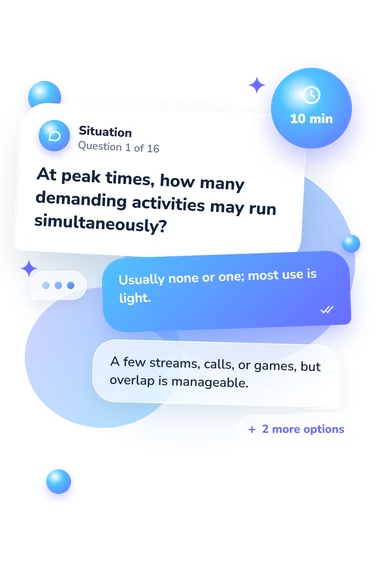
Example Questions From the Test
- Usually none or one; most use is light.
- A few streams, calls, or games, but overlap is manageable.
- Many demanding activities run together and occasionally strain the connection.
- Multiple heavy users, high-resolution streams, uploads, and transfers routinely overlap.
- We mostly send messages, forms, and occasional photos.
- We use video calls and sometimes upload ordinary files.
- We frequently upload large projects, media libraries, or cloud backups.
- We livestream, produce media, or move very large files on tight schedules.
- They are uncommon, so download time is not an important factor.
- They happen periodically, and I want them finished in a reasonable time.
- They happen frequently enough that faster completion would be valuable.
- Extremely large transfers are a daily or time-critical part of my work.
What Internet Speed Do I Need Quiz - Description and methodology of the test
Choosing a plan becomes easier when household habits are translated into likely capacity needs. The What Internet Speed Do I Need Quiz is intended for people comparing service tiers for shared homes, remote work, entertainment, or demanding transfers. By considering more than a single bandwidth number, this internet speed quiz examines overlap, upload activity, devices, downloads, and the value placed on spare capacity. Its result points to a planning profile rather than a provider guarantee.
What This Assessment Measures
The questionnaire matches household habits to four profiles. It helps households consider the best internet speed for home by balancing cost, concurrency, uploads, downloads, devices, and tolerance for waiting.
These profiles describe the result:
- Light Use: Around 50 Mbps: 0-12 shows whether a light routine aligns: Limited fit 0-4, Possible fit 5-8, Strong fit 9-12.
- Everyday Use: Around 100 Mbps: 0-12 shows whether routine streaming and calls align: Limited fit 0-4, Possible fit 5-8, Strong fit 9-12.
- Busy Home: Around 300 Mbps: 0-12 shows whether concurrent users and devices align: Limited fit 0-4, Possible fit 5-8, Strong fit 9-12.
- Power Use: 500 Mbps or More: 0-12 shows whether heavy uploads and transfers align: Limited fit 0-4, Possible fit 5-8, Strong fit 9-12.
The highest score marks strongest affinity; profiles within one point blend, with no forced winner or tie-breaker.
Methodology and Evidence Base
Each item offers four ordered choices, moving from lighter, less-overlapping use toward heavier, concurrent, time-sensitive demands. Themes cover peak overlap, uploads, large downloads, devices, streaming, calls, spare capacity, price, and transfer pressure.
Each profile receives a displayed score and band; because per-answer weights are not stated, the bands should not be reverse-engineered into a hidden formula.
Conceptually, the structure is consistent with the FCC Household Broadband Guide (2011), which links simultaneous household activity with service needs. Rosston, Savage, and Waldman (2010) contribute research on broadband demand, while Netflix and Zoom document activity-specific requirements for streaming and video communication. These sources support the planning logic; they do not validate this exact online version.
As a home internet speed guide, the result is a practical profile estimate for comparing plan tiers, not a measurement of actual service performance. Actual experience also depends on upload speed, latency, Wi-Fi coverage, congestion, provider performance, and the honesty and current context of self-report. Use it to frame a plan comparison, then check service details that matter for your household.
- Federal Communications Commission, Office of Engineering and Technology, and Consumer and Governmental Affairs Bureau. Household Broadband Guide. 2011.
- Rosston, Gregory L., Scott J. Savage, and Donald M. Waldman. “Household Demand for Broadband Internet in 2010.” The B.E. Journal of Economic Analysis & Policy, vol. 10, no. 1, 2010, pp. 1-45. 10.2202/1935-1682.2541
- Netflix. “Netflix-recommended internet speeds.” Netflix Help Center.
- Zoom Video Communications, Inc. “Zoom system requirements: Zoom Web App.” Zoom Support.
Updated: