
What Do I Want for My Birthday Quiz
How the Scales are Structured
Who Usually Takes This Test?
See How You Compare
Below is a preview of how scores are typically distributed across each scale.
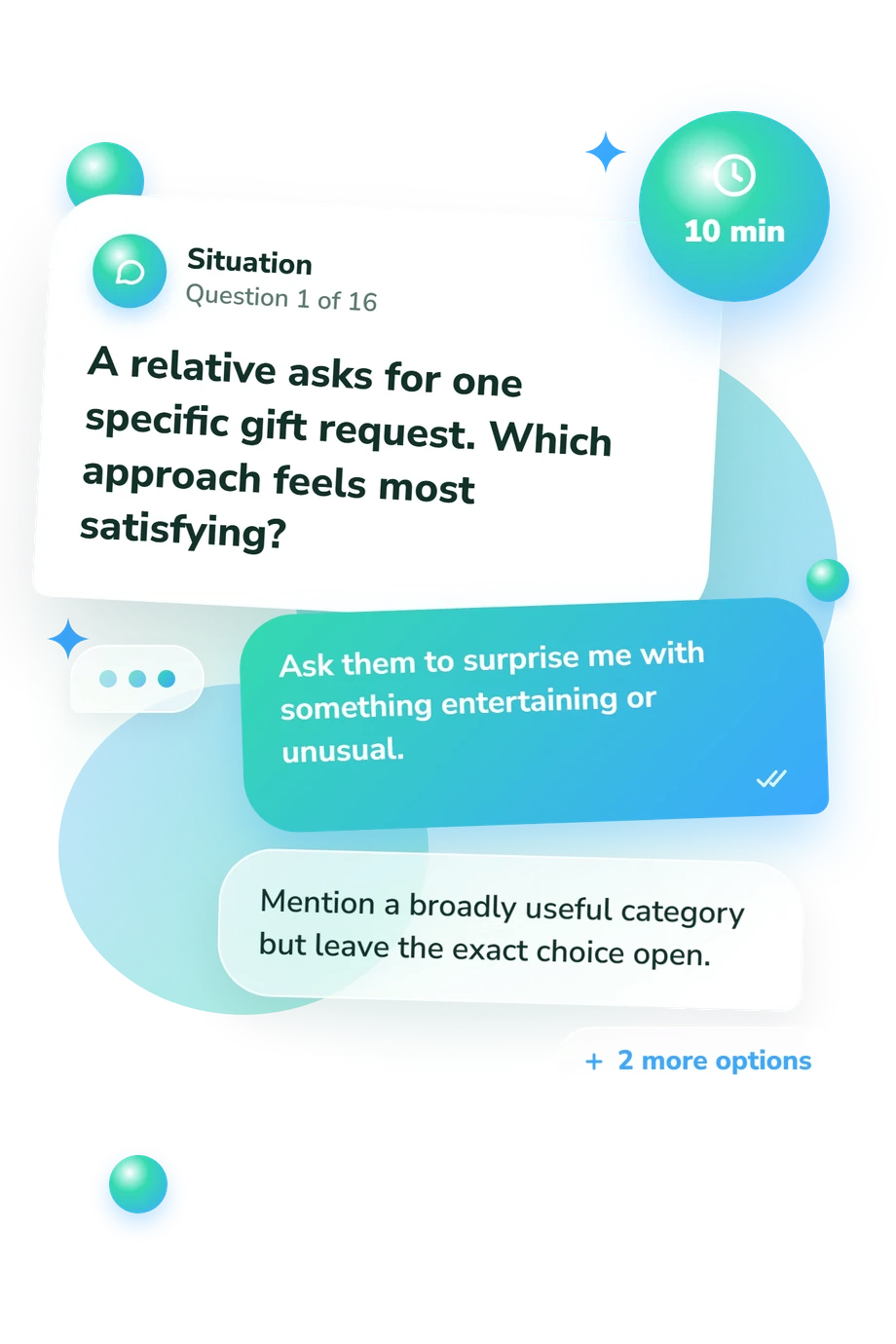
Example Questions From the Test
- A lively plan that gets me out and doing something new.
- A small treat I can enjoy during my usual routine.
- A quiet evening with good food and a few comforting extras.
- A fully restful setup where I can switch off and feel cared for.
- See whether I can use it toward merchandise instead.
- Choose an easy activity near home when the timing is convenient.
- Book an event, class, or outing I have been considering.
- Build a mini-adventure around it and make the occasion memorable.
- Still having a useful or beautiful item from it.
- Knowing the day was pleasant and uncomplicated.
- Remembering one enjoyable activity that felt chosen for me.
- Having a vivid story about something special I did or discovered.
What Do I Want for My Birthday Quiz - Description and methodology of the test
People who are unsure whether they want comfort, a keepsake, an experience, or a useful upgrade can use the What Do I Want for My Birthday Quiz to clarify a wish-list direction. It is intended for anyone preparing to answer what do you want for your birthday or explain gift preferences to family and friends. The result highlights dominant and blended priorities rather than prescribing one present.
What the Questionnaire Measures
Four gift directions describe the value a birthday present may provide. This can make what should I get for my birthday easier to consider when several choices appeal.
The dimensions and displayed bands are:
- Comfort and Self-Care (0-12) measures restorative comfort; Energy Elsewhere (0-4), Selective Comfort (5-8), and Comfort Curator (9-12) are its bands.
- Meaningful Keepsakes (0-12) measures personal meaning; Function First (0-4), Personal Touch (5-8), and Keepsake Connection (9-12) are its bands.
- Memorable Experiences (0-12) measures interest in shared activities; Tangible Preference (0-4), Open to an Outing (5-8), and Experience Seeker (9-12) are its bands.
- Practical Upgrades (0-12) measures useful everyday improvements; Pleasure Over Utility (0-4), Useful if Well Chosen (5-8), and Everyday Upgrader (9-12) are its bands.
The highest score shows the strongest affinity; outcomes within one point of it, including ties, form a blended result.
Methodology and Scientific Basis
Each self-report item presents a birthday situation with four response choices. The alternatives weigh usefulness, novelty, personalization, comfort, emotional meaning, and anticipation. Answers combine into outcome scores without requiring a product, budget, or recipient.
When someone thinks I don't know what I want for my birthday, repeated contrasts show which benefits matter. The pattern can make preferences easier to explain and a wish list more focused.
Conceptually, the questionnaire is consistent with Parsons et al. (2011), who studied benefits recipients seek from gifts. Gino and Flynn (2011) address explicit requests, which can help answer the practical question: what should I ask for for my birthday? Chan and Mogilner (2017) examine experiential gifts, while d’Astous and Mouakhar-Klouz (2022) examine self-gifting. Together, these studies support fit, explicit preferences, experiences, and self-directed reward; they do not make this questionnaire an adaptation of those measures.
Interpret the result as a current preference profile. Mood, recent experiences, practical needs, self-awareness, and response bias can affect answers. Without published norms or clinical cutoffs, its bands are descriptive and best used for reflection and gift conversations.
- Parsons, Andrew G., Paul W. Ballantine, and Ann-Marie Kennedy. (2011). Gift exchange: benefits sought by the recipient. International Journal of Sociology and Social Policy, 31(7-8), 411-423. 10.1108/01443331111149851
- Gino, Francesca, and Francis J. Flynn. (2011). Give them what they want: The benefits of explicitness in gift exchange. Journal of Experimental Social Psychology, 47(5), 915-922. 10.1016/j.jesp.2011.03.015
- Chan, Cindy, and Cassie Mogilner. (2017). Experiential Gifts Foster Stronger Social Relationships Than Material Gifts. Journal of Consumer Research, 43(6), 913-931. 10.1093/jcr/ucw067
- d’Astous, Alain, and Dania Mouakhar-Klouz. (2022). Self-gift giving and satisfaction with life: A behavioural tendency perspective. International Journal of Consumer Studies, 46(1), 268-278. 10.1111/ijcs.12674
Updated: