
What Color Is Your Brain Quiz
How the Scales are Structured
Who Usually Takes This Test?
See How You Compare
Below is a preview of how scores are typically distributed across each scale.
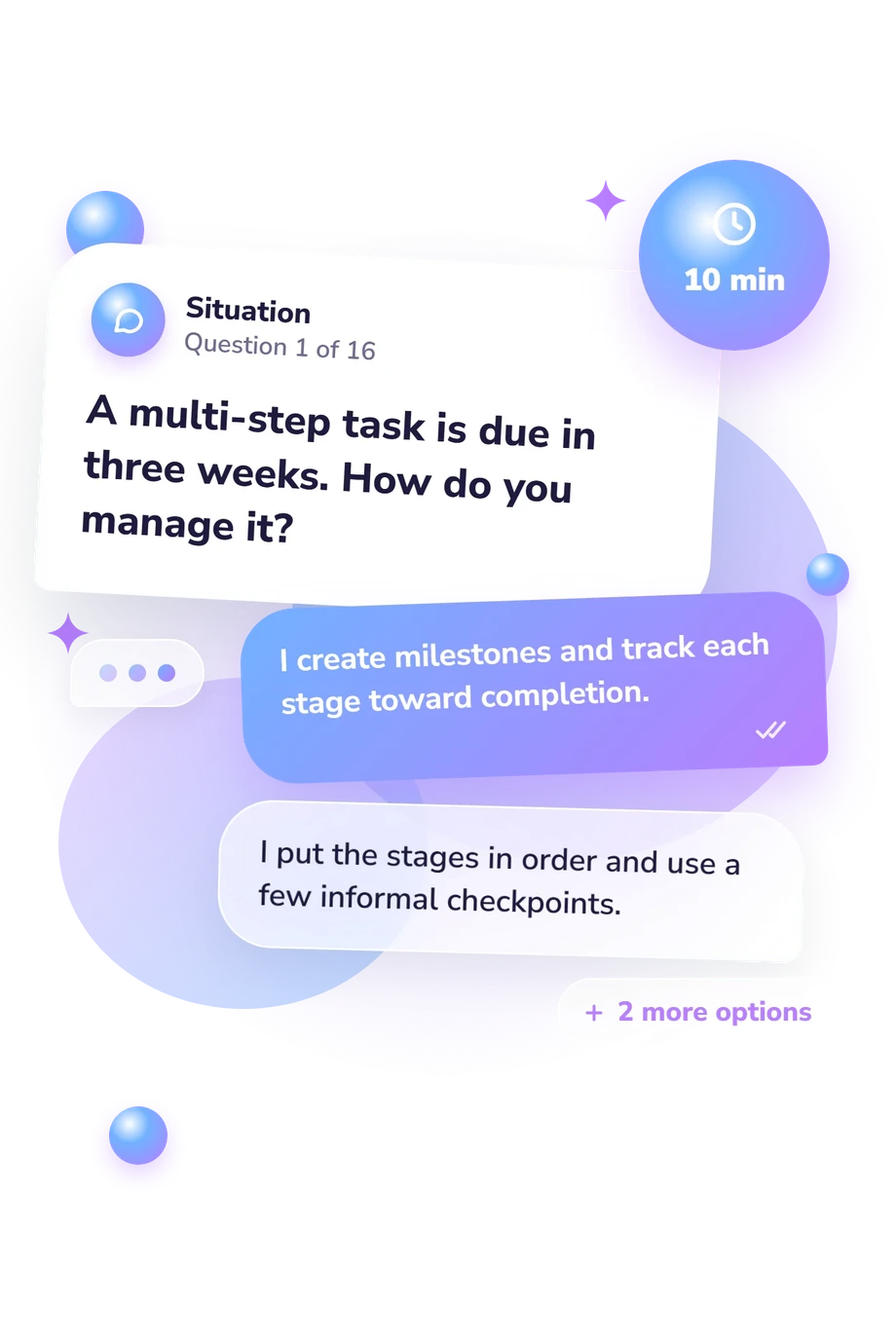
Example Questions From the Test
- Ask for criteria that can narrow the task.
- Propose several unusual directions before judging any of them.
- Improve an idea that has already shown promise.
- Select a workable route so the group can begin.
- Wait until a stable plan can be formed from reliable information.
- Pause long enough to map the most likely contingencies.
- Test a small move and use the result to choose the next one.
- Act on the current information and adjust continuously.
- Restore the original procedure and see where execution drifted.
- Troubleshoot the known steps one at a time.
- Introduce a variation while retaining the routine's useful parts.
- Reframe the goal and imagine a fundamentally different approach.
What Color Is Your Brain Quiz - Description and methodology of the test
People who want a simple way to reflect on how they approach decisions, plans, ideas, and action may find the What Color Is Your Brain Quiz a useful starting point. It frames everyday thinking preferences through four color profiles rather than assigning a fixed personality type. A brain color quiz can help you notice which approaches feel most natural and where you may flex between them.
What This Assessment Explores
Questions use ordinary situations: managing deadlines, adapting to change, exploring uncertain ideas, learning by doing, checking claims, and organizing shared responsibilities. Read as a what color is my brain quiz, the result shows preferred approaches rather than ability or character.
These are the four dimensions shown in the result:
- Blue Brain (0-12) measures affinity for evidence and careful reasoning; Background Blue 0-4, Available Blue 5-8, Strong Blue 9-12.
- Gold Brain (0-12) measures affinity for order and dependable follow-through; Background Gold 0-4, Available Gold 5-8, Strong Gold 9-12.
- Green Brain (0-12) measures affinity for imagination and original possibilities; Background Green 0-4, Available Green 5-8, Strong Green 9-12.
- Orange Brain (0-12) measures affinity for hands-on learning and real-time adaptation; Background Orange 0-4, Available Orange 5-8, Strong Orange 9-12.
The highest score is the strongest affinity; scores within one point indicate a blend.
Methodology and Evidence Base
Each item presents a familiar scenario with four response options; the respondent chooses the approach that feels most natural. The format contrasts evidence-seeking, organizing, imaginative, and action-oriented tendencies in a forced-choice self-report exercise. The four-option structure makes this brain color test focused on preference rather than performance.
Scoring compares four separate totals rather than producing one overall score. The highest total indicates the strongest affinity, while near ties indicate a blend. The result describes preference patterns, not skill, intelligence, or a fixed label.
The framework is traceable to What Color Is Your Brain? (Glazov, 2008). The Quill newsletter and a Daily Herald report show practical and educational uses of the model. Brown, Acevedo, and Fisher (2013) study four broad temperament dimensions separately; their findings are conceptually relevant, but they do not validate this questionnaire.
The online scoring is therefore descriptive rather than a standardized, norm-referenced assessment. Results may shift with current context, self-perception, and response style, so compare the pattern with real behavior when using it for reflection or communication.
- Glazov, Sheila N. What Color Is Your Brain?: A Fun and Fascinating Approach to Understanding Yourself and Others. Visioneer, LLC, 2008. ISBN 978-1-55642-807-4.
- Quill Corporation. “What Color Is YOUR Brain?” Quill newsletter, vol. 22, no. 3, March 2006.
- Daday, Eileen O. “Schools Experiment with ‘Brain Color’ to Help Students Identify How They Learn.” Daily Herald, February 7, 2011.
- Brown, Lucy L., Bianca Acevedo, and Helen E. Fisher. “Neural Correlates of Four Broad Temperament Dimensions: Testing Predictions for a Novel Construct of Personality.” PLoS ONE 8, no. 11 (2013): e78734. 10.1371/journal.pone.0078734.
Updated: