
Valentine's Day Quiz
How the Scales are Structured
Who Usually Takes This Test?
See How You Compare
Below is a preview of how scores are typically distributed across each scale.
Example Questions From the Test
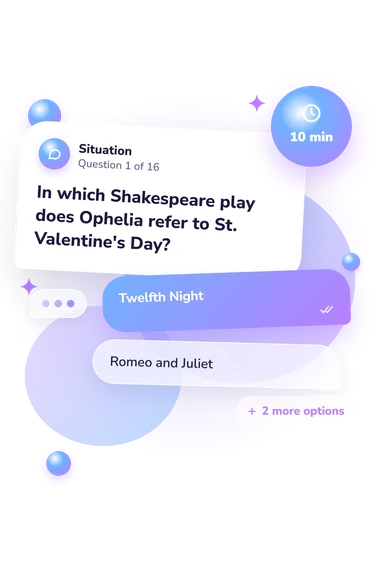
- Twelfth Night
- Romeo and Juliet
- A Midsummer Night's Dream
- Hamlet
- 30 Rock
- New Girl
- The Office
- Parks and Recreation
- Eros
- Hermes
- Apollo
- Hymen
Valentine's Day Quiz - Description and methodology of the test
Readers interested in February 14's history and customs can take this Valentine's Day Quiz, testing familiar knowledge alongside international details. It suits curious adults, students, trivia fans, and anyone interested in a valentines quiz exploring how literature, gift-giving, symbols, and friendship shape the holiday. As a holiday knowledge test, the result indicates your overall breadth of Valentine's Day knowledge and points to areas where further learning may be useful.
What This Assessment Explores
Rather than measuring romantic compatibility, this valetines day quiz tests cultural knowledge about February 14. Its international holiday trivia spans literary references, regional customs, gift-giving rituals, symbols, dates, and popular culture, so it suits curious learners and trivia fans.
These are the main areas represented by the questions:
- Literary connections test recognition of Shakespeare, medieval poetry, and stories linked with courtship.
- International customs show whether you can identify practices from Japan, Finland, Wales, Denmark, Brazil, and South Korea.
- Symbols and expressions measure recall of flowers, sweets, greetings, dates, and XOXO.
- Popular culture checks knowledge of modern references such as Galentine’s Day and the Juliet Club.
These themes feed the Valentine's Day Knowledge scale, scored from 0-16 correct answers. New to the Traditions covers 0-6, Growing Trivia Knowledge 7-12, and Valentine's Day Expert 13-16. The result describes factual recall, not affection or relationship quality.
Methodology and Evidence Base
Each item presents a short prompt with four answer choices, and the respondent selects the most accurate option. This valintines day quiz's result is expressed on a 0-16 scale of correct answers, so interpretation concerns breadth of recall across these topics rather than a personality score or measure of romantic experience.
Its historical framing is conceptually consistent with Hutton (1996), while Blackburn and Holford (1999) and Otto (2016) provide context for calendar traditions, cards, candy, and international observances. Minowa, Khomenko, and Belk (2011) offer the closest subject-specific research for the Japanese gift-giving questions, including the social meaning of giri-choco and White Day.
Those sources provide historical and cultural context; the questionnaire uses the displayed descriptive bands and is not presented as an adaptation of those publications. Connecting dates and observances with literature, gift-giving, symbols, and popular culture gives this free valentines quiz an accessible, descriptive result for choosing topics to learn or discuss. Scores can shift with prior reading, cultural exposure, memory, and guessing, so the bands work best as descriptive feedback for choosing topics to learn or discuss.
- Ronald Hutton, The Stations of the Sun: A History of the Ritual Year in Britain, Oxford University Press, 1996. 10.1093/acprof:oso/9780198205708.001.0001
- Bonnie J. Blackburn and Leofranc Holford-Strevens, The Oxford Companion to the Year, Oxford University Press, 1999.
- Carolyn Otto, Holidays Around the World: Celebrate Valentine's Day: With Love, Cards, and Candy, National Geographic Kids, 2016.
- Yuko Minowa, Olga Khomenko, and Russell W. Belk, "Social Change and Gendered Gift-Giving Rituals: A Historical Analysis of Valentine's Day in Japan," Journal of Macromarketing, 31(1), 2011, 44-56. 10.1177/0276146710375831