
UX Quiz
How the Scales are Structured
Who Usually Takes This Test?
See How You Compare
Below is a preview of how scores are typically distributed across each scale.
Example Questions From the Test
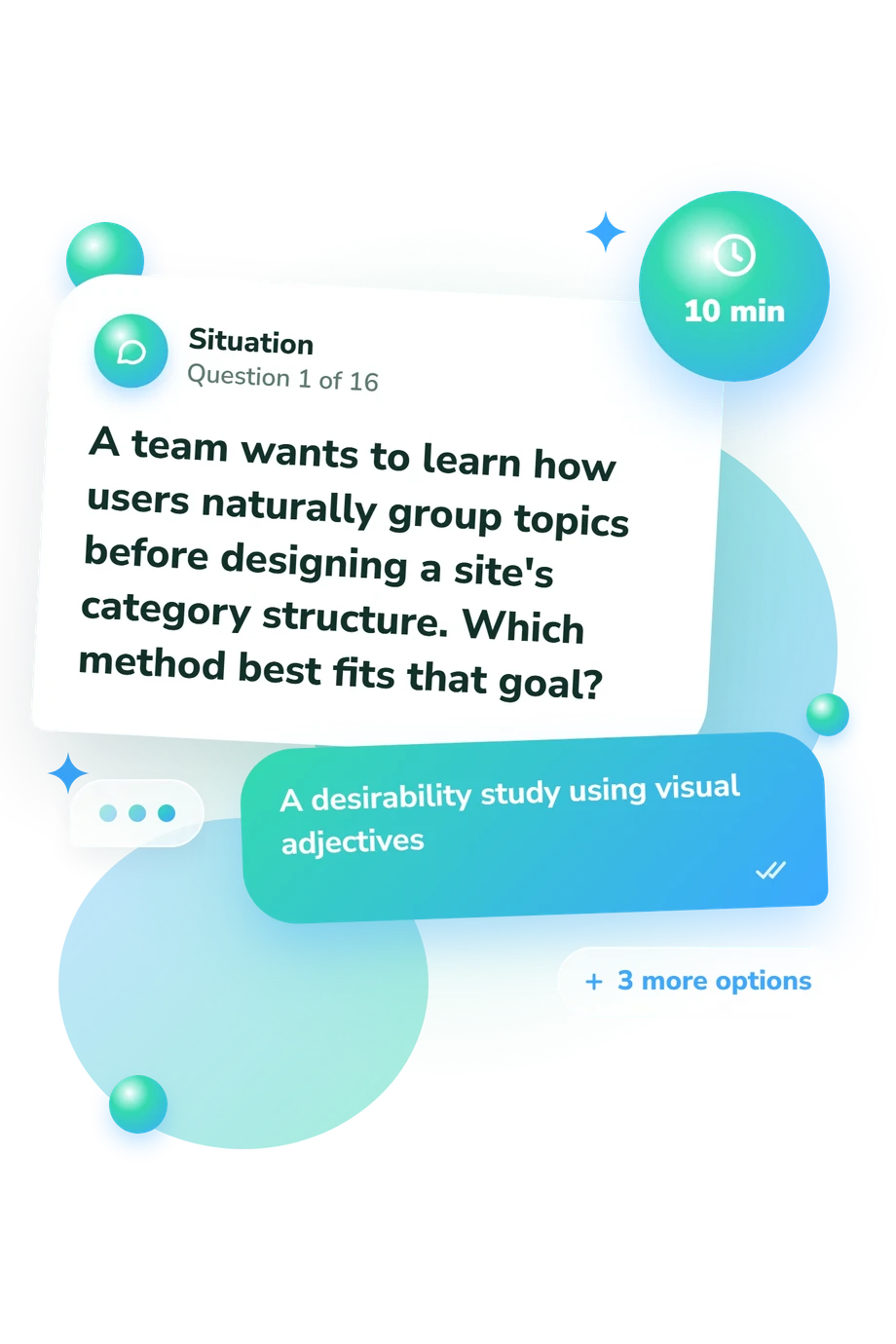
- A desirability study using visual adjectives
- An A/B test of two finished checkout pages
- A card-sorting study with representative users
- A performance test of server response times
- Ask a broad audience to rate the brand's overall appeal
- Compare two decorative banner designs on the home page
- Run usability sessions in which target customers attempt the checkout
- Review competitors and assume their checkout choices fit these customers
- Average time on task
- Task success rate
- Net Promoter Score
- Error frequency per participant
UX Quiz - Description and methodology of the test
For readers who want to judge their working grasp of user research, interaction design, and accessibility, the UX Quiz offers a focused knowledge check built around practical decisions. It suits students, career changers, designers, researchers, and anyone revisiting core concepts. As a UX design quiz, it can reveal which ideas feel secure and which deserve more deliberate review.
What This Assessment Explores
Short scenarios ask you to identify the method, principle, or conclusion that best fits a UX situation. This quiz is a user experience knowledge test; its result identifies study priorities from research to accessibility.
The main themes represented by the items are:
- User research methods show whether you can match card sorting, usability testing, and observation to the question being investigated.
- Interaction design principles measure recognition of progressive disclosure, consistency, signifiers, cognitive load, and recovery-oriented feedback.
- Accessibility practice reflects your ability to identify logical keyboard focus, visible labels, and inclusive interaction requirements.
- Evidence and measurement test whether you can distinguish task success, A/B-test conclusions, sampling concerns, and bias-aware research decisions.
The displayed UX Knowledge (0-16) scale reports Foundations to build (0-6), Developing knowledge (7-12), or Strong knowledge (13-16): higher bands indicate consistent recognition of sound UX practice, not professional certification.
Methodology and Evidence Base
Methodologically, this is a multiple-choice knowledge questionnaire rather than a satisfaction survey or personality inventory. Each item offers plausible alternatives and asks for the best method, principle, or interpretation in a defined situation. The result is one total on the displayed scale; no separate domain scores are presented.
Conceptually, it is consistent with Piedra et al. (2026), whose study examines knowledge assessment across usability, UX, and accessibility; it is not presented as a direct adaptation of that instrument. Nielsen's usability engineering framework supports the focus on observable difficulties, iterative prototyping, and practical design principles. Accessibility items align with W3C's WCAG 2.2 guidance, while Lewis and Sauro provide measurement context for user-experience data.
The displayed result provides educational bands, while population norms and standardization are not established for this questionnaire, so it functions as an educational self-check. Prior exposure to UX concepts, guessing, concentration, and familiarity with terminology can affect performance. This questionnaire functions as a UX principles quiz whose result can identify study priorities, while practical skill depends on applying methods with users and evidence.
- Antonio Piedra, Ignacio Diaz-Oreiro, Jose A. Brenes, and Gustavo Lopez, "A Data-Driven Approach to Knowledge Assessment in Usability, UX, and Accessibility," International Journal of Computer Science and Information Technology, vol. 18, no. 3, pp. 1-16, 2026. 10.5121/ijcsit.2026.18301
- Jakob Nielsen, Usability Engineering, Morgan Kaufmann, 1993.
- World Wide Web Consortium (W3C), Web Content Accessibility Guidelines (WCAG) 2.2, W3C Recommendation, 2023.
- James R. Lewis and Jeff Sauro, Quantifying the User Experience: Practical Statistics for User Research, 2nd ed., Morgan Kaufmann, 2016.
Updated: